
Free Safe Operating Procedure (Bench Vice) Template
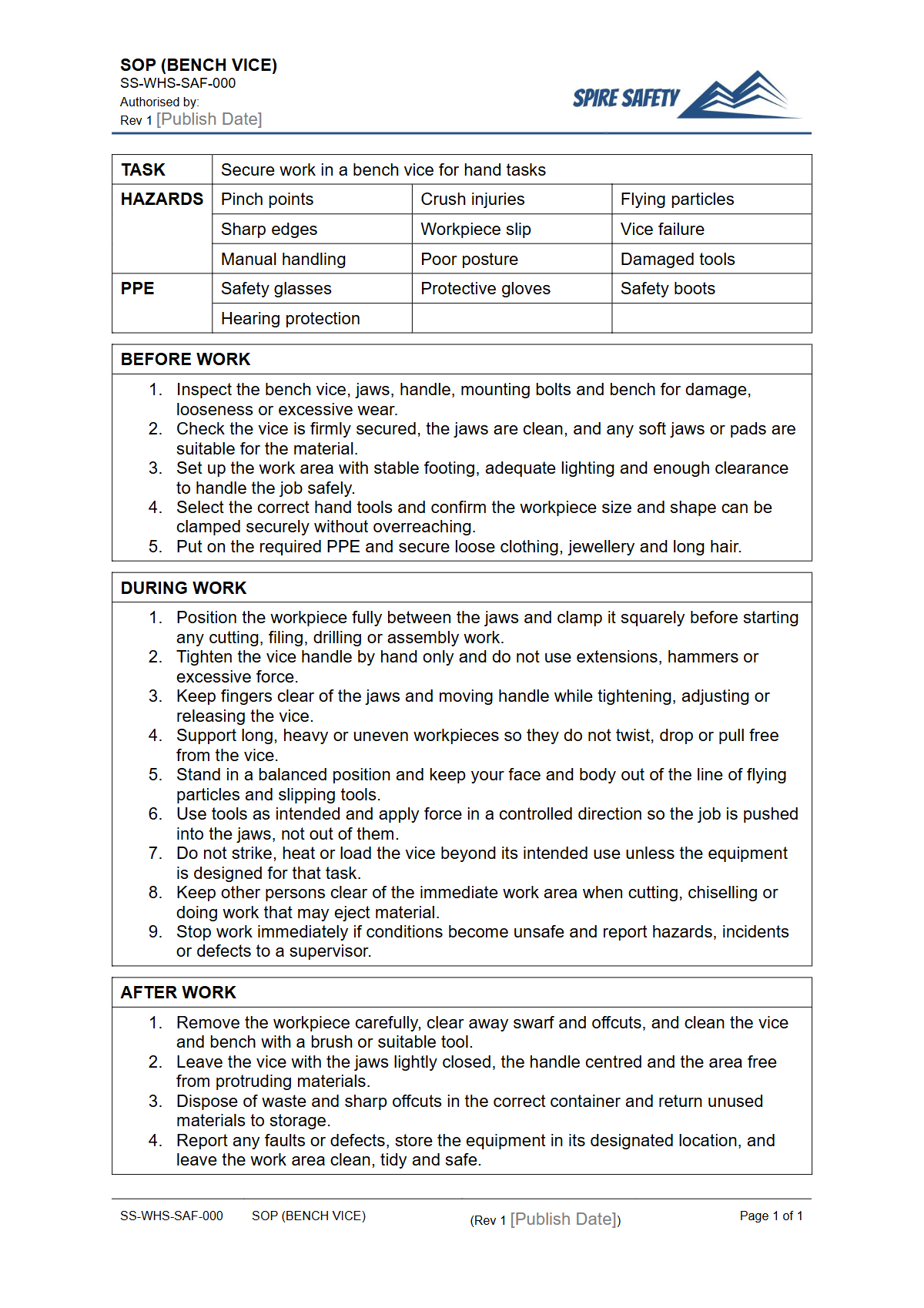
Download our free Safe Operating Procedure (Bench Vice) template. This customisable DOCX and PDF provides a structured framework for safe workshop practices.
Free Safe Operating Procedure (Bench Vice) Template
DOCX • 126 KB + PDF
Updated Oct 2026
No signup required
Purpose of the Free Safe Operating Procedure (Bench Vice) Template
A bench vice is a fundamental tool in countless workshops, but its simplicity can lead to complacency. This Free Safe Operating Procedure (Bench Vice) Template provides a structured document to outline the required steps for its safe operation, inspection, and maintenance.
Even basic hand tools can introduce significant hazards, such as crushing, pinching, and musculoskeletal strain from improper posture or over-exertion. Implementing a formal SOP helps standardise safe work practices, serves as a vital training aid for new workers, and demonstrates a commitment to proactive risk management.
A documented SOP is a key element in controlling identified hazards and forms an integral part of broader WHS management systems. It ensures that every person using the equipment is aware of the approved method, required personal protective equipment (PPE), and associated risks. This systematic approach reduces the likelihood of incidents and creates a consistent safety standard across your entire team.
Video walkthrough
How to use the Free Safe Operating Procedure (Bench Vice) Template
This template is provided as a starting point in both DOCX and PDF formats. It is designed to be adapted to the specific context of your workplace.
To use it effectively, download the document and customise it with details relevant to your operations. This includes specifying the types of bench vices in use, the appropriate PPE (e.g., safety glasses, gloves), site-specific emergency procedures, and your organisation's maintenance and inspection schedule.
For consistency across your workshop, you might also use our Free Bench Grinder SOP (Safe Operating Procedure) Template for other common equipment.
Important: This is a template only. We are not WHS consultants, and this document must be reviewed, customised, and approved by a competent person within your organisation.
Meaningful consultation with the workers who actually use the bench vice is a critical step in ensuring the final SOP is practical, relevant, and effective. The goal is to create a document that accurately reflects your specific work environment and tasks.
When to use it
A Safe Operating Procedure for a bench vice should be a readily accessible and frequently used document. It is not meant to be filed away and forgotten.
Use this SOP during the induction and training of new employees or apprentices to establish safe habits from the start. It should also be a key reference for refresher training to prevent skill fade and complacency.
Furthermore, the SOP serves as a benchmark for workplace inspections and observations. Following an incident or near-miss involving a vice, the SOP should be reviewed and updated as part of the investigation process to prevent recurrence.
Regular reviews, often as part of routine WHS compliance auditing, ensure the procedure remains current with any changes in equipment or work practices.
Who should use it
This SOP is intended for a wide range of personnel within an organisation. Workshop managers and supervisors should use it to enforce standards, conduct training, and perform safety observations.
Workers and apprentices are the primary end-users, relying on the SOP to understand and follow the established safe method for clamping, securing, and working with materials. WHS advisors and safety committees will find the template useful for developing and standardising safety documentation across the organisation, ensuring a consistent approach to risk control for various pieces of equipment, similar to how one might create procedures using our FREE Plasma Cutter SOP (Safe Operating Procedure) Template for more complex tools.
Ultimately, anyone who operates, supervises the use of, or maintains a bench vice should be familiar with its contents. A robust SOP, when properly implemented and communicated, helps build a culture where safety is a shared responsibility.
If you need assistance developing or implementing these procedures, our WHS consulting services can provide expert guidance.
By embedding this SOP into your daily operations, you take a practical step towards minimising workshop risks. Explore our free WHS resources library for more templates and guides to support your safety management system.
Common mistakes
Common mistakes to avoid
- Over-tightening the vice, which can damage the workpiece or the screw mechanism itself.
- Using extensions or 'cheater bars' on the handle to gain extra leverage, which can break the handle or strip the threads.
- Using the vice as an anvil for hammering, as the cast iron body is often brittle and can crack under impact.
- Failing to properly secure the vice to the workbench, leading to instability and potential accidents.
Legal references
Legal considerations
The following legal requirements may be relevant to this type of work.
- Work Health and Safety Act (Harmonised) — Provides the primary duties for protecting workers and other people from work health and safety risks.
- Work Health and Safety Regulations (Harmonised) — Sets out requirements supporting the management of workplace hazards and risks.
The following codes may be relevant to this type of work.
- Managing WHS Risks Code of Practice — Provides practical guidance on identifying hazards, assessing risks and applying effective controls.
- Work Health and Safety Consultation, Cooperation and Coordination Code of Practice — Provides practical guidance on consulting workers and coordinating with other duty holders.
- Managing the Work Environment and Facilities Code of Practice — Provides practical guidance on safe work environments, workplace facilities and related controls.
Did you know
Vise vs. Vice
In Australian and British English, the tool is called a 'vice'. The spelling 'vise' is primarily used in American English.
Mechanical Advantage
A bench vice uses a simple screw mechanism (a type of inclined plane) to convert rotational force on the handle into a powerful linear clamping force, giving it a significant mechanical advantage.
FAQ
Frequently asked questions
01What are the main hazards of using a bench vice?
02Does this bench vice SOP template meet Australian WHS requirements?
03How often should a Safe Operating Procedure for a bench vice be reviewed?
04Is an SOP required for a simple tool like a bench vice?
Share this resource
Free Safe Operating Procedure (Bench Vice) Template
Browse Categories
How To Use It
- 1Download and open in Word or PDF.
- 2Replace the placeholders with your business details.
- 3Get it reviewed by a WHS specialist before rollout.
Need it customised?
Our WHS consultants can adapt this template to your site, run a gap analysis, or audit what you already have in place.
Book a Free Consultation WHS consulting servicesor call 1300 156 382
Related templates
- Free Safe Operating Procedure (Bending Machine) Template
- Free Safe Operating Procedure (Berry Harvesting) Template
- Free Safe Operating Procedure (Bilge Cleaning) Template
- Free Safe Operating Procedure (Bin Lift Area Setup) Template
- Free Safe Operating Procedure (Bin Wash Station) Template
- Free Safe Operating Procedure (Biohazard Spill Cleanup) Template