
Free Safe Operating Procedure (Bending Machine) Template
Get a structured starting point for your workshop with our free Safe Operating Procedure (Bending Machine) template, available in DOCX and PDF formats.
Free Safe Operating Procedure (Bending Machine) Template
DOCX • 126 KB + PDF
Updated Oct 2026
No signup required
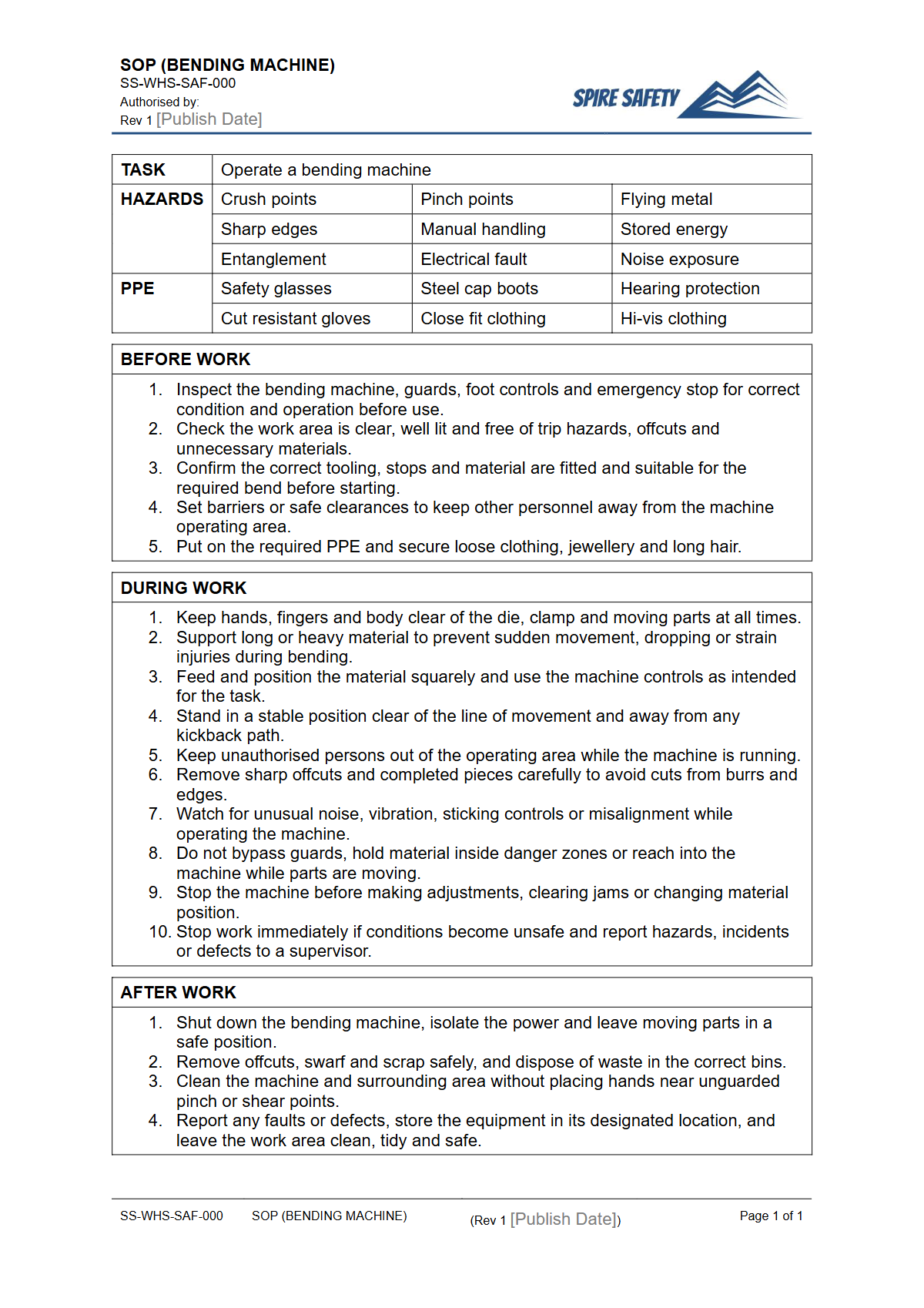
Purpose of the Free Safe Operating Procedure (Bending Machine) Template
This free Safe Operating Procedure (Bending Machine) template provides a structured framework for documenting the safety requirements for operating metal bending machinery in your workshop. A Safe Operating Procedure (SOP), sometimes called a Safe Work Method Statement (SWMS) for high-risk work, is a crucial document that outlines a step-by-step process to perform a task safely.
For bending machines, this involves managing significant risks like crushing, pinching, entanglement, and material projectiles. Using a clear SOP helps organisations meet their duty of care under Australian WHS laws by controlling hazards associated with plant operation.
Implementing robust procedures for all machinery is a fundamental part of building comprehensive WHS management systems. This template acts as a starting point, helping you to formally identify hazards, assess risks, and specify the control measures required to ensure operators remain safe. It promotes consistent and safe work practices, aids in worker training and induction, and forms a key piece of evidence demonstrating proactive safety management.
Video walkthrough
How to use the Free Safe Operating Procedure (Bending Machine) Template
This Safe Operating Procedure template is available for download in both DOCX and PDF formats. The DOCX version is fully editable, allowing you to tailor the content directly to your workplace's specific needs.
We recommend customising the document by adding your company logo, specific machine details, and site-specific emergency procedures. Consultation is a mandatory part of the risk management process, so it is vital to involve your machine operators and supervisors in the drafting and review process.
IMPORTANT NOTE: This is a template, not a finished document. We have developed it as a starting point, and you must customise it to reflect the specific bending machine model, tasks, risks, and control measures present in your workplace.
Always cross-reference the procedure with the manufacturer’s operating manual and conduct a site-specific risk assessment.
Once customised, the SOP should be used to train all operators before they use the equipment. Its effectiveness should be regularly verified through observation and consultation.
Engaging an external party for WHS compliance auditing can provide an objective assessment of how well your safety procedures are being implemented on the workshop floor.
When to use it
A Safe Operating Procedure for a bending machine should be a readily accessible document used in several situations. It is essential during the induction and training of new employees or when an existing worker is being trained to use the machine for the first time.
It serves as an on-the-job reference to reinforce correct, safe practices and should be reviewed before undertaking non-routine or complex bending tasks.
The SOP should also be reviewed and updated following any incident or near miss involving the machine, after any modifications to the machine or its guarding, or when legislative requirements change. Many workshops use similar metal forming equipment, and you may find our Free Brake Press SOP (Safe Operating Procedure) Template a useful complementary resource.
Who should use it
This Safe Operating Procedure is intended for a range of personnel within an organisation. The primary users are the machine operators themselves, who must understand and follow the documented steps to ensure their own safety and the safety of those around them.
Supervisors and workshop managers must use the SOP to enforce safe work practices, conduct training, and perform competency assessments. WHS managers and safety officers will use the document as part of the broader safety management system, for risk assessments, and during incident investigations. For another common workshop machine, consider our FREE CNC Machine SOP (Safe Operating Procedure) Template.
Key elements of a Bending Machine Safe Operating Procedure
A thorough SOP for a bending machine should cover several critical stages of operation to be effective. These include:
- Required PPE: Specify mandatory personal protective equipment, such as safety glasses, steel-capped boots, and appropriate gloves (while assessing entanglement risks).
- Pre-operational Checks: A checklist of items to inspect before starting work. This includes verifying that guards are in place and functional, checking emergency stops, inspecting tooling for damage, and ensuring the work area is clear of obstructions.
- Operational Steps: A sequential guide to performing the bending task. This covers powering up the machine, securing the workpiece, setting bending parameters, correct hand placement (away from pinch points), and using two-hand controls or other safety devices.
- Post-operational Shutdown: Instructions for safely powering down the machine, cleaning the work area, and storing tooling and materials correctly.
- Emergency Procedures: Clear instructions on how to react in an emergency, including the location of emergency stops, first aid contacts, and incident reporting processes.
In fabrication environments, bending machines are often used alongside cutting equipment. Ensure you have procedures for all high-risk plant, such as this FREE Plasma Cutter SOP (Safe Operating Procedure) Template, to maintain a consistent safety standard across your operations. You can explore our full range of templates in our free WHS resources library.
Common mistakes
Common mistakes to avoid
- Failing to customise the template for the specific make and model of the bending machine.
- Neglecting to consult with experienced machine operators when drafting or reviewing the procedure.
- Using the SOP for one-off training but not as a regular, accessible reference for operators.
- Forgetting to include specific instructions for changing and inspecting tooling, a high-risk activity.
Legal references
Legal considerations
The following legal requirements may be relevant to this type of work.
- Work Health and Safety Act (Harmonised) — Provides the primary duties for protecting workers and other people from work health and safety risks.
- Work Health and Safety Regulations (Harmonised) — Sets out requirements supporting the management of workplace hazards and risks.
The following codes may be relevant to this type of work.
- Managing WHS Risks Code of Practice — Provides practical guidance on identifying hazards, assessing risks and applying effective controls.
- Work Health and Safety Consultation, Cooperation and Coordination Code of Practice — Provides practical guidance on consulting workers and coordinating with other duty holders.
- Managing the Work Environment and Facilities Code of Practice — Provides practical guidance on safe work environments, workplace facilities and related controls.
Did you know
Guarding is Key
Many serious injuries involving bending machines and press brakes are due to inadequate or bypassed machine guarding. Modern machines often incorporate light curtains or dual-hand controls as a primary safety feature.
Hydraulic Power
Hydraulic bending machines can exert forces exceeding hundreds of tonnes. A small hydraulic leak can inject fluid under the skin at high pressure, causing a severe and often underestimated medical emergency.
FAQ
Frequently asked questions
01What is the purpose of a Safe Operating Procedure for a bending machine?
02How often should a bending machine SOP be reviewed?
03Does this template cover all legal WHS requirements?
04Who is responsible for implementing the SOP?
Share this resource
Free Safe Operating Procedure (Bending Machine) Template
Browse Categories
How To Use It
- 1Download and open in Word or PDF.
- 2Replace the placeholders with your business details.
- 3Get it reviewed by a WHS specialist before rollout.
Need it customised?
Our WHS consultants can adapt this template to your site, run a gap analysis, or audit what you already have in place.
Book a Free Consultation WHS consulting servicesor call 1300 156 382
Related templates
- Free Safe Operating Procedure (Berry Harvesting) Template
- Free Safe Operating Procedure (Bilge Cleaning) Template
- Free Safe Operating Procedure (Bin Lift Area Setup) Template
- Free Safe Operating Procedure (Bin Wash Station) Template
- Free Safe Operating Procedure (Biohazard Spill Cleanup) Template
- Free Safe Operating Procedure (Biosafety Cabinet) Template