
Free Safe Operating Procedure (Bedside Locker Cleaning) Template
Download our free Safe Operating Procedure (Bedside Locker Cleaning) template for healthcare and aged care settings.
Free Safe Operating Procedure (Bedside Locker Cleaning) Template
DOCX • 126 KB + PDF
Updated Oct 2026
No signup required
Purpose of the Free Safe Operating Procedure (Bedside Locker Cleaning) Template
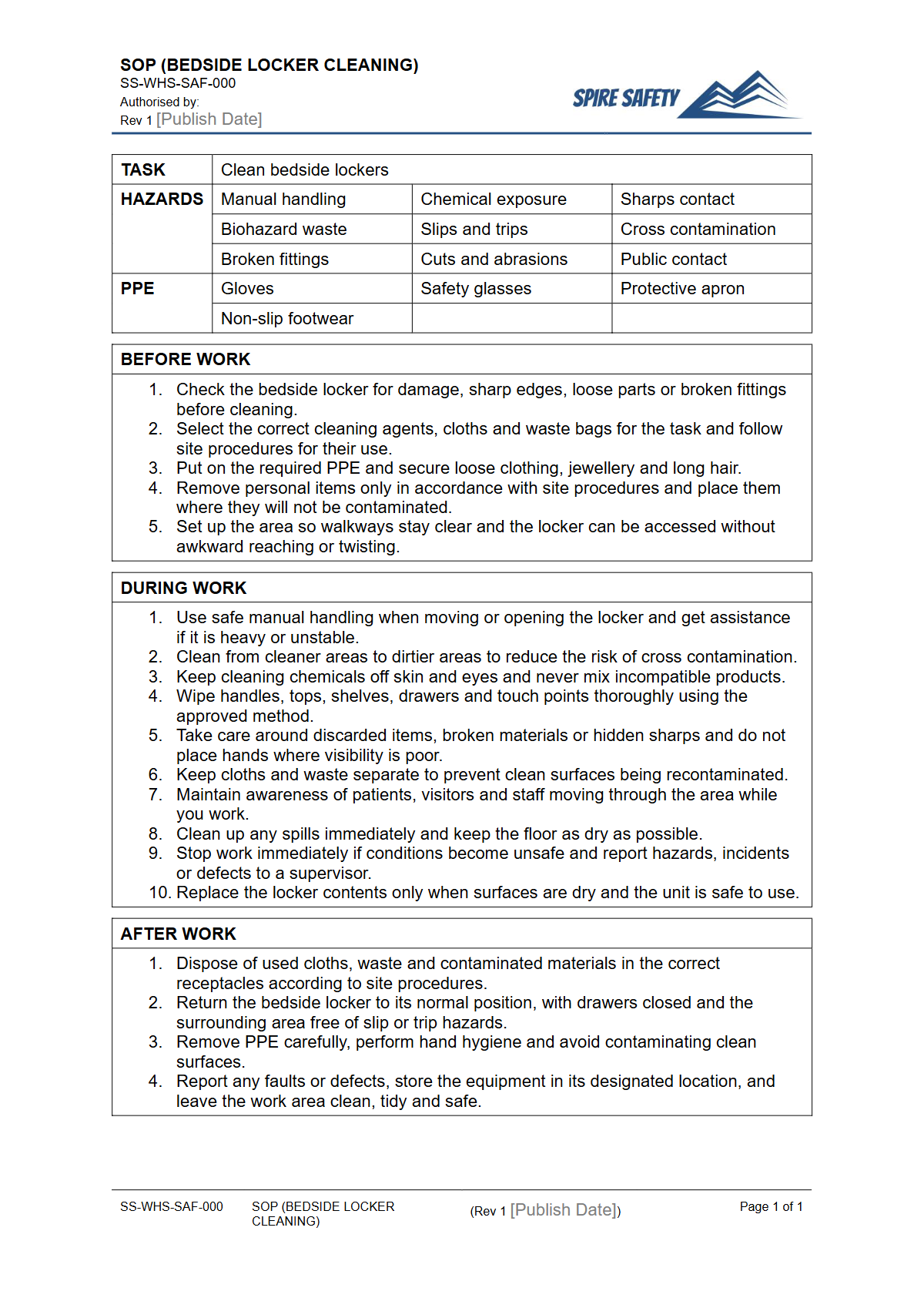
This Free Safe Operating Procedure (Bedside Locker Cleaning) Template provides a structured framework for documenting the required steps to safely and effectively clean bedside lockers in healthcare, aged care, and clinical environments. Its primary purpose is to standardise cleaning protocols to minimise health and safety risks for workers and prevent cross-contamination between patients.
By establishing a clear, repeatable process, your organisation can effectively manage hazards associated with chemical handling, biological agents, and hazardous manual tasks.
A documented SOP is a critical component of a robust safety management system. It serves as a training tool for new and existing staff, ensures consistency in cleaning standards, and demonstrates a commitment to maintaining a safe environment.
Implementing this procedure helps control the risks of healthcare-associated infections (HAIs) and ensures workers are aware of correct chemical use, required personal protective equipment (PPE), and waste disposal methods. A well-defined SOP forms a foundational part of your broader WHS management systems, contributing to overall workplace safety and quality of care.
Video walkthrough
How to use the Free Safe Operating Procedure (Bedside Locker cleaning) Template
Our Safe Operating Procedure for bedside locker cleaning is provided as a fully editable DOCX file, with a PDF version also available for easy printing and distribution. To use the template, simply download the file and open it in your preferred word processor.
The document is pre-formatted with sections covering key safety areas, including hazard identification, PPE requirements, step-by-step instructions, and emergency responses. You can add your company logo and specific site details to make it your own.
Important: This document is a template only. It must be customised to reflect the specific hazards and control measures relevant to your workplace.
We have provided a solid starting point, but you must review and amend the content to account for the exact cleaning chemicals you use (referencing their Safety Data Sheets), the type of lockers on-site, your facility’s waste management streams, and any unique environmental factors. For expert assistance in adapting this or any other safety document, consider our professional WHS consulting services.
Key Components of the SOP
A comprehensive SOP for cleaning should go beyond a simple checklist. This template prompts you to consider and document the following critical elements:
- Hazard Identification: Outlines potential risks such as chemical exposure (skin contact, inhalation), ergonomic strain from awkward postures, and biological hazards from contaminated surfaces.
- Personal Protective Equipment (PPE): Specifies the exact PPE required, such as nitrile gloves, safety glasses, or aprons, to protect workers from identified hazards.
- Step-by-Step Procedure: Details the sequence of tasks from preparation (gathering supplies) to completion (final inspection). This includes steps for removing contents, applying cleaning solutions, ensuring correct contact time for disinfectants, and wiping surfaces methodically. If staff need to access high surfaces, your procedure should specify the safe use of appropriate equipment; our FREE Step Ladder SOP Template can help formalise this related task.
- Waste Disposal: Instructs on the correct disposal of used cloths, contaminated waste, and empty chemical containers according to facility protocols and local regulations.
- Emergency Procedures: Provides clear instructions on what to do in case of a chemical spill, accidental exposure, or other incidents.
When to use it
This SOP should be implemented as the standard process for all bedside locker cleaning activities. It is essential for routine daily or weekly cleaning schedules to maintain hygiene standards.
It is also critically important for terminal cleaning, which occurs after a patient is discharged or transferred, to prepare the space for the next occupant. Furthermore, the principles and emergency protocols within the SOP should be referenced for managing spills or contamination incidents involving the locker.
Who should use it
This SOP is designed for use by all personnel responsible for environmental hygiene and patient room cleaning. This includes dedicated cleaning and environmental services staff, healthcare assistants, patient care assistants, and in some facilities, nurses.
Supervisors and managers should also use this document to conduct training, set performance expectations, and verify correct procedures are being followed. Regular verification of the process can be integrated into your quality assurance program or internal WHS compliance auditing schedule.
By ensuring everyone follows the same approved procedure, you create a more predictable and safer environment for both staff and patients. If you're looking for more ways to document safe work practices, you can explore our complete free WHS resources library for other templates and checklists.
Common mistakes
Common mistakes to avoid
- Using incorrect dilution ratios for cleaning chemicals, making them ineffective or overly hazardous.
- Failing to allow for sufficient disinfectant contact time, preventing the chemical from killing pathogens.
- Using the same cloth for multiple surfaces without cleaning it, leading to cross-contamination.
- Neglecting to wear appropriate Personal Protective Equipment (PPE), risking chemical burns or skin irritation.
Legal references
Legal considerations
The following legal requirements may be relevant to this type of work.
- Work Health and Safety Act (Harmonised) — Provides the primary duties for protecting workers and other people from work health and safety risks.
- Work Health and Safety Regulations (Harmonised) — Sets out requirements supporting the management of workplace hazards and risks.
The following codes may be relevant to this type of work.
- Managing WHS Risks Code of Practice — Provides practical guidance on identifying hazards, assessing risks and applying effective controls.
- Work Health and Safety Consultation, Cooperation and Coordination Code of Practice — Provides practical guidance on consulting workers and coordinating with other duty holders.
- Managing the Work Environment and Facilities Code of Practice — Provides practical guidance on safe work environments, workplace facilities and related controls.
Did you know
Contact Time is Critical
For a disinfectant to be effective, it must remain wet on a surface for a specific amount of time, known as 'contact time' or 'dwell time'. Wiping it off too early can mean that dangerous pathogens are not killed.
Infection Control
According to the Australian Commission on Safety and Quality in Health Care, healthcare-associated infections (HAIs) are a significant cause of harm to patients, and effective environmental cleaning is a primary strategy for prevention.
FAQ
Frequently asked questions
01Why is an SOP important for a simple task like cleaning a locker?
02What is the difference between cleaning, sanitising, and disinfecting?
03How often should terminal cleaning of a bedside locker be performed?
04What information should be in the chemical safety section of the SOP?
Share this resource
Free Safe Operating Procedure (Bedside Locker Cleaning) Template
Browse Categories
How To Use It
- 1Download and open in Word or PDF.
- 2Replace the placeholders with your business details.
- 3Get it reviewed by a WHS specialist before rollout.
Need it customised?
Our WHS consultants can adapt this template to your site, run a gap analysis, or audit what you already have in place.
Book a Free Consultation WHS consulting servicesor call 1300 156 382
Related templates
- Free Safe Operating Procedure (Beer Line Cleaning) Template
- Free Safe Operating Procedure (Beer Tap Cleaning) Template
- Free Safe Operating Procedure (Belt Loader) Template
- Free Safe Operating Procedure (Belt Sander) Template
- Free Safe Operating Procedure (Bench Polisher) Template
- Free Safe Operating Procedure (Bench Shears) Template