
Free Safe Operating Procedure (Beer Tap Cleaning) Template
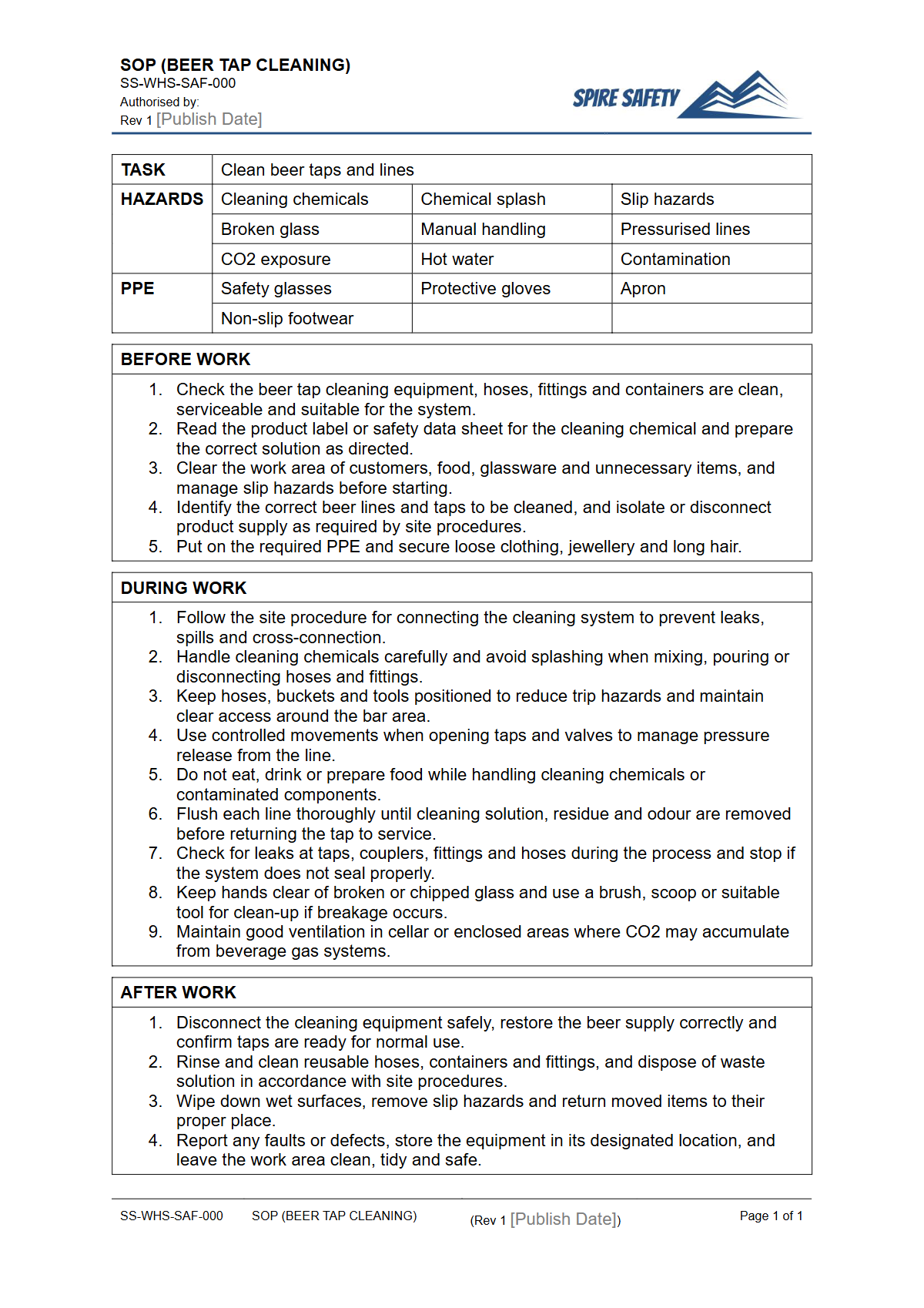
Download our free Safe Operating Procedure (Beer Tap Cleaning) Template (DOCX & PDF). A structured starting point for creating a robust safety procedure.
Free Safe Operating Procedure (Beer Tap Cleaning) Template
DOCX • 126 KB + PDF
Updated Oct 2026
No signup required
Purpose of the Free Safe Operating Procedure (Beer Tap Cleaning) Template
Maintaining clean beer taps and lines is crucial for any hospitality venue, not just for quality but also for safety. The process involves handling hazardous chemicals, working with pressurised systems, and manual handling tasks.
This Free Safe Operating Procedure (Beer Tap Cleaning) Template provides a structured framework to document the risks and control measures associated with this routine but critical task.
A well-defined SOP is a key component of a safe system of work. It helps ensure that all workers, regardless of experience, follow a consistent, safe, and effective process.
This reduces the risk of chemical burns, injuries from pressurised equipment, and other potential incidents. Implementing documented procedures like this one demonstrates a commitment to proactive safety management and forms a vital part of your overall WHS management systems.
What this Safe Operating Procedure covers:
- Essential pre-operational checks, including system depressurisation.
- Step-by-step instructions for the cleaning cycle.
- Required Personal Protective Equipment (PPE).
- Emergency procedures and post-cleaning checks.
Video walkthrough
How to use the Free Safe Operating Procedure (Beer Tap Cleaning) Template
This template is provided in an editable DOCX format, allowing for complete customisation. The key to an effective Safe Operating Procedure is ensuring it accurately reflects the specific equipment, chemicals, and environment of your workplace.
Generic procedures are rarely sufficient to control all site-specific risks.
Important: This is a template, not a finished document. You must customise this Safe Operating Procedure to align with your specific beer dispensing system, the cleaning chemicals you use, and your operational context.
We strongly recommend consulting the Safety Data Sheet (SDS) for your cleaning solutions and incorporating its specific handling, PPE, and first aid requirements. After customisation, a competent person should review and approve the document before it is used for training and operational guidance.
For a formal review of your safety documents, consider a professional WHS compliance auditing service.
When to use it
This Safe Operating Procedure should be the primary reference document for every beer tap and line cleaning task. It is a tool for both training and operational use.
New staff should be trained using the finalised SOP before they are permitted to perform the task unsupervised. It should also be used as a refresher for existing staff and be readily available in the work area for quick reference.
Regularly review the SOP, especially if you introduce new cleaning chemicals, change your dispensing equipment, or after any incident or near-miss. Integrating this document into your routine maintenance schedule ensures safety remains a priority.
The principles here also apply to other pressurised systems, and you might find our Free Air Compressor SOP Template useful for documenting procedures for related equipment.
Who should use it
This template is designed for use by managers, supervisors, and health and safety representatives in pubs, bars, clubs, restaurants, and breweries. Anyone responsible for drafting, implementing, or overseeing workplace safety procedures will find it a valuable starting point.
It empowers managers to fulfil their duty of care by providing a clear, documented process for a hazardous task. For workers, it provides unambiguous instructions on how to perform their duties safely.
If you need assistance integrating this SOP or developing other safety documentation, engaging with a WHS consulting specialist can provide expert guidance. While this SOP deals with a specific task, other common workplace hazards like working at heights may also be present; our FREE Step Ladder SOP Template can help address those risks.
By customising and implementing this procedure, you contribute to a safer work environment for everyone. For more templates and safety guides, explore our complete free WHS resources library.
Common mistakes
Common mistakes to avoid
- Failing to fully de-pressurise the system before disconnecting lines.
- Using incorrect concentrations of cleaning chemicals, making them ineffective or overly corrosive.
- Not flushing lines thoroughly with fresh water, leaving chemical residue that taints the beer.
- Neglecting to wear appropriate PPE, especially safety glasses and chemical-resistant gloves.
Legal references
Legal considerations
The following legal requirements may be relevant to this type of work.
- Work Health and Safety Act (Harmonised) — Provides the primary duties for protecting workers and other people from work health and safety risks.
- Work Health and Safety Regulations (Harmonised) — Sets out requirements supporting the management of workplace hazards and risks.
The following codes may be relevant to this type of work.
- Managing WHS Risks Code of Practice — Provides practical guidance on identifying hazards, assessing risks and applying effective controls.
- Work Health and Safety Consultation, Cooperation and Coordination Code of Practice — Provides practical guidance on consulting workers and coordinating with other duty holders.
- Managing the Work Environment and Facilities Code of Practice — Provides practical guidance on safe work environments, workplace facilities and related controls.
Did you know
Pressure Points
A typical beer dispensing system operates at pressures between 10-15 PSI, but CO2 or Nitrogen gas cylinders can contain pressures exceeding 800 PSI. Mishandling these high-pressure components is a significant workplace hazard.
Bacteria Buildup
Yeast, mould, and bacteria can build up in unclean beer lines, creating biofilm that is resistant to cleaning. This not only spoils the taste and appearance of beer but can also pose a health risk to consumers.
FAQ
Frequently asked questions
01What are the main hazards when cleaning beer taps?
02How often should beer lines be cleaned?
03Is special training required to clean beer taps?
04What Personal Protective Equipment (PPE) is needed for beer line cleaning?
Share this resource
Free Safe Operating Procedure (Beer Tap Cleaning) Template
Browse Categories
How To Use It
- 1Download and open in Word or PDF.
- 2Replace the placeholders with your business details.
- 3Get it reviewed by a WHS specialist before rollout.
Need it customised?
Our WHS consultants can adapt this template to your site, run a gap analysis, or audit what you already have in place.
Book a Free Consultation WHS consulting servicesor call 1300 156 382
Related templates
- Free Safe Operating Procedure (Belt Loader) Template
- Free Safe Operating Procedure (Belt Sander) Template
- Free Safe Operating Procedure (Bench Polisher) Template
- Free Safe Operating Procedure (Bench Shears) Template
- Free Safe Operating Procedure (Bench Vice) Template
- Free Safe Operating Procedure (Bending Machine) Template