
Free Safe Operating Procedure (Belt Loader) Template
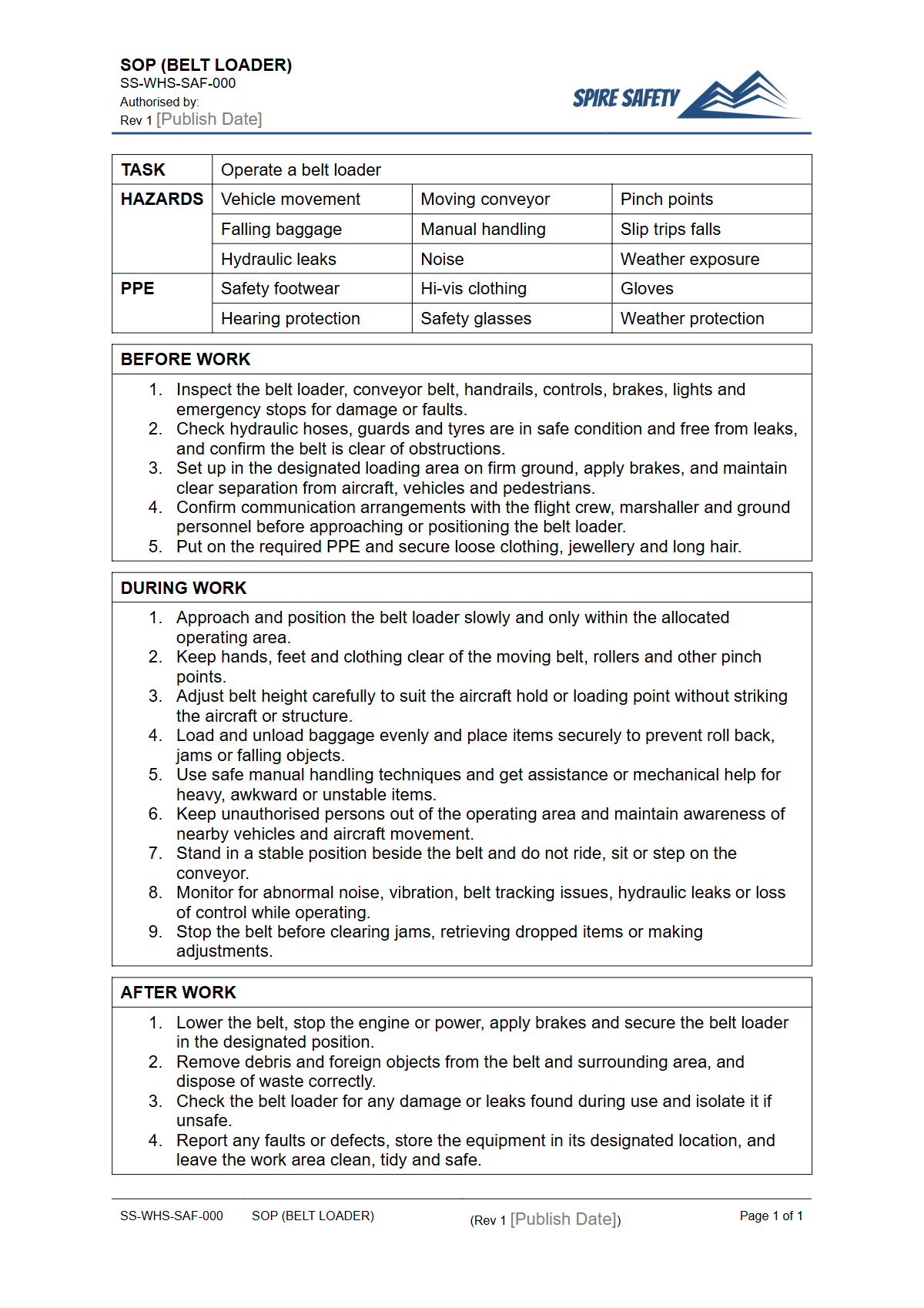
Download our free Safe Operating Procedure (Belt Loader) template. This structured DOCX and PDF resource helps you outline safe work practices.
Free Safe Operating Procedure (Belt Loader) Template
DOCX • 126 KB + PDF
Updated Oct 2026
No signup required
Purpose of the Free Safe Operating Procedure (Belt Loader) Template
Belt loaders are essential equipment in aviation, logistics, and freight industries, but they introduce significant workplace hazards if not managed correctly. This Free Safe Operating Procedure (Belt Loader) Template provides a structured starting point for documenting the safe use of this machinery at your worksite.
Formalising your process is a critical step in controlling risks such as entanglement in moving parts, crush injuries between the loader and vehicles or structures, falls from height, and manual handling injuries during loading and unloading.
An SOP ensures that every operator follows a consistent, approved, and safe method for every task. It serves as a key training document and a reference for workers, supervisors, and managers.
By clearly defining pre-operational checks, safe operating steps, and shutdown procedures, this template helps your organisation meet its duty of care to provide a safe system of work. The principles are similar to those in our Free Safe Operating Procedure for Conveyor Belt Operation, focusing on the interaction between operator and machine.
Video walkthrough
How to use the Free Safe Operating Procedure (Belt Loader) Template
To effectively use this resource, it must be adapted to your specific workplace. A generic document cannot account for the unique variables of your site, equipment models, and operational demands. Follow these steps to implement it correctly:
- Download: Select the DOCX version for easy editing.
- Consult: Involve the workers who operate the belt loaders and their direct supervisors. Their firsthand experience is invaluable for creating a practical and effective procedure.
- Customise: Conduct a risk assessment for the specific belt loader tasks at your site. Add your company name, site details, and the specific make and model of the equipment. Detail the required Personal Protective Equipment (PPE), such as high-visibility clothing, safety footwear, and gloves.
- Review and Approve: Have a competent person, such as a WHS Manager or senior leader, review and approve the final document before it is issued for use.
Important: This is a template, not a finished document. We have provided a structured framework aligned with Australian WHS practice, but you must customise it with your site-specific information to ensure it is relevant and effective.
A robust SOP is a cornerstone of effective WHS management systems, demonstrating a clear commitment to operational safety.
When to use it
A Safe Operating Procedure for a belt loader should be integrated into your daily operations. It is not a document to be filed away and forgotten. Use it during:
- Worker Induction and Training: The SOP should be the primary document for training new operators on the safe use of the equipment. This includes assessing their competency before they are authorised to work unsupervised.
- Pre-Start Checks: The procedure should include a checklist that operators complete before each shift to ensure the belt loader is safe to use.
- Task Execution: Workers can use the SOP as a quick reference to confirm the correct steps for a specific task, especially non-routine ones.
- Incident Investigations: Following an incident or near miss involving a belt loader, the SOP should be reviewed to determine if the procedure was followed and if it needs to be updated to prevent a recurrence.
- Regular Reviews: Procedures should be reviewed on a regular schedule (e.g., annually) and whenever new equipment is introduced or a process is changed. This also applies when providing training on other mobile plant, where the principles might be similar to those in our FREE Telehandler SOP Template.
Who should use it
This template is designed for anyone responsible for workplace safety and the management of plant and equipment. This includes:
- Persons Conducting a Business or Undertaking (PCBUs): Business owners and directors can use this template to fulfil their primary duty of care to provide safe work systems.
- WHS Managers and Safety Officers: Safety professionals will use this document as a key tool in the site's safety management system. Its implementation and effectiveness may be verified as part of a regular WHS compliance audit.
- Supervisors and Team Leaders: Front-line leaders are responsible for ensuring workers follow the SOP. They use it for training, monitoring performance, and conducting toolbox talks.
- Operators: The workers who use the belt loaders are the end-users of the SOP. They rely on it for clear instructions on how to perform their job safely, in a similar way they might use a procedure for operating other vehicles such as those covered in the FREE Body Truck SOP Template.
By using this template, you create a clear line of communication about safety expectations for everyone involved. For a wider selection of safety documentation, browse our entire free WHS resources library.
Common mistakes
Common mistakes to avoid
- Using a generic template without customising it with site-specific risks and controls.
- Failing to consult with equipment operators during the drafting and review process.
- Treating the SOP as a one-time, 'tick-and-flick' compliance exercise.
- Not reviewing or updating the SOP after a near miss, incident, or change in machinery.
Legal references
Legal considerations
The following legal requirements may be relevant to this type of work.
- Work Health and Safety Act (Harmonised) — Provides the primary duties for protecting workers and other people from work health and safety risks.
- Work Health and Safety Regulations (Harmonised) — Sets out requirements supporting the management of workplace hazards and risks.
The following codes may be relevant to this type of work.
- Managing WHS Risks Code of Practice — Provides practical guidance on identifying hazards, assessing risks and applying effective controls.
- Work Health and Safety Consultation, Cooperation and Coordination Code of Practice — Provides practical guidance on consulting workers and coordinating with other duty holders.
- Managing the Work Environment and Facilities Code of Practice — Provides practical guidance on safe work environments, workplace facilities and related controls.
Did you know
Aviation Safety Design
Many modern belt loaders used in aviation are specifically designed with safety features like emergency stop buttons at both ends (operator cab and conveyor head) and guardrails to prevent falls and entanglement.
FAQ
Frequently asked questions
01What should be included in a belt loader SOP?
02How often should a Safe Operating Procedure for a belt loader be reviewed?
03Is specific training required to operate a belt loader?
04What are the main hazards of using a belt loader?
Share this resource
Free Safe Operating Procedure (Belt Loader) Template
Browse Categories
How To Use It
- 1Download and open in Word or PDF.
- 2Replace the placeholders with your business details.
- 3Get it reviewed by a WHS specialist before rollout.
Need it customised?
Our WHS consultants can adapt this template to your site, run a gap analysis, or audit what you already have in place.
Book a Free Consultation WHS consulting servicesor call 1300 156 382
Related templates
- Free Safe Operating Procedure (Belt Sander) Template
- Free Safe Operating Procedure (Bench Polisher) Template
- Free Safe Operating Procedure (Bench Shears) Template
- Free Safe Operating Procedure (Bench Vice) Template
- Free Safe Operating Procedure (Bending Machine) Template
- Free Safe Operating Procedure (Berry Harvesting) Template