
Free Safe Operating Procedure (Bed Rail Inspection) Template
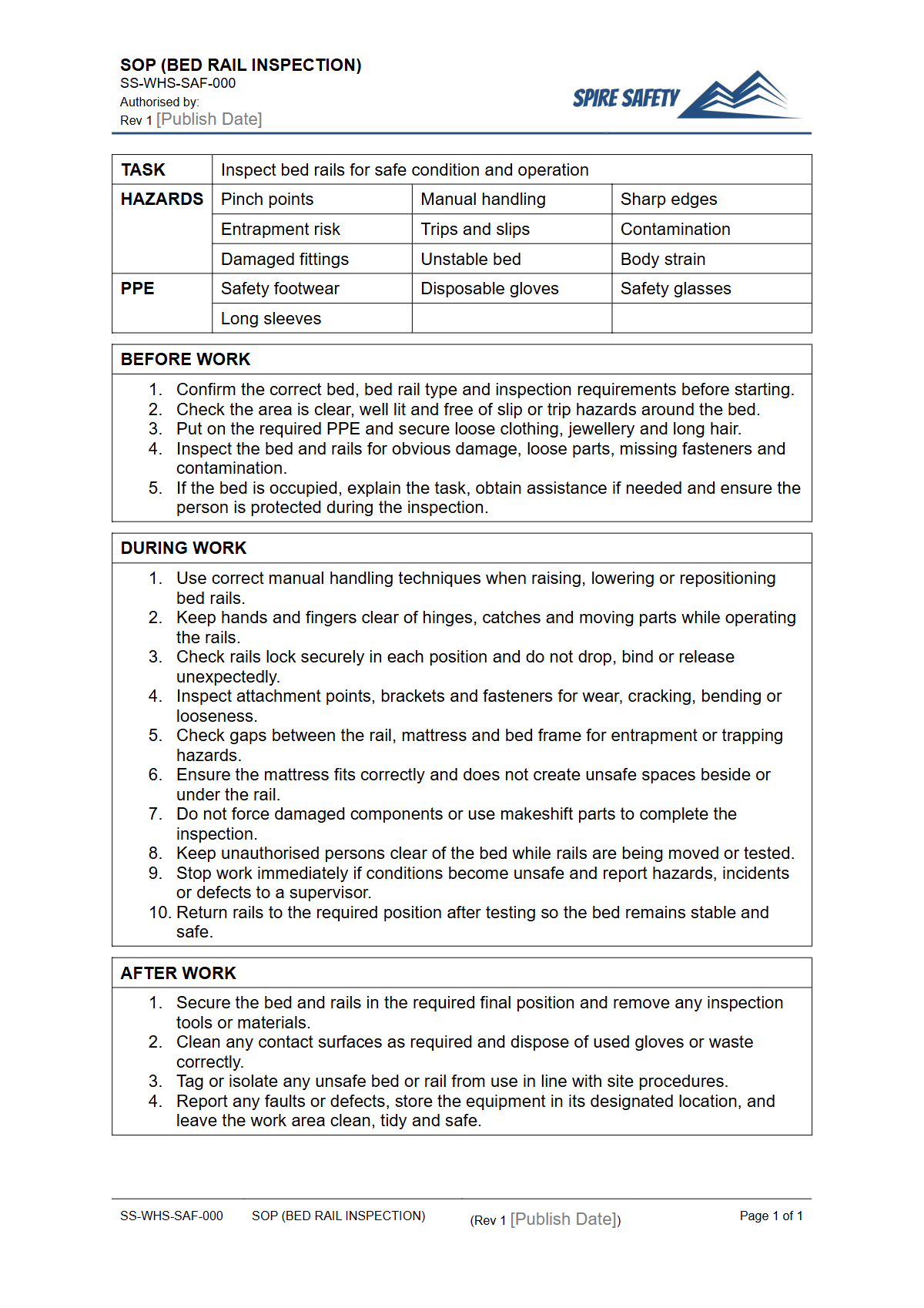
Download our free Safe Operating Procedure (Bed Rail Inspection) template. This structured DOCX and PDF helps formalise your inspection process.
Free Safe Operating Procedure (Bed Rail Inspection) Template
DOCX • 126 KB + PDF
Updated Oct 2026
No signup required
Purpose of the Free Safe Operating Procedure (Bed Rail Inspection) Template
This Free Safe Operating Procedure (Bed Rail Inspection) Template provides a structured framework for workplaces, particularly in healthcare, aged care, and disability support settings, to formalise their bed rail inspection process. Bed rails, while intended to prevent falls, can introduce severe risks such as entrapment, asphyxiation, and injury if they are incompatible, poorly maintained, or incorrectly installed.
This SOP template assists organisations in documenting a safe system of work to manage these risks effectively. By standardising the inspection steps, you can ensure consistency, accountability, and the proactive identification of hazards before they cause harm to patients or residents.
Video walkthrough
How to use the Free Safe Operating Procedure (Bed Rail Inspection) Template
This template is provided as a starting point in both DOCX and PDF formats. Download the DOCX file to customise it for your specific operational needs.
A robust SOP is more than a checklist; it forms a critical part of your facility's broader safety framework.
Important: This is a template only. We are not safety consultants and cannot guarantee this document will be suitable for your specific business.
You MUST customise this Safe Operating Procedure to reflect the unique hazards, equipment models (bed frames, rails, mattresses), and control measures relevant to your workplace. Integrating this SOP is a key step in developing comprehensive WHS management systems that protect both workers and vulnerable persons.
To effectively adapt this template, you should:
- Insert your company name, logo, and other identifying details.
- List the specific models of bed rails and associated beds used in your facility.
- Define the required Personal Protective Equipment (PPE), if any.
- Clearly assign responsibilities for conducting inspections, documenting results, and taking corrective action.
- Review and align the procedure with manufacturer's instructions and relevant Australian standards.
- Set a schedule for regular reviews of the SOP itself to ensure it remains current.
When to use this Safe Operating Procedure
A bed rail inspection SOP should be implemented as part of a routine safety and maintenance schedule. The procedure should be performed:
- At regular, scheduled intervals (e.g., monthly, quarterly) as determined by a risk assessment.
- Before a bed and rail system is assigned to a new patient or resident.
- Following any incident or near-miss involving bed rails.
- After the bed, mattress, or rails have been serviced, repaired, or replaced.
- As part of a regular WHS compliance audit to verify that safety processes are being followed correctly.
Who should use this Safe Operating Procedure
This procedure should be carried out by personnel who are competent and have received specific training on bed rail safety and inspection. This may include maintenance staff, clinical managers, care coordinators, or designated WHS representatives.
It is crucial that the individuals performing the inspection understand the specific risks of entrapment and are familiar with the equipment in use. Just as our free Step Ladder SOP is designed for those using simple equipment, this procedure is for personnel specifically trained in bed rail safety protocols.
Key Inspection Points for Bed Rails
Your customised SOP should detail specific inspection criteria. Key areas to focus on include:
- Structural Integrity: Check for cracks, bending, or damage to the rail, its mounting brackets, and all securing hardware. Ensure all components are free from rust or corrosion.
- Secure Latching: Test the latching mechanism to confirm it engages securely and cannot be accidentally dislodged. The rail should be stable and firm when raised and locked.
- Gap Analysis: Meticulously measure the gaps within the rail, between the rail and the mattress, and between the rail and the headboard/footboard to ensure they comply with recognised safety standards for preventing head, neck, and body entrapment.
- Mattress Compatibility: Verify that the mattress size and thickness are appropriate for the bed frame and rail system, as an incorrect fit can create dangerous gaps.
- Component Condition: Inspect all rollers, casters, and protective bumpers for wear and tear, ensuring they function as intended.
- Labels and Warnings: Ensure all manufacturer's safety labels and warnings are present, legible, and intact.
Documenting these checks provides a clear historical record, demonstrating due diligence in managing risks. For more templates and safety guides, you can browse our complete free WHS resources library.
Common mistakes
Common mistakes to avoid
- Using a generic checklist without customising it for specific bed and rail models.
- Forgetting to check the compatibility between the rail, bed frame, and mattress.
- Failing to properly document inspection findings and any corrective actions taken.
- Neglecting to train staff on the inspection procedure and the specific risks of entrapment.
Legal references
Legal considerations
The following legal requirements may be relevant to this type of work.
- Work Health and Safety Act (Harmonised) — Provides the primary duties for protecting workers and other people from work health and safety risks.
- Work Health and Safety Regulations (Harmonised) — Sets out requirements supporting the management of workplace hazards and risks.
The following codes may be relevant to this type of work.
- Managing WHS Risks Code of Practice — Provides practical guidance on identifying hazards, assessing risks and applying effective controls.
- Work Health and Safety Consultation, Cooperation and Coordination Code of Practice — Provides practical guidance on consulting workers and coordinating with other duty holders.
- Managing the Work Environment and Facilities Code of Practice — Provides practical guidance on safe work environments, workplace facilities and related controls.
Did you know
The Seven Entrapment Zones
Australian and international health regulators, like the TGA, have identified seven potential zones of entrapment in and around a bed rail system where a person's head, neck, or body could get caught.
FAQ
Frequently asked questions
01What is the biggest risk associated with bed rails in aged care?
02How often should bed rails be inspected?
03Is a Safe Operating Procedure a legal requirement in Australia?
04Can I use this template for any type of bed rail?
Share this resource
Free Safe Operating Procedure (Bed Rail Inspection) Template
Browse Categories
How To Use It
- 1Download and open in Word or PDF.
- 2Replace the placeholders with your business details.
- 3Get it reviewed by a WHS specialist before rollout.
Need it customised?
Our WHS consultants can adapt this template to your site, run a gap analysis, or audit what you already have in place.
Book a Free Consultation WHS consulting servicesor call 1300 156 382
Related templates
- Free Safe Operating Procedure (Bed Table Cleaning) Template
- Free Safe Operating Procedure (Bed Wheel Lock Check) Template
- Free Safe Operating Procedure (Bedroom Safety Check) Template
- Free Safe Operating Procedure (Bedside Curtain Change) Template
- Free Safe Operating Procedure (Bedside Locker Cleaning) Template
- Free Safe Operating Procedure (Beer Line Cleaning) Template