
Free Safe Operating Procedure (Bed Table Cleaning) Template
Download our free Safe Operating Procedure (SOP) template for bed table cleaning. A customisable DOCX and PDF to standardise hygiene and infection control.
Free Safe Operating Procedure (Bed Table Cleaning) Template
DOCX • 126 KB + PDF
Updated Oct 2026
No signup required
Purpose of the Free Safe Operating Procedure (Bed Table Cleaning) Template
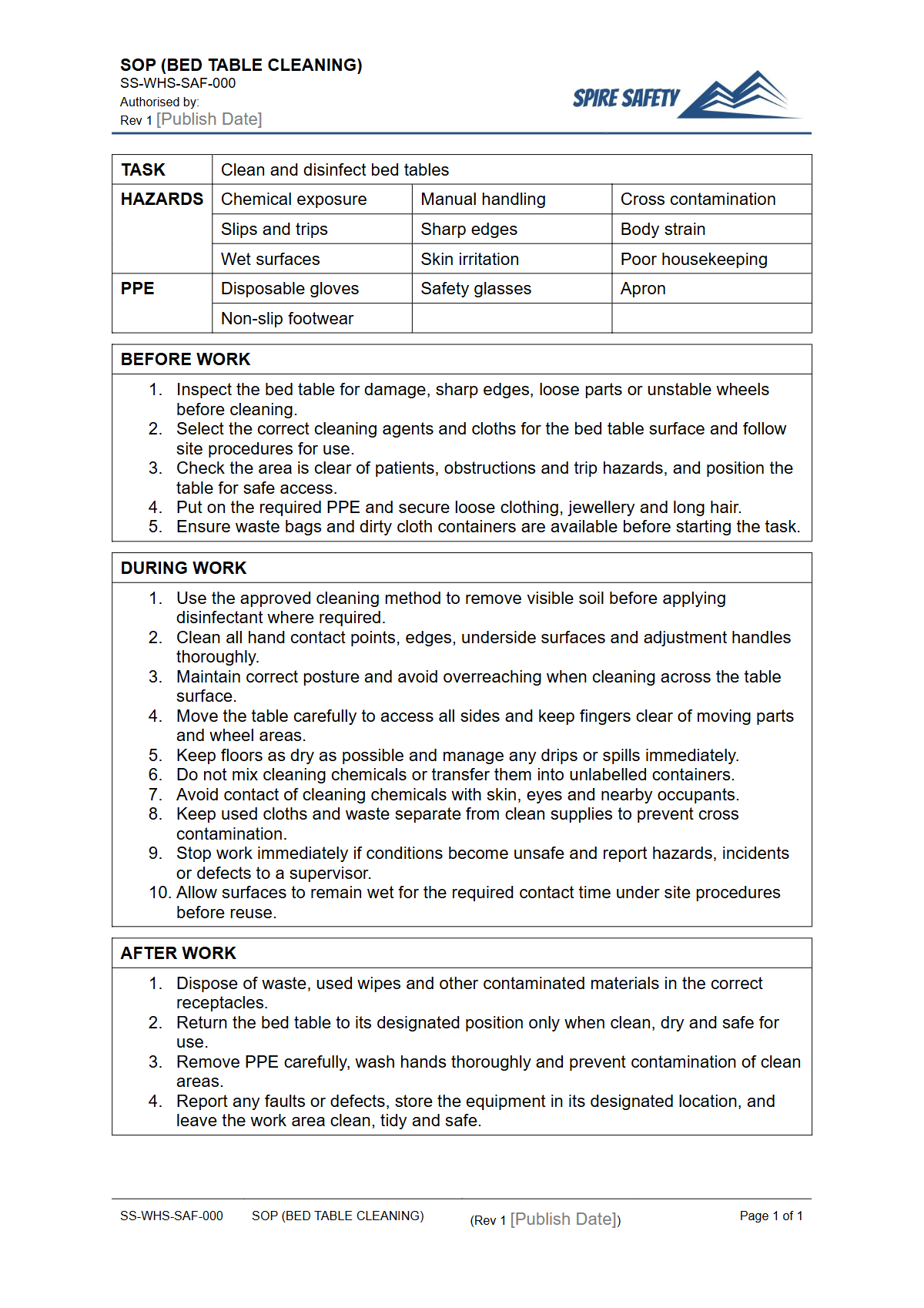
Proper cleaning and disinfection of high-touch surfaces like bed tables are critical for infection prevention and control in healthcare, aged care, and disability support settings. This Free Safe Operating Procedure (Bed Table Cleaning) Template provides a structured framework for documenting the required steps to perform this task safely and effectively.
Using a standardised procedure helps minimise the risk of cross-contamination, protect patients and residents, and ensure workers are safeguarded from potential hazards such as chemical exposure from cleaning agents, ergonomic injuries from repetitive tasks, and contact with biological hazards.
A well-defined SOP ensures consistency in cleaning standards across all staff and shifts. It serves as an essential training tool and a reference point for daily operations, reinforcing your organisation's commitment to health and safety.
Implementing clear, documented processes is a fundamental part of a robust safety framework, demonstrating due diligence in managing workplace risks. This document forms a key part of your overall WHS management system, integrating procedural safety into your organisational practices.
Video walkthrough
How to use the Free Safe Operating Procedure (Bed Table Cleaning) Template
This document is a starting point designed for customisation. Download the DOCX file and adapt it to reflect the specific context of your facility.
You will need to detail the exact cleaning products and disinfectants used (including their safety data sheets), the personal protective equipment (PPE) required, the frequency of cleaning, and the specific steps from preparation to waste disposal. This Safe Operating Procedure should be developed in consultation with the workers who perform the task.
Important: This is a template and not a complete, ready-to-use document. It is essential that you customise this template to suit the unique requirements of your workplace.
We are not liable for any incidents or compliance issues arising from the use of this document. You must ensure the final procedure accurately reflects your site-specific risk assessment and operational needs.
When to use a Safe Operating Procedure
This SOP should be used as the primary guide for all bed table cleaning activities. This includes routine daily cleaning, terminal cleaning after a patient or resident is discharged, and enhanced cleaning during an outbreak.
It is also a critical resource for inducting and training new cleaning or care staff, ensuring they understand the approved method from their first day. The procedure should be readily accessible in the work area for quick reference.
Furthermore, it serves as a benchmark during safety observations and procedural reviews, helping to identify any deviations from the standard process. Regular reviews are essential for maintaining effective safety protocols, often forming part of a scheduled WHS compliance audit.
Who should use it
This SOP is intended for any worker tasked with cleaning and disinfecting bed tables. This may include environmental services staff, dedicated cleaners, healthcare assistants, personal care workers, and nursing staff.
Supervisors and managers are responsible for ensuring the procedure is implemented, understood, and followed correctly. They should use it to conduct training, monitor performance, and provide feedback.
WHS managers and infection control coordinators can also use this template to standardise cleaning protocols across a facility or organisation, ensuring a consistent approach to managing hygiene-related risks. If you require assistance tailoring this or other documents, consider engaging professional WHS consulting services.
Documenting safety procedures should not be limited to complex or high-risk machinery. Everyday tasks, when performed incorrectly or inconsistently, can also present significant hazards.
Just as you would formalise the safe use of common equipment with a step ladder SOP, standardising cleaning tasks is vital for managing risks in a healthcare environment. By formalising these procedures, you create a culture where every task is performed with safety and diligence in mind. You can find more templates to support your safety system in our free WHS resources library.
Common mistakes
Common mistakes to avoid
- Failing to specify the correct dilution rates and contact time for disinfectants.
- Neglecting to list all required Personal Protective Equipment (PPE), such as gloves and eye protection.
- Not training workers on the finalised SOP or verifying their competency.
- Using generic language instead of clear, step-by-step instructions specific to the workplace.
Legal references
Legal considerations
The following legal requirements may be relevant to this type of work.
- Work Health and Safety Act (Harmonised) — Provides the primary duties for protecting workers and other people from work health and safety risks.
- Work Health and Safety Regulations (Harmonised) — Sets out requirements supporting the management of workplace hazards and risks.
The following codes may be relevant to this type of work.
- Managing WHS Risks Code of Practice — Provides practical guidance on identifying hazards, assessing risks and applying effective controls.
- Work Health and Safety Consultation, Cooperation and Coordination Code of Practice — Provides practical guidance on consulting workers and coordinating with other duty holders.
- Managing the Work Environment and Facilities Code of Practice — Provides practical guidance on safe work environments, workplace facilities and related controls.
Did you know
Infection Control
Studies have shown that high-touch surfaces in patient rooms, such as bed tables and bed rails, can become contaminated with pathogens within hours of being cleaned.
Worker Consultation
Under Australian WHS law, a Person Conducting a Business or Undertaking (PCBU) has a duty to consult with workers on matters that directly affect their health and safety.
FAQ
Frequently asked questions
01Why is a Safe Operating Procedure for bed table cleaning necessary?
02What common hazards are associated with cleaning bed tables?
03How often should a Safe Operating Procedure be reviewed?
04Can this bed table cleaning template be used for other surfaces?
Share this resource
Free Safe Operating Procedure (Bed Table Cleaning) Template
Browse Categories
How To Use It
- 1Download and open in Word or PDF.
- 2Replace the placeholders with your business details.
- 3Get it reviewed by a WHS specialist before rollout.
Need it customised?
Our WHS consultants can adapt this template to your site, run a gap analysis, or audit what you already have in place.
Book a Free Consultation WHS consulting servicesor call 1300 156 382
Related templates
- Free Safe Operating Procedure (Bed Wheel Lock Check) Template
- Free Safe Operating Procedure (Bedroom Safety Check) Template
- Free Safe Operating Procedure (Bedside Curtain Change) Template
- Free Safe Operating Procedure (Bedside Locker Cleaning) Template
- Free Safe Operating Procedure (Beer Line Cleaning) Template
- Free Safe Operating Procedure (Beer Tap Cleaning) Template