
Free Safe Operating Procedure (Bedroom Safety Check) Template
Download our free Safe Operating Procedure for a Bedroom Safety Check. This DOCX & PDF template helps identify common hazards in accommodation settings.
Free Safe Operating Procedure (Bedroom Safety Check) Template
DOCX • 126 KB + PDF
Updated Oct 2026
No signup required
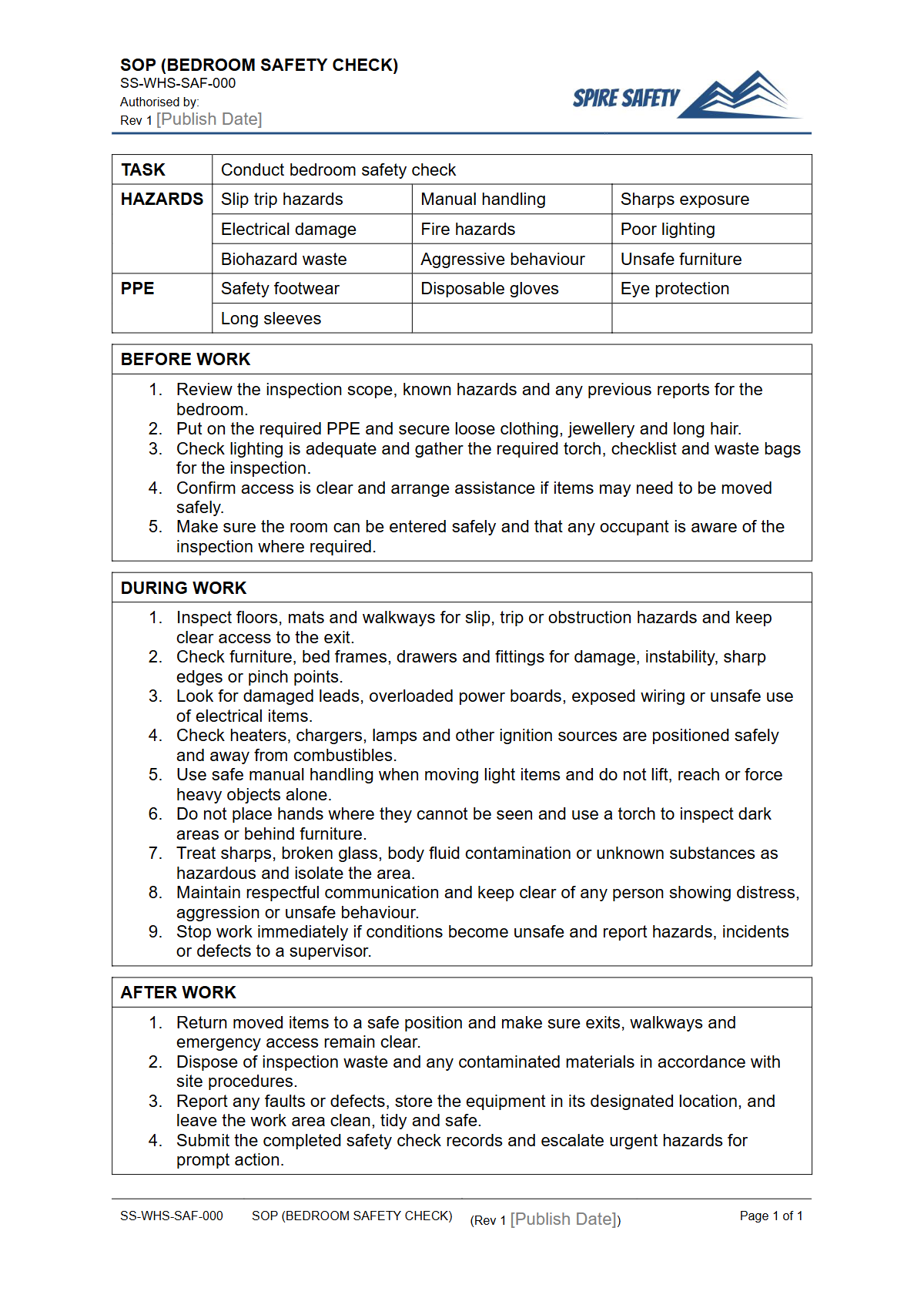
Purpose of the Free Safe Operating Procedure (Bedroom Safety Check) Template
Ensuring the safety of bedrooms in accommodation, healthcare, or residential settings is a critical part of an organisation's duty of care. Our Free Safe Operating Procedure (Bedroom Safety Check) Template provides a structured framework for systematically identifying and controlling common hazards.
This document helps standardise your inspection process, ensuring that key safety elements like trip hazards, electrical safety, fire precautions, and accessibility are consistently checked.
Using a formal Safe Operating Procedure (SOP) demonstrates a commitment to proactive risk management. It transforms informal checks into a documented, repeatable process that can be used for training, auditing, and continuous improvement.
This is a foundational step in creating a safe environment for guests, residents, and employees, aligned with Australian WHS best practices.
Video walkthrough
How to use the Free Safe Operating Procedure (Bedroom Safety Check) Template
This resource is available as a fully editable DOCX file and a print-ready PDF. The DOCX version allows for complete customisation to suit the unique requirements of your workplace, whether it's a hotel, motel, aged care facility, or NDIS accommodation.
Important: This is a template, not a finished document. To be effective, we recommend you customise it to your specific site, equipment, and operational context. You should consult with your team—including housekeeping, maintenance, and management—to identify all relevant hazards and refine the control measures. For expert assistance in tailoring this document or integrating it into your broader safety framework, consider our WHS consulting services.
Implementing the SOP
Once customised, the SOP should be integrated into your existing WHS management systems. Ensure all relevant personnel are trained on the procedure's steps and understand their responsibilities. Keep the document in a location that is easily accessible to staff who perform the checks.
Regular reviews and updates are essential to keep the procedure relevant and effective.
When to use a Bedroom Safety Check SOP
A bedroom safety check is not a one-time task. This Safe Operating Procedure should be used consistently at several key moments to maintain a safe environment. Common applications include:
- Before guest or resident arrival: To ensure the room is safe for a new occupant.
- As part of a regular maintenance schedule: For example, weekly or monthly checks in long-term accommodation.
- After maintenance or repair work: To verify that no new hazards, such as tools or debris, have been left behind. This is particularly important if tasks required equipment like ladders, which have their own safety protocols outlined in resources like our FREE Step Ladder SOP Template.
- Following a reported incident or near-miss: To investigate the cause and prevent recurrence.
Who should use this SOP
This template is designed for a range of personnel responsible for workplace health and safety in accommodation and care settings. Key users include:
- Property and Facilities Managers: For establishing and overseeing safety protocols across a site.
- Housekeeping Staff: As a daily or pre-arrival checklist to ensure room safety.
- Maintenance Teams: To guide safety checks before, during, and after working in a room.
- WHS Officers and Coordinators: For developing and auditing safety procedures as part of their compliance activities. A robust procedure is a key piece of evidence during a WHS compliance audit.
- NDIS and Aged Care Support Workers: To ensure the living spaces of vulnerable individuals are free from preventable hazards.
Explore our full free WHS resources library for other templates and checklists to support your safety management system.
Common mistakes
Common mistakes to avoid
- Forgetting to customise the template with site-specific hazards and room layouts.
- Not providing adequate training to staff on how to follow the procedure correctly.
- Failing to review and update the SOP after an incident or when changes are made to the room or furniture.
- Treating the SOP as a simple 'tick-box' exercise instead of an active process of hazard identification.
Legal references
Legal considerations
The following legal requirements may be relevant to this type of work.
- Work Health and Safety Act (Harmonised) — Provides the primary duties for protecting workers and other people from work health and safety risks.
- Work Health and Safety Regulations (Harmonised) — Sets out requirements supporting the management of workplace hazards and risks.
The following codes may be relevant to this type of work.
- Managing WHS Risks Code of Practice — Provides practical guidance on identifying hazards, assessing risks and applying effective controls.
- Work Health and Safety Consultation, Cooperation and Coordination Code of Practice — Provides practical guidance on consulting workers and coordinating with other duty holders.
- Managing the Work Environment and Facilities Code of Practice — Provides practical guidance on safe work environments, workplace facilities and related controls.
Did you know
Falls are a Major Risk
Falls are a leading cause of injury-related hospitalisation in Australia, particularly for older people. Simple bedroom safety checks can significantly reduce this risk by identifying common hazards like loose rugs, poor lighting, and clutter.
The Importance of Consultation
Under model WHS laws, PCBUs must consult with workers on matters affecting their health and safety. Involving housekeeping and maintenance staff when developing your Bedroom Safety Check SOP ensures the procedure is practical and effective.
FAQ
Frequently asked questions
01What should be included in a bedroom safety check?
02How often should bedroom safety checks be performed?
03Is a Safe Operating Procedure a legal requirement for bedroom checks?
04Can I use this template for NDIS or aged care facilities?
Share this resource
Free Safe Operating Procedure (Bedroom Safety Check) Template
Browse Categories
How To Use It
- 1Download and open in Word or PDF.
- 2Replace the placeholders with your business details.
- 3Get it reviewed by a WHS specialist before rollout.
Need it customised?
Our WHS consultants can adapt this template to your site, run a gap analysis, or audit what you already have in place.
Book a Free Consultation WHS consulting servicesor call 1300 156 382
Related templates
- Free Safe Operating Procedure (Bedside Curtain Change) Template
- Free Safe Operating Procedure (Bedside Locker Cleaning) Template
- Free Safe Operating Procedure (Beer Line Cleaning) Template
- Free Safe Operating Procedure (Beer Tap Cleaning) Template
- Free Safe Operating Procedure (Belt Loader) Template
- Free Safe Operating Procedure (Belt Sander) Template