
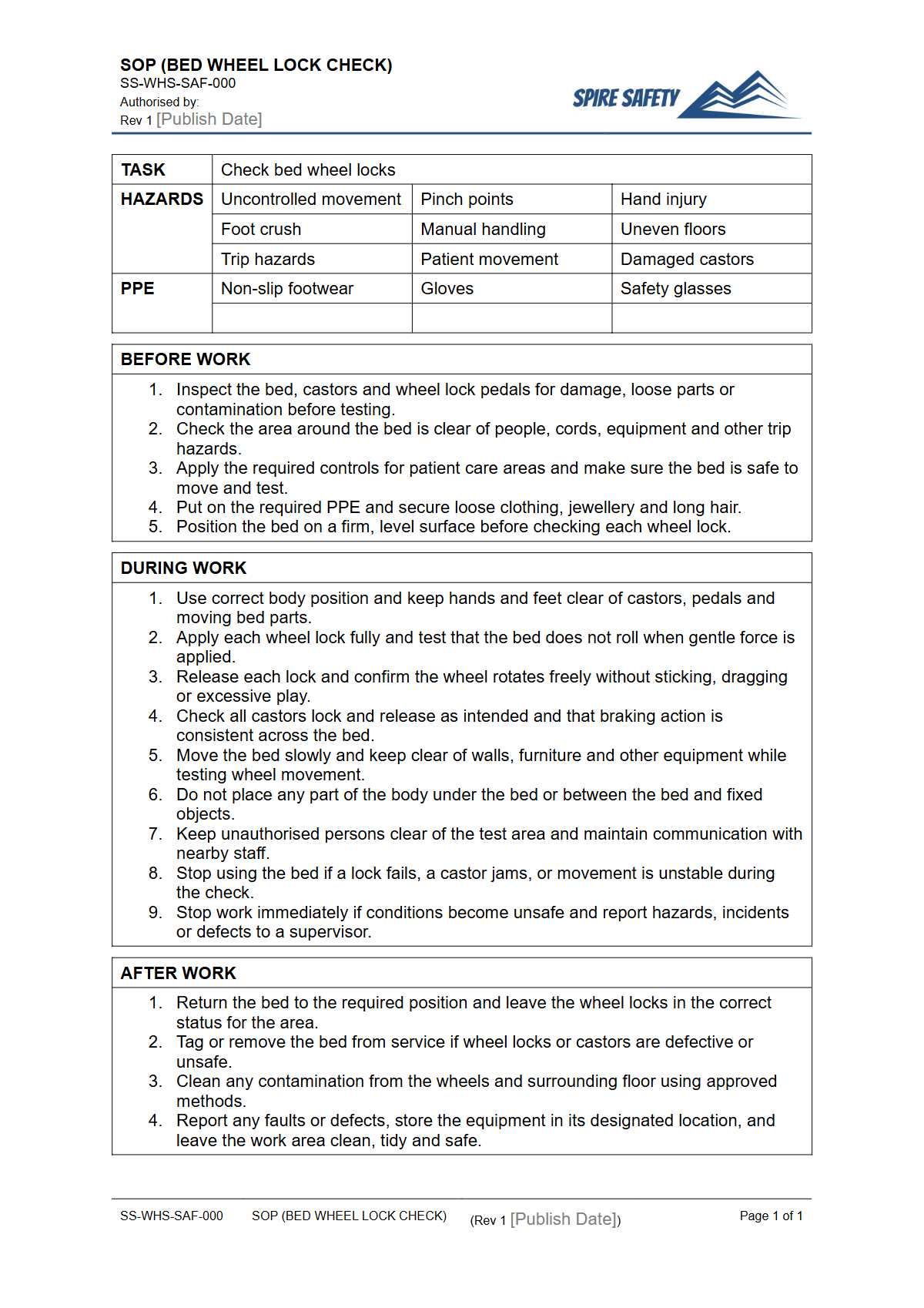
Free Safe Operating Procedure (Bed Wheel Lock Check) Template
Download our free Safe Operating Procedure (Bed Wheel Lock Check) template.
Free Safe Operating Procedure (Bed Wheel Lock Check) Template
DOCX • 126 KB + PDF
Updated Oct 2026
No signup required
Purpose of the Free Safe Operating Procedure (Bed Wheel Lock Check) Template
This Free Safe Operating Procedure (Bed Wheel Lock Check) Template provides a framework for ensuring that beds, particularly in healthcare, aged care, and disability support settings, are stable and secure. The primary purpose is to prevent unintended movement that can lead to patient or resident falls, which are a significant cause of injury.
A formalised procedure helps standardise behaviour across all staff, reducing the risk of accidents during patient transfers, repositioning, and when a bed is left unattended.
Implementing a clear SOP for this task is a fundamental component of managing hazards in a care environment. It demonstrates a commitment to worker and patient safety by formalising risk controls. This procedure should form part of your broader safety framework, which is a core element of effective WHS management systems.
Video walkthrough
How to use the Free Safe Operating Procedure (Bed Wheel Lock Check) Template
Our Safe Operating Procedure for a bed wheel lock check is provided as a fully editable DOCX file, with a PDF version also available for easy printing and distribution. To use the template, simply download the file and open it in your preferred word processor.
You can then add your company branding, specify the exact models of beds used in your facility, and list any site-specific requirements or environmental considerations.
It is crucial to adapt this document to the unique context of your organisation. During customisation, you should consult with workers who perform the task daily to ensure the procedure is practical and reflects actual work practices.
Important Customisation Note
This document is a template and not a complete Safe Operating Procedure. We have provided a structured starting point, but it is your responsibility to ensure the final document is tailored to the specific equipment, environment, and risks in your workplace. This includes consulting with your workers and other relevant stakeholders. For guidance on tailoring documentation to your operational needs, you may consider seeking specialist WHS consulting.
When to use it
A bed wheel lock check is not a one-off task. The procedure should be performed consistently at several key moments to maintain safety. Key triggers for performing the check include:
- Before transferring a patient or resident to or from the bed.
- After moving the bed for any reason, such as cleaning or repositioning within the room.
- Before providing any form of personal or clinical care that requires the patient to be in bed.
- Whenever a patient or resident is left unattended in the bed.
- As part of a routine room safety check at the beginning of a shift or during handovers.
These checks are just as important as other routine safety tasks. For example, similar procedural discipline is required when using equipment common in care facilities, as outlined in our free Step Ladder SOP.
Who should use it
This Safe Operating Procedure should be used by all personnel who interact with or work in the vicinity of patient or resident beds. This includes a wide range of roles:
- Nurses (Registered and Enrolled)
- Aged Care Workers and Personal Care Assistants (PCAs)
- Patient Services Assistants (PSAs)
- Allied Health Professionals (e.g., physiotherapists, occupational therapists)
- Cleaning and maintenance staff
Every person in these roles must receive training on the procedure to understand their responsibility in ensuring bed stability. Verifying that these checks are being completed correctly can be incorporated into regular WHS compliance audits to ensure ongoing adherence and identify any need for retraining.
You can find more templates and checklists in our free WHS resources library to support your safety programs.
Common mistakes
Common mistakes to avoid
- Assuming locks are engaged without performing a physical check.
- Forgetting to re-engage the locks after moving the bed for cleaning or access.
- Using a generic SOP that doesn't account for the different locking mechanisms on various bed models in the facility.
- Failing to train all relevant staff, including cleaners and maintenance personnel, on the importance and procedure of the check.
Legal references
Legal considerations
The following legal requirements may be relevant to this type of work.
- Work Health and Safety Act (Harmonised) — Provides the primary duties for protecting workers and other people from work health and safety risks.
- Work Health and Safety Regulations (Harmonised) — Sets out requirements supporting the management of workplace hazards and risks.
The following codes may be relevant to this type of work.
- Managing WHS Risks Code of Practice — Provides practical guidance on identifying hazards, assessing risks and applying effective controls.
- Work Health and Safety Consultation, Cooperation and Coordination Code of Practice — Provides practical guidance on consulting workers and coordinating with other duty holders.
- Managing the Work Environment and Facilities Code of Practice — Provides practical guidance on safe work environments, workplace facilities and related controls.
Did you know
Fall Statistics
According to the Australian Institute of Health and Welfare (AIHW), falls are a leading cause of injury-related hospitalisation and death, particularly among older Australians. Many of these falls occur in residential aged care facilities and hospitals.
A Simple Check
The most effective way to check if a bed lock is engaged is a gentle 'push-pull' test. A visual check alone can be deceiving, as some locking mechanisms may appear engaged when they are not fully secured.
FAQ
Frequently asked questions
01What is a Safe Operating Procedure for a bed wheel lock check?
02Why is checking bed wheel locks so important in aged care?
03Who is responsible for performing bed wheel lock checks?
04How often should bed wheel locks be checked?
Share this resource
Free Safe Operating Procedure (Bed Wheel Lock Check) Template
Browse Categories
How To Use It
- 1Download and open in Word or PDF.
- 2Replace the placeholders with your business details.
- 3Get it reviewed by a WHS specialist before rollout.
Need it customised?
Our WHS consultants can adapt this template to your site, run a gap analysis, or audit what you already have in place.
Book a Free Consultation WHS consulting servicesor call 1300 156 382
Related templates
- Free Safe Operating Procedure (Bedroom Safety Check) Template
- Free Safe Operating Procedure (Bedside Curtain Change) Template
- Free Safe Operating Procedure (Bedside Locker Cleaning) Template
- Free Safe Operating Procedure (Beer Line Cleaning) Template
- Free Safe Operating Procedure (Beer Tap Cleaning) Template
- Free Safe Operating Procedure (Belt Loader) Template