
Free Safe Operating Procedure (Bearing Puller) Template
Download our free Safe Operating Procedure (Bearing Puller) template. This customisable DOCX & PDF resource helps document safe work practices for mechanics.
Free Safe Operating Procedure (Bearing Puller) Template
DOCX • 126 KB + PDF
Updated Oct 2026
No signup required
Purpose of the Free Safe Operating Procedure (Bearing Puller) Template
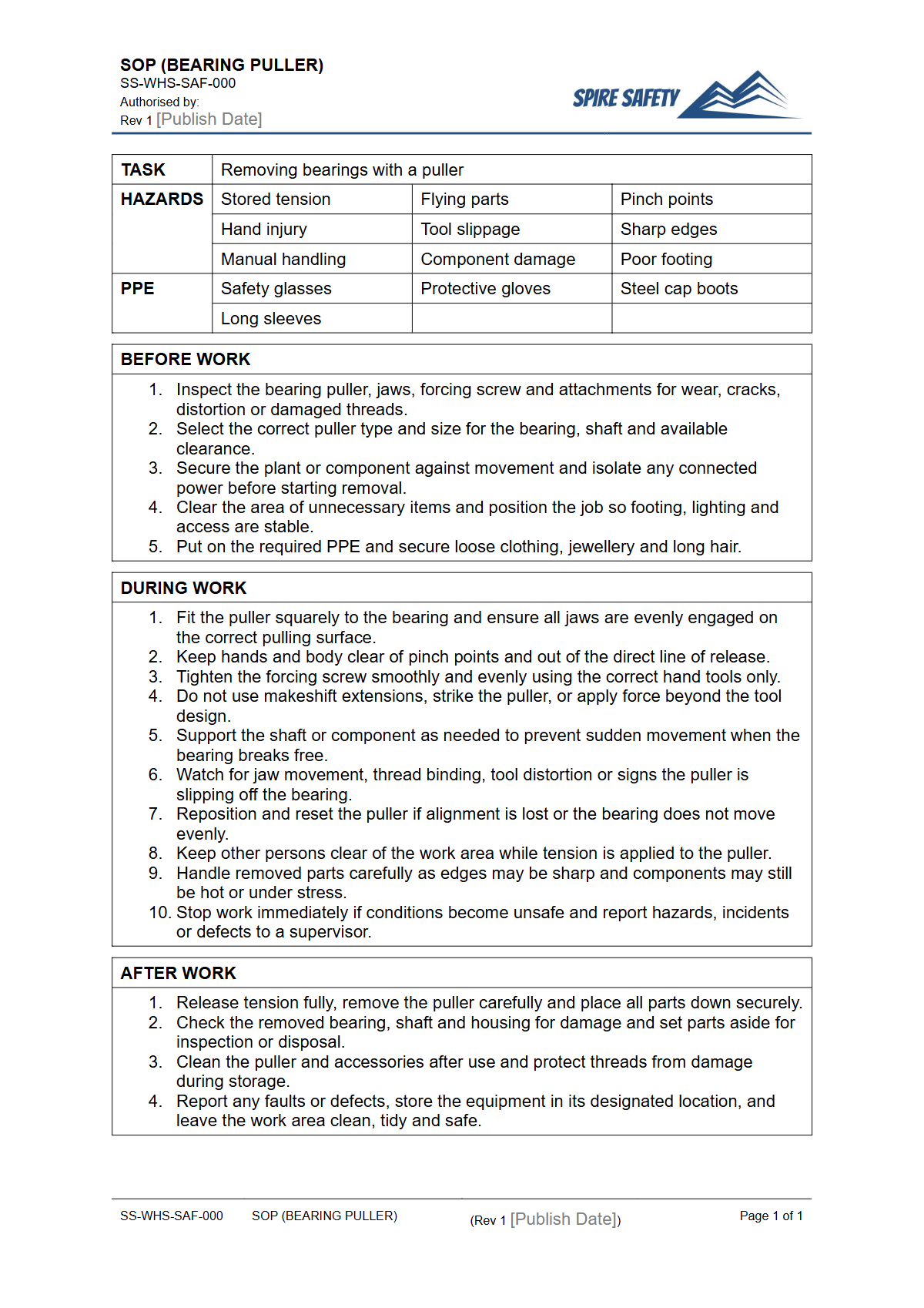
This Free Safe Operating Procedure (Bearing Puller) Template provides a structured framework for documenting the risks and controls associated with using mechanical or hydraulic bearing pullers. Using a bearing puller involves significant stored energy, which can lead to projectiles and serious injury if not managed correctly.
This template helps you outline the step-by-step process, required personal protective equipment (PPE), and emergency procedures to ensure worker safety.
A well-drafted SOP is a critical administrative control measure that supports a business's primary duty of care. It forms a key component of your overall safety framework, ensuring that tasks are performed consistently and safely by all operators.
Integrating this SOP with broader safety documentation, such as a Free Air Compressor SOP for related workshop equipment, helps create a comprehensive safety system.
Video walkthrough
How to use the Free Safe Operating Procedure (Bearing Puller) Template
This document is designed as a starting point. To make it effective, you must customise it to reflect the specific equipment, environment, and procedures in your workplace.
Download the DOCX file and edit it to include details about your specific model of bearing puller (e.g., manual, hydraulic), the types of bearings being removed, and any unique site conditions. We have populated the template with common steps and hazards, but your own risk assessment should guide the final content.
It is essential that you consult with the workers who actually use the equipment during the customisation process. Their direct experience is invaluable for identifying practical risks and effective controls.
Once finalised, the SOP should be used as a training tool for new operators and a reference for experienced staff. The effectiveness of your procedures can be verified through a systematic WHS compliance auditing program.
Before You Start
Ensure a competent person completes a thorough risk assessment before finalising this SOP. This involves identifying all potential hazards, assessing the level of risk, and implementing control measures to eliminate or minimise them.
Hazards may include stored energy release, component failure, hydraulic fluid injection, and ergonomic strains. Control measures should follow the hierarchy of controls, prioritising elimination and engineering solutions where possible.
Consultation is Key
Under Australian WHS law, businesses must consult with their workers on matters affecting their health and safety. Involve your mechanics, fitters, and maintenance staff in drafting and reviewing the SOP.
This not only leads to a more practical and effective document but also helps secure worker buy-in and promotes a positive safety culture. This collaborative approach is a cornerstone of effective WHS management systems.
When to use a Bearing Puller SOP
A Safe Operating Procedure for a bearing puller should be used whenever the task of removing press-fit bearings, gears, pulleys, or other components from a shaft is undertaken. It is particularly important for high-risk scenarios, such as when dealing with large or heavily seized components where significant force is required.
The SOP should be readily available at the point of work, either as a printed copy or on a digital device.
This procedure is also essential during worker induction, training, and competency assessments. It serves as the official source of truth for the approved method of work, reducing the likelihood of dangerous improvisation.
Using this alongside other machinery-specific procedures, like a Free Brake Press SOP (Safe Operating Procedure) Template, helps standardise safety across all workshop tasks.
Who should use it
This template is intended for use by Persons in Control of a Business or Undertaking (PCBUs), WHS managers, supervisors, and maintenance managers in industries such as automotive repair, manufacturing, mining, and heavy machinery maintenance. It provides the necessary structure to create a compliant and practical procedure.
The finalised SOP should be used by all personnel authorised to operate bearing pullers, including mechanics, apprentices, and maintenance fitters. It ensures that everyone, regardless of experience level, follows the same safety-critical steps.
For tasks involving different equipment, you can find other specific guides in our free WHS resources library to maintain consistency in your documentation.
Regular review of your SOPs is crucial. Just as you would review a FREE Plasma Cutter SOP (Safe Operating Procedure) Template after an equipment update, this bearing puller procedure should be updated whenever new models are introduced, after an incident occurs, or as part of a scheduled periodic review.
Common mistakes
Common mistakes to avoid
- Using a puller that is too small or not rated for the required force.
- Failing to ensure the puller is centred and its jaws have a secure, square grip on the workpiece.
- Neglecting to wear mandatory eye protection during setup and operation.
- Applying excessive force with impact tools ('cheater bars') on manual pullers not designed for it.
Legal references
Legal considerations
The following legal requirements may be relevant to this type of work.
- Work Health and Safety Act (Harmonised) — Provides the primary duties for protecting workers and other people from work health and safety risks.
- Work Health and Safety Regulations (Harmonised) — Sets out requirements supporting the management of workplace hazards and risks.
The following codes may be relevant to this type of work.
- Managing WHS Risks Code of Practice — Provides practical guidance on identifying hazards, assessing risks and applying effective controls.
- Work Health and Safety Consultation, Cooperation and Coordination Code of Practice — Provides practical guidance on consulting workers and coordinating with other duty holders.
- Managing the Work Environment and Facilities Code of Practice — Provides practical guidance on safe work environments, workplace facilities and related controls.
Did you know
Stored Energy Potential
A bearing puller operates by creating immense pulling force. This force represents stored mechanical energy, which, if released suddenly, can be equivalent to a small explosion.
Types of Pullers
Bearing pullers come in various designs, including two-jaw, three-jaw, and hydraulic models. Three-jaw pullers generally provide a more stable and evenly distributed pulling force, reducing the risk of slippage.
FAQ
Frequently asked questions
01What is the main hazard when using a bearing puller?
02Is a Safe Operating Procedure legally required for a bearing puller in Australia?
03What PPE is required for using a bearing puller?
04How often should a bearing puller SOP be reviewed?
Share this resource
Free Safe Operating Procedure (Bearing Puller) Template
Browse Categories
How To Use It
- 1Download and open in Word or PDF.
- 2Replace the placeholders with your business details.
- 3Get it reviewed by a WHS specialist before rollout.
Need it customised?
Our WHS consultants can adapt this template to your site, run a gap analysis, or audit what you already have in place.
Book a Free Consultation WHS consulting servicesor call 1300 156 382
Related templates
- Free Safe Operating Procedure (Beauty Bed Cleaning) Template
- Free Safe Operating Procedure (Bed Alarm Setup) Template
- Free Safe Operating Procedure (Bed Rail Inspection) Template
- Free Safe Operating Procedure (Bed Table Cleaning) Template
- Free Safe Operating Procedure (Bed Wheel Lock Check) Template
- Free Safe Operating Procedure (Bedroom Safety Check) Template