
Free Safe Operating Procedure (Beading Machine) Template
Download our free Safe Operating Procedure (Beading Machine) template.
Free Safe Operating Procedure (Beading Machine) Template
DOCX • 126 KB + PDF
Updated Oct 2026
No signup required
Purpose of the Free Safe Operating Procedure (Beading Machine) Template
A beading machine, used for forming strengthening ribs or flanges in sheet metal, presents significant workplace hazards if not managed correctly. Key risks include entanglement in rotating shafts, cuts from sharp metal edges, and crushing or pinching injuries.
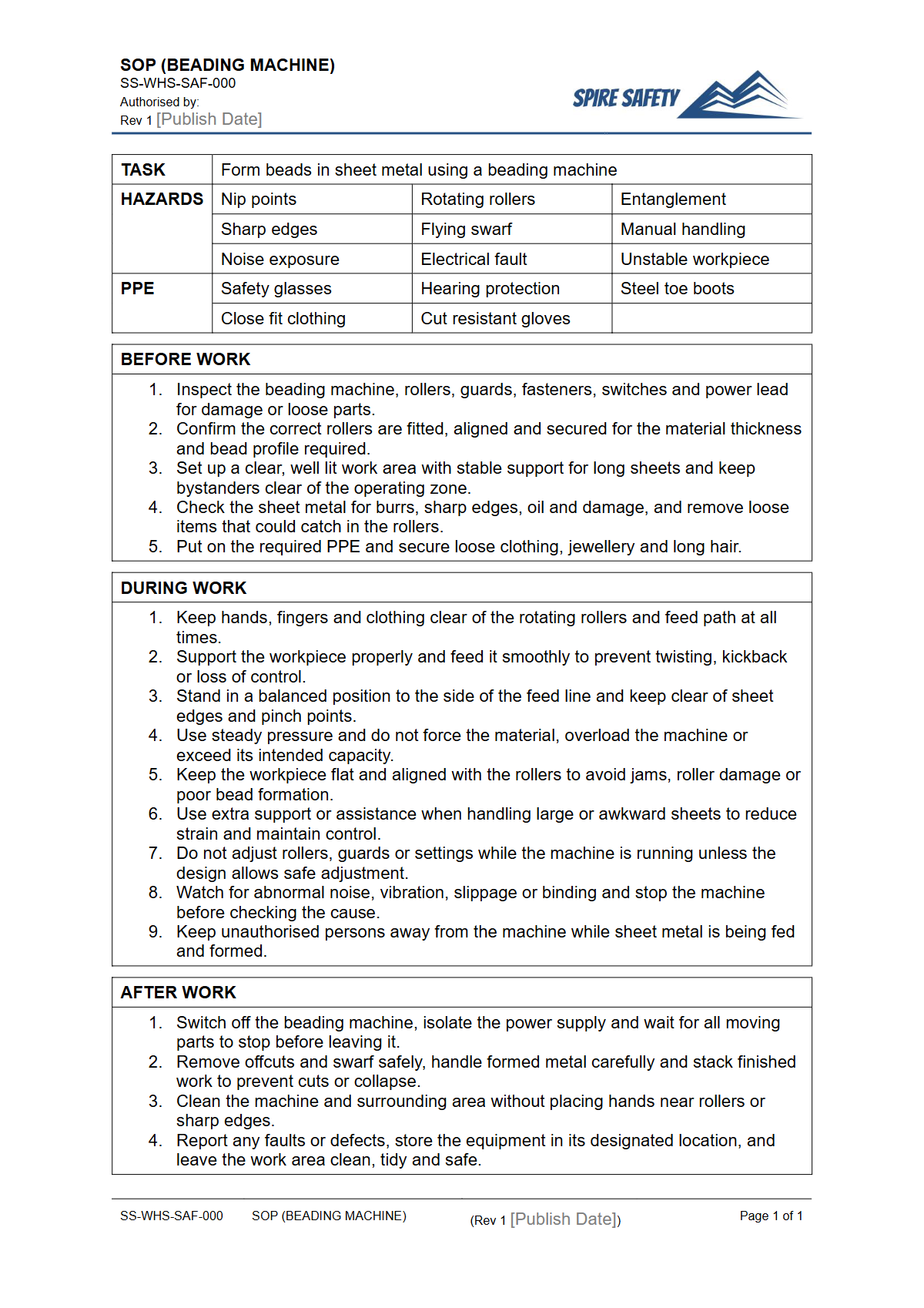
This Free Safe Operating Procedure (Beading Machine) Template provides a structured starting point for documenting the safest way to perform this task. It helps your organisation meet its duty of care by systematically identifying hazards, assessing risks, and outlining clear control measures for operators to follow.
Using a documented Safe Operating Procedure (SOP) is a fundamental part of a robust safety system. It serves as an essential training tool for new workers and a critical reference for experienced operators.
Formalising your procedures ensures consistency in work practices, reduces the likelihood of incidents, and demonstrates a proactive approach to safety management. Integrating this SOP into your broader WHS management systems helps create a safer, more organised, and more productive workshop environment.
Video walkthrough
How to use the Free Safe Operating Procedure (Beading Machine) Template
This resource is provided in both DOCX and PDF formats for your convenience. The DOCX file is fully editable, allowing you to tailor the content to your specific operational needs.
IMPORTANT: This template provides a comprehensive framework based on common Australian WHS practices, but it is not a finished document. We cannot know the specific hazards of your workplace, the exact model of your machine, or your unique processes.
You MUST consult with your workers and conduct a site-specific risk assessment to customise this document fully. This ensures the final SOP is relevant, effective, and reflects the reality of your operations.
To implement this Safe Operating Procedure:
- Download the template and open the DOCX file.
- Enter your company details, document control information, and the specific location and model of the beading machine.
- Review the listed hazards and controls. Add or remove items based on a risk assessment conducted at your workplace.
- Detail the required Personal Protective Equipment (PPE), such as safety glasses and cut-resistant gloves.
- Clearly outline the step-by-step process for pre-start checks, operation, and shutdown procedures.
- Define the training and competency requirements for operators.
- Have the final document reviewed and approved by a competent person (e.g., a supervisor or WHS manager) before issuing it.
Each piece of machinery requires its own specific procedure. For example, the safety controls for a beading machine differ significantly from those needed for other fabrication equipment.
Our FREE Plasma Cutter SOP Template provides a specific guide for that distinct process.
When to use a Beading Machine SOP
A Safe Operating Procedure for a beading machine should be used as a primary reference tool throughout the equipment's lifecycle. It is not a document to be filed away and forgotten.
Use it during new worker inductions and task-specific training to ensure they understand the approved method of work from day one. It should be readily accessible near the machine for operators to reference at any time, reinforcing correct and safe behaviour.
The SOP is also a critical document for review following any incident or near-miss. It should be updated whenever the machine is modified, the process changes, or new hazards are identified. Regular reviews, typically annually, ensure the procedure remains current and effective, similar to procedures for other plant like those detailed in our Free Brake Press SOP Template.
Who should use this Safe Operating Procedure
Safety is a shared responsibility, and this SOP is a tool for multiple roles within an organisation. Persons Conducting a Business or Undertaking (PCBUs) and their management teams use it to fulfil their primary duty of care.
WHS Managers and Safety Officers use it to standardise procedures and as a baseline for inspections and audits. Supervisors and Team Leaders are responsible for ensuring operators are trained on the SOP and adhere to it during daily work.
Finally, Workers and Operators must use the SOP to understand how to perform their tasks safely, protecting themselves and their colleagues.
Periodic checks of workplace procedures are a key part of maintaining safety standards. These reviews can be incorporated into your schedule of regular WHS compliance audits to verify that documented procedures are being followed correctly. For complex automated equipment, you may also need procedures like our CNC Machine SOP. You can find these and more in our complete free WHS resources library.
Common mistakes
Common mistakes to avoid
- Using a generic template without customising it for the specific machine model and workplace tasks.
- Failing to adequately train workers on the SOP's contents and verify their understanding.
- Not reviewing the SOP after an incident or when processes change, making it outdated.
- Storing the SOP in an office where it is not easily accessible to operators at the point of use.
Legal references
Legal considerations
The following legal requirements may be relevant to this type of work.
- Work Health and Safety Act (Harmonised) — Provides the primary duties for protecting workers and other people from work health and safety risks.
- Work Health and Safety Regulations (Harmonised) — Sets out requirements supporting the management of workplace hazards and risks.
The following codes may be relevant to this type of work.
- Managing WHS Risks Code of Practice — Provides practical guidance on identifying hazards, assessing risks and applying effective controls.
- Work Health and Safety Consultation, Cooperation and Coordination Code of Practice — Provides practical guidance on consulting workers and coordinating with other duty holders.
- Managing the Work Environment and Facilities Code of Practice — Provides practical guidance on safe work environments, workplace facilities and related controls.
Did you know
Hierarchy of Control
An SOP is an 'administrative control'. While vital, it should be implemented alongside higher-level controls like fixed guarding (engineering control) to prevent access to rotating parts wherever practicable.
Worker Consultation
Under Australian WHS law, you must consult with workers on safety matters. Involving the machine operators in drafting and reviewing the SOP makes it more practical and increases their commitment to following it.
FAQ
Frequently asked questions
01What are the main hazards of operating a beading machine?
02Is a Safe Operating Procedure a legal requirement in Australia?
03How often should I review my beading machine SOP?
04Can I use this template for a sheet metal folder or guillotine?
Share this resource
Free Safe Operating Procedure (Beading Machine) Template
Browse Categories
How To Use It
- 1Download and open in Word or PDF.
- 2Replace the placeholders with your business details.
- 3Get it reviewed by a WHS specialist before rollout.
Need it customised?
Our WHS consultants can adapt this template to your site, run a gap analysis, or audit what you already have in place.
Book a Free Consultation WHS consulting servicesor call 1300 156 382
Related templates
- Free Safe Operating Procedure (Beam Clamp) Template
- Free Safe Operating Procedure (Bearing Puller) Template
- Free Safe Operating Procedure (Beauty Bed Cleaning) Template
- Free Safe Operating Procedure (Bed Alarm Setup) Template
- Free Safe Operating Procedure (Bed Rail Inspection) Template
- Free Safe Operating Procedure (Bed Table Cleaning) Template