
Free Safe Operating Procedure (Battery Storage) Template
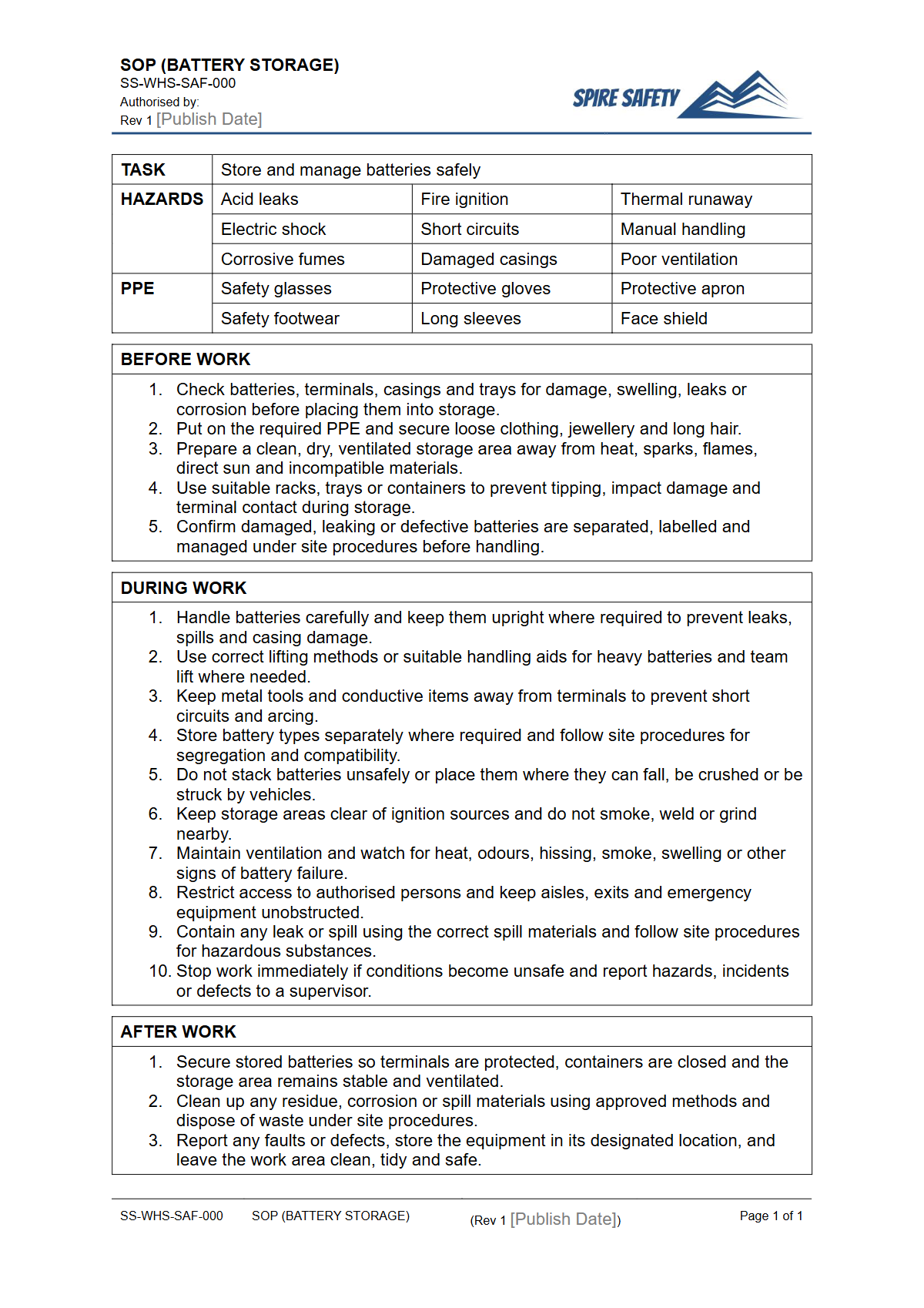
Download our free Safe Operating Procedure (Battery Storage) Template to outline safe work practices for handling and storing batteries.
Free Safe Operating Procedure (Battery Storage) Template
DOCX • 126 KB + PDF
Updated Oct 2026
No signup required
Purpose of the Free Safe Operating Procedure (Battery Storage) Template
Effectively managing the risks associated with battery storage is a critical part of workplace health and safety. From small workshops to large industrial facilities, batteries pose significant hazards, including chemical burns from acid spills, fire and explosion from thermal runaway, electrical shocks, and manual handling injuries.
This Free Safe Operating Procedure (Battery Storage) Template provides a structured framework for documenting step-by-step instructions to control these risks and ensure tasks are performed safely and consistently.
A documented SOP is a key component of a compliant safety system. It serves as a vital tool for training, serves as a benchmark for performance, and demonstrates a commitment to proactive risk management.
Integrating clear procedures like this one is a fundamental part of building robust WHS management systems that protect your workers and your organisation.
Video walkthrough
How to use the Free Safe Operating Procedure (Battery Storage) Template
This document is a template, not a finished procedure. To be effective, it must be customised to reflect the specific battery types, equipment, and unique environment of your workplace.
Download the DOCX file and consult with workers and other stakeholders to add site-specific details, including emergency contacts, makes and models of charging equipment, and required personal protective equipment (PPE).
You should methodically review each section and adapt the content. For example, detail the specific steps for connecting and disconnecting chargers, the location of spill kits, and the procedure for segregating different battery chemistries. This process of customisation is similar for all task-based procedures, whether you are documenting the use of complex machinery or common equipment like an air compressor SOP.
Customisation is Essential
IMPORTANT: This is a template only. You must customise it to suit the specific battery types, charging equipment, storage areas, and legal requirements of your state or territory.
We are not liable for any incidents arising from the use of this document. It is your responsibility to ensure the final SOP is accurate, comprehensive, and fit for purpose.
When to use a Battery Storage Safe Operating Procedure
An SOP for battery storage should be used as a primary reference document for several key activities. It is essential for inducting new employees and for providing refresher training to existing workers, ensuring everyone understands the established safety protocols.
It should also be readily available in the work area for operators to consult before starting a task, particularly for non-routine activities.
The SOP also provides a baseline for workplace inspections and observations. Supervisors can use it to verify that correct procedures are being followed.
Periodically, your entire safety framework should be checked for effectiveness and compliance, a process supported by a formal WHS compliance auditing program.
Who should use this Safe Operating Procedure
This SOP should be used by all personnel involved in the handling, charging, storage, and maintenance of batteries. This includes warehouse staff, mechanics, technicians, and any other workers who interact with battery systems as part of their duties.
The clear, step-by-step format helps ensure a consistent and safe approach across all shifts and teams, much like a plasma cutter SOP does for fabrication tasks.
Supervisors and managers have a responsibility to ensure the SOP is implemented, understood, and followed. They should use it as a tool for training, monitoring work, and conducting incident investigations.
Safety professionals and WHS committees can also use the template to develop and review safety documentation as part of their broader risk management responsibilities. Safely accessing items on storage racks might even require reference to a step ladder SOP to prevent falls.
This document is one of many templates designed to assist Australian businesses in managing their safety obligations. You can explore our complete free WHS resources library for more templates, checklists, and guides.
Common mistakes
Common mistakes to avoid
- Using a generic SOP without customising it for specific battery types and workplace conditions.
- Storing incompatible battery chemistries together or near flammable materials.
- Neglecting to provide or maintain specific fire extinguishers suitable for the battery type (e.g., Class D for lithium-metal fires).
- Failing to adequately train workers on emergency procedures, especially for handling spills and fires.
Legal references
Legal considerations
The following legal requirements may be relevant to this type of work.
- Work Health and Safety Act (Harmonised) — Provides the primary duties for protecting workers and other people from work health and safety risks.
- Work Health and Safety Regulations (Harmonised) — Sets out requirements supporting the management of workplace hazards and risks.
The following codes may be relevant to this type of work.
- Managing WHS Risks Code of Practice — Provides practical guidance on identifying hazards, assessing risks and applying effective controls.
- Work Health and Safety Consultation, Cooperation and Coordination Code of Practice — Provides practical guidance on consulting workers and coordinating with other duty holders.
- Managing the Work Environment and Facilities Code of Practice — Provides practical guidance on safe work environments, workplace facilities and related controls.
Did you know
Thermal Runaway
A single damaged lithium-ion cell can enter an uncontrollable, self-heating state called thermal runaway, releasing flammable gases and reaching temperatures over 700°C, potentially causing a chain reaction in adjacent cells.
Recycling Power
Over 95% of the components in a standard lead-acid battery, including the lead plates, plastic casing, and electrolyte, can be recovered and recycled, making it one of Australia's most successful recycling stories.
FAQ
Frequently asked questions
01What are the main hazards of battery storage?
02Do I need a specific SOP for different battery types like lead-acid vs. lithium-ion?
03How often should a Battery Storage SOP be reviewed?
04Can this template be used for large-scale Battery Energy Storage Systems (BESS)?
Share this resource
Free Safe Operating Procedure (Battery Storage) Template
Browse Categories
How To Use It
- 1Download and open in Word or PDF.
- 2Replace the placeholders with your business details.
- 3Get it reviewed by a WHS specialist before rollout.
Need it customised?
Our WHS consultants can adapt this template to your site, run a gap analysis, or audit what you already have in place.
Book a Free Consultation WHS consulting servicesor call 1300 156 382
Related templates
- Free Safe Operating Procedure (Battery Tester) Template
- Free Safe Operating Procedure (BBQ Area Cleanup) Template
- Free Safe Operating Procedure (Beading Machine) Template
- Free Safe Operating Procedure (Beam Clamp) Template
- Free Safe Operating Procedure (Bearing Puller) Template
- Free Safe Operating Procedure (Beauty Bed Cleaning) Template