
Free Safe Operating Procedure (Battery Tester) Template
Need to formalise the safe use of battery testers? Our free SOP template provides a structured starting point aligned with Australian WHS practices.
Free Safe Operating Procedure (Battery Tester) Template
DOCX • 126 KB + PDF
Updated Oct 2026
No signup required
Purpose of the Free Safe Operating Procedure (Battery Tester) Template
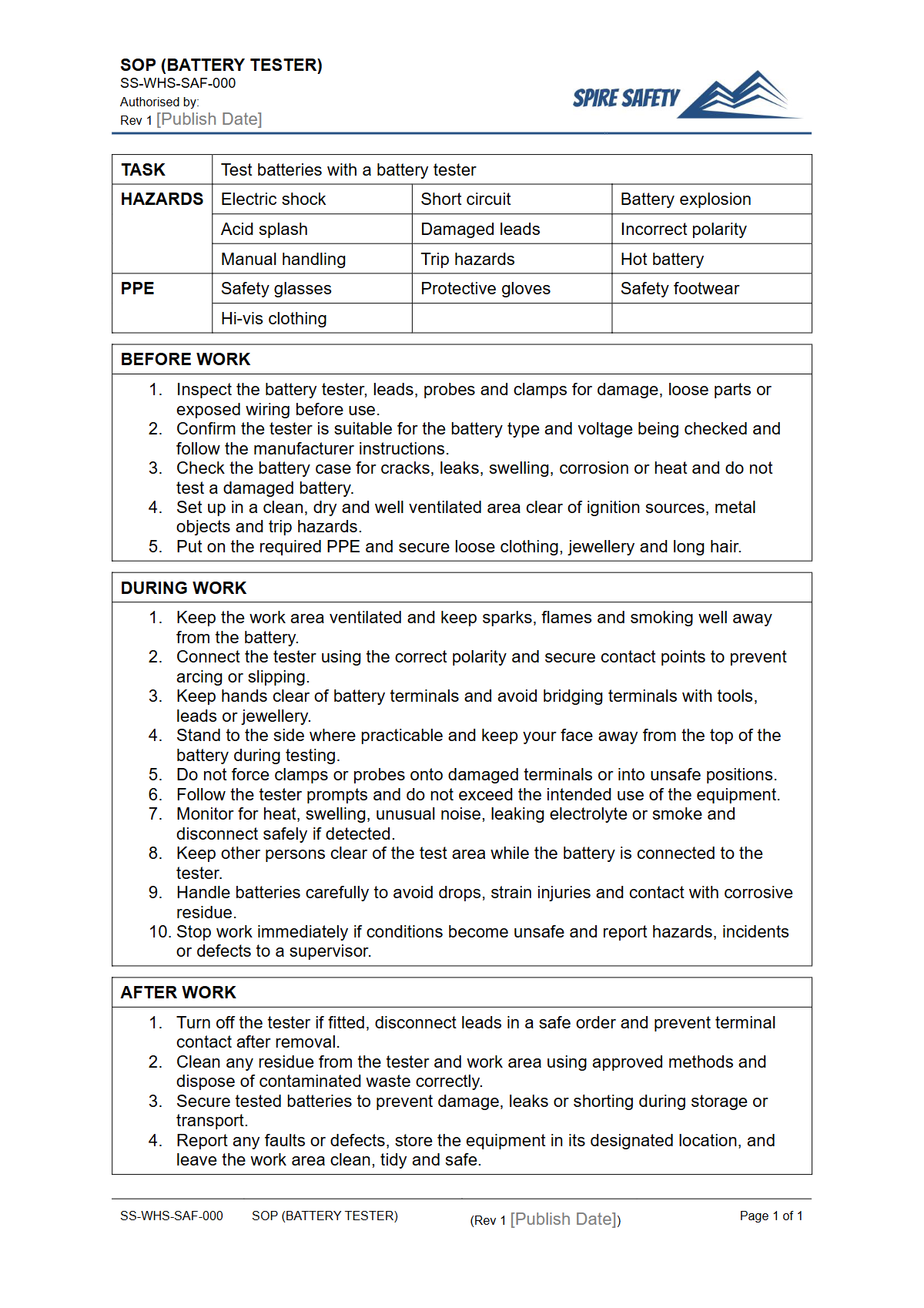
Effectively managing workshop hazards is a critical part of any workplace safety program. This free Safe Operating Procedure (Battery Tester) Template provides a customisable framework for documenting the step-by-step process for safely using battery testing equipment.
Using a battery tester, while a common task, involves significant risks including electric shock, arc flash, chemical burns from battery acid, and potential explosions from ignited hydrogen gas. A formal SOP helps to control these risks by providing clear, consistent instructions for all workers.
Implementing a Safe Operating Procedure for this task ensures that all operators understand the required precautions, personal protective equipment (PPE), and emergency responses. This document serves as a key component in a broader safety framework, demonstrating a commitment to proactive risk management.
Formalising procedures like this is a fundamental part of building robust WHS management systems that protect your team and support your legal obligations.
Video walkthrough
How to use the Free Safe Operating Procedure (Battery Tester) Template
This document is designed as a starting point. To make it effective for your workplace, you must adapt it to your specific context. The process is straightforward:
- Download: Choose between the DOCX and PDF formats.
- Customise: Add your company name and logo. More importantly, detail the specific make and model of the battery tester(s) used on your site. Fill in details about your workshop's layout, ventilation, first aid facilities, and emergency contacts.
- Consult: Discuss the draft procedure with the workers who will be using it. Their direct experience is invaluable for creating a practical and effective document.
- Approve and Train: Once finalised, the SOP should be formally approved by a manager or supervisor. All relevant workers must be trained on the procedure before they are authorised to use the equipment.
- Review: Schedule regular reviews to ensure the SOP remains current.
Please note: This document is a template and must be customised to suit the specific equipment, environment, and tasks in your workplace. We strongly recommend consultation with your team and relevant stakeholders during its development.
Many workshops contain a variety of equipment, each presenting unique hazards. It is best practice to have a distinct SOP for each piece of significant plant or machinery.
For example, alongside this procedure, you might also need an SOP for air compressors to cover all common workshop tasks.
When to use a Safe Operating Procedure
A Safe Operating Procedure for a battery tester should be used as a primary reference document in several situations:
- Pre-Task Planning: Workers should review the SOP before starting work, especially if they perform the task infrequently.
- Worker Training and Induction: The SOP is an essential training tool for new employees or for workers being trained on a new task.
- Refresher Training: It forms the basis for periodic refresher training to prevent complacency and reinforce safe work habits.
- Incident Investigation: Following an incident or near miss involving a battery tester, the SOP should be reviewed to identify any gaps or areas for improvement.
- Audits and Inspections: The procedure serves as a benchmark during internal or external safety audits. An effective program of WHS compliance auditing will verify that documented procedures are being followed in practice.
Who should use it
This Safe Operating Procedure is intended for use by several groups within an organisation:
- Persons Conducting a Business or Undertaking (PCBUs): To meet their primary duty of care to provide and maintain a safe system of work.
- Managers and Supervisors: To train workers, enforce safe work practices, and ensure that equipment is maintained in a safe condition.
- Workers: As a guide to performing the task safely and consistently, and to understand the associated hazards and controls.
- WHS Professionals: To integrate into the overall safety management system and use as a basis for risk assessments and training development.
Safe Operating Procedures are not just for complex, heavy machinery. Everyday tools and tasks can present significant risks if not managed correctly.
Establishing clear procedures for common activities, such as those covered in our step ladder SOP, is just as important for building a comprehensive safety culture. You can find more templates to help manage your workplace risks in our complete free WHS resources library.
Common mistakes
Common mistakes to avoid
- Forgetting to wear appropriate PPE, especially safety glasses or a face shield and insulated gloves.
- Testing batteries in a poorly ventilated area, allowing potentially explosive hydrogen gas to accumulate.
- Using a tester with incorrect settings or one that is not rated for the battery's voltage or chemistry.
- Failing to inspect the tester's leads, clamps, and casing for damage or fraying before each use.
Legal references
Legal considerations
The following legal requirements may be relevant to this type of work.
- Work Health and Safety Act (Harmonised) — Provides the primary duties for protecting workers and other people from work health and safety risks.
- Work Health and Safety Regulations (Harmonised) — Sets out requirements supporting the management of workplace hazards and risks.
The following codes may be relevant to this type of work.
- Managing WHS Risks Code of Practice — Provides practical guidance on identifying hazards, assessing risks and applying effective controls.
- Work Health and Safety Consultation, Cooperation and Coordination Code of Practice — Provides practical guidance on consulting workers and coordinating with other duty holders.
- Managing the Work Environment and Facilities Code of Practice — Provides practical guidance on safe work environments, workplace facilities and related controls.
Did you know
Hydrogen Hazard
Lead-acid batteries can release highly explosive hydrogen gas, especially when being charged or tested under load. A single spark from a poor connection or a dropped tool is enough to ignite the gas and cause a dangerous battery explosion.
Hidden Energy
Even a 'flat' 12V car battery can retain enough energy to cause a severe arc flash or thermal burn if short-circuited. Metal jewellery like rings and watches should always be removed before working on batteries.
FAQ
Frequently asked questions
01What are the main hazards of using a battery tester?
02Is an SOP legally required for a battery tester in Australia?
03How often should a Safe Operating Procedure for a battery tester be reviewed?
04Can I use this template for all types of battery testers and batteries?
Share this resource
Free Safe Operating Procedure (Battery Tester) Template
Browse Categories
How To Use It
- 1Download and open in Word or PDF.
- 2Replace the placeholders with your business details.
- 3Get it reviewed by a WHS specialist before rollout.
Need it customised?
Our WHS consultants can adapt this template to your site, run a gap analysis, or audit what you already have in place.
Book a Free Consultation WHS consulting servicesor call 1300 156 382
Related templates
- Free Safe Operating Procedure (BBQ Area Cleanup) Template
- Free Safe Operating Procedure (Beading Machine) Template
- Free Safe Operating Procedure (Beam Clamp) Template
- Free Safe Operating Procedure (Bearing Puller) Template
- Free Safe Operating Procedure (Beauty Bed Cleaning) Template
- Free Safe Operating Procedure (Bed Alarm Setup) Template