
Free Safe Operating Procedure (Battery Recycling Intake) Template
Download our free Safe Operating Procedure (Battery Recycling Intake) Template.
Free Safe Operating Procedure (Battery Recycling Intake) Template
DOCX • 126 KB + PDF
Updated Oct 2026
No signup required
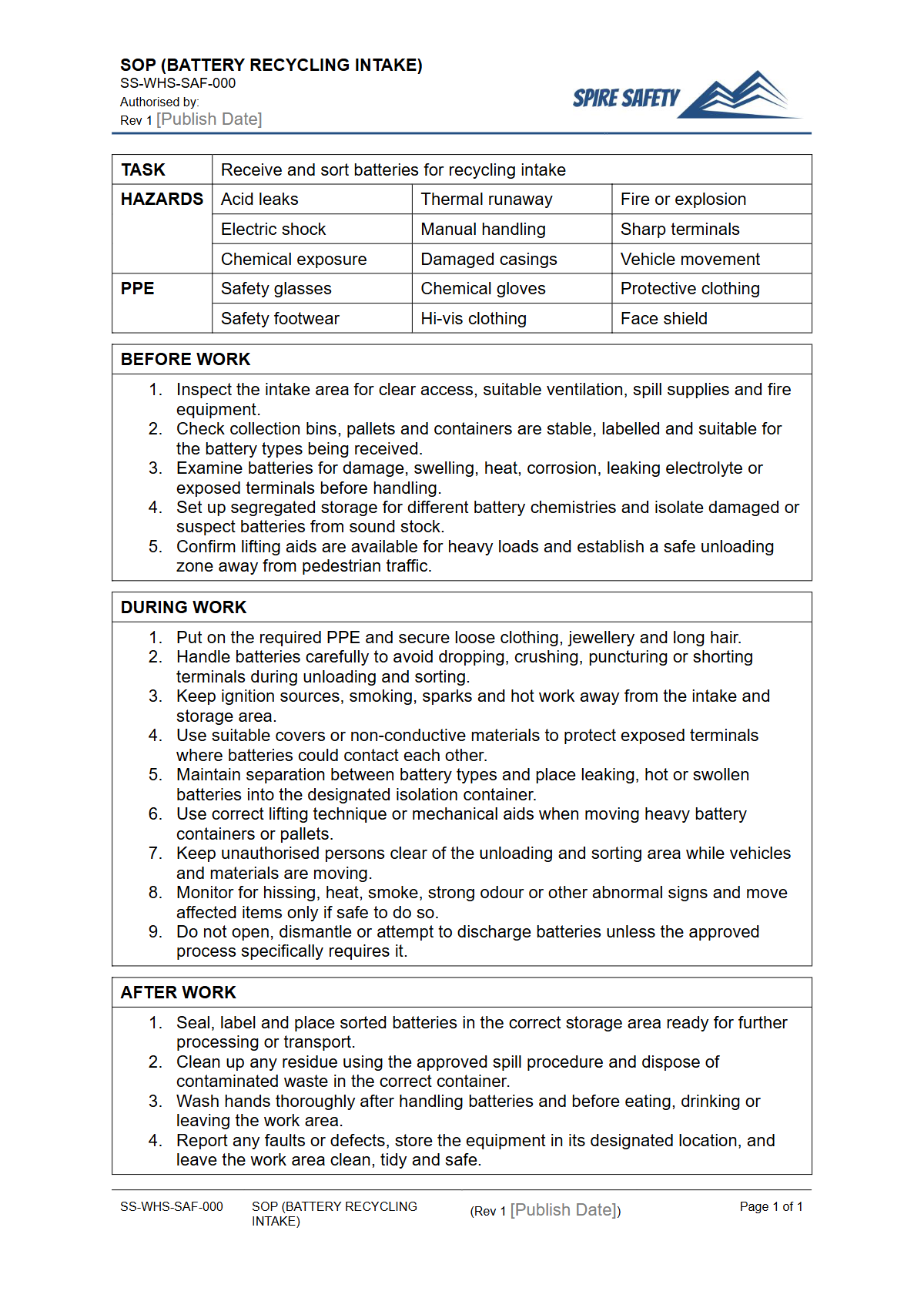
Purpose of the Free Safe Operating Procedure (Battery Recycling Intake) Template
Managing the intake of used batteries for recycling is a high-risk activity that demands a formal, documented process. This free Safe Operating Procedure (Battery Recycling Intake) Template provides a structured starting point for your organisation to outline the required safety controls.
The procedure helps manage significant hazards such as chemical exposure from leaking batteries, fire and explosion risks associated with lithium-ion cells, and musculoskeletal injuries from hazardous manual tasks.
Implementing a clear SOP demonstrates a commitment to worker safety and forms a critical component of your overall safety management system. It ensures that all personnel involved in the battery intake process are aware of the risks and follow a consistent, safe method for every task, from initial receival and inspection to sorting and storage.
This document is designed to be integrated into your existing WHS management systems to help standardise safe work practices.
Video walkthrough
How to use the Free Safe Operating Procedure (Battery Recycling Intake) Template
This document is a template and must be customised to suit the specific circumstances of your workplace. A generic procedure is not sufficient to ensure safety. To use this template effectively, you should:
- Conduct a thorough risk assessment of your battery intake area and processes.
- Incorporate details of your specific equipment, such as battery analysers, spill kits, and fire suppression systems.
- Define the roles and responsibilities for workers, supervisors, and managers.
- Add site-specific emergency procedures, including contact numbers and evacuation plans for battery fires or chemical spills.
- Consult with your workers during the customisation process to ensure the procedure is practical and reflects how the work is actually done.
Important: We strongly recommend that a competent person reviews and customises this document to align with your operational needs and the relevant codes of practice. The finished SOP should be used as a key training tool for all employees involved in the task. If batteries are received via truck, you should also ensure procedures are aligned with documents like our Body Truck SOP.
When to use a Safe Operating Procedure
A Safe Operating Procedure for battery recycling intake should be actively used and referenced in several situations. It is essential for the induction and training of new employees before they are permitted to handle any batteries.
The SOP serves as the foundation for task-specific training and competency assessments.
It should also be used for refresher training for existing staff to reinforce safe practices and communicate any procedural updates. Furthermore, the SOP is a critical reference document during incident investigations, helping to determine if established procedures were followed.
Regularly reviewing and updating the SOP can be prompted by regular WHS compliance audits, which help identify gaps or necessary improvements in your safety processes.
Who should use this SOP
This SOP is intended for use by multiple roles within an organisation handling battery recycling. WHS Managers and Safety Officers will use it as a foundational document to build, implement, and review safety protocols.
Supervisors and Team Leaders are responsible for enforcing the procedure, delivering on-the-job training, and ensuring their teams follow the outlined steps correctly.
Most importantly, workers who directly handle the batteries must use the SOP as their guide for performing tasks safely. Their involvement in its development and review is crucial for its success.
For external support in developing and implementing such critical documents, engaging with specialist WHS consulting services can provide expert guidance. Tasks may also involve working at heights on storage racks, requiring reference to specific procedures like our Step Ladder SOP template.
This template is just one of many professionally developed documents available in our extensive free WHS resources library, designed to support Australian businesses in their safety efforts.
Common mistakes
Common mistakes to avoid
- Mixing different battery chemistries (e.g., lithium-ion with lead-acid) in the same storage container.
- Failing to insulate terminals of lithium-ion batteries, creating a short-circuit and fire risk.
- Using generic manual handling procedures instead of specific ones for heavy or awkwardly shaped batteries.
- Storing damaged or leaking batteries without proper containment, leading to spills and exposure.
Legal references
Legal considerations
The following legal requirements may be relevant to this type of work.
- Work Health and Safety Act (Harmonised) — Provides the primary duties for protecting workers and other people from work health and safety risks.
- Work Health and Safety Regulations (Harmonised) — Sets out requirements supporting the management of workplace hazards and risks.
The following codes may be relevant to this type of work.
- Managing WHS Risks Code of Practice — Provides practical guidance on identifying hazards, assessing risks and applying effective controls.
- Work Health and Safety Consultation, Cooperation and Coordination Code of Practice — Provides practical guidance on consulting workers and coordinating with other duty holders.
- Managing the Work Environment and Facilities Code of Practice — Provides practical guidance on safe work environments, workplace facilities and related controls.
Did you know
Thermal Runaway Risk
A single damaged lithium-ion battery can enter 'thermal runaway', reaching temperatures over 500°C. This can cause a chain reaction, igniting other batteries and creating a significant fire hazard that is very difficult to extinguish.
Lead-Acid Weight
A typical lead-acid car battery weighs between 15 and 25 kg. Repetitively lifting these without proper mechanical aids or team lifting techniques is a leading cause of musculoskeletal injuries in recycling facilities.
FAQ
Frequently asked questions
01What are the main hazards when handling used batteries for recycling?
02Does this SOP cover all types of batteries?
03How often should a Safe Operating Procedure for battery intake be reviewed?
04Who is responsible for training workers on this SOP?
Share this resource
Free Safe Operating Procedure (Battery Recycling Intake) Template
Browse Categories
How To Use It
- 1Download and open in Word or PDF.
- 2Replace the placeholders with your business details.
- 3Get it reviewed by a WHS specialist before rollout.
Need it customised?
Our WHS consultants can adapt this template to your site, run a gap analysis, or audit what you already have in place.
Book a Free Consultation WHS consulting servicesor call 1300 156 382
Related templates
- Free Safe Operating Procedure (Battery Rivet Gun) Template
- Free Safe Operating Procedure (Battery Spill Cleanup) Template
- Free Safe Operating Procedure (Battery Storage) Template
- Free Safe Operating Procedure (Battery Tester) Template
- Free Safe Operating Procedure (BBQ Area Cleanup) Template
- Free Safe Operating Procedure (Beading Machine) Template