
Free Safe Operating Procedure (Battery Rivet Gun) Template
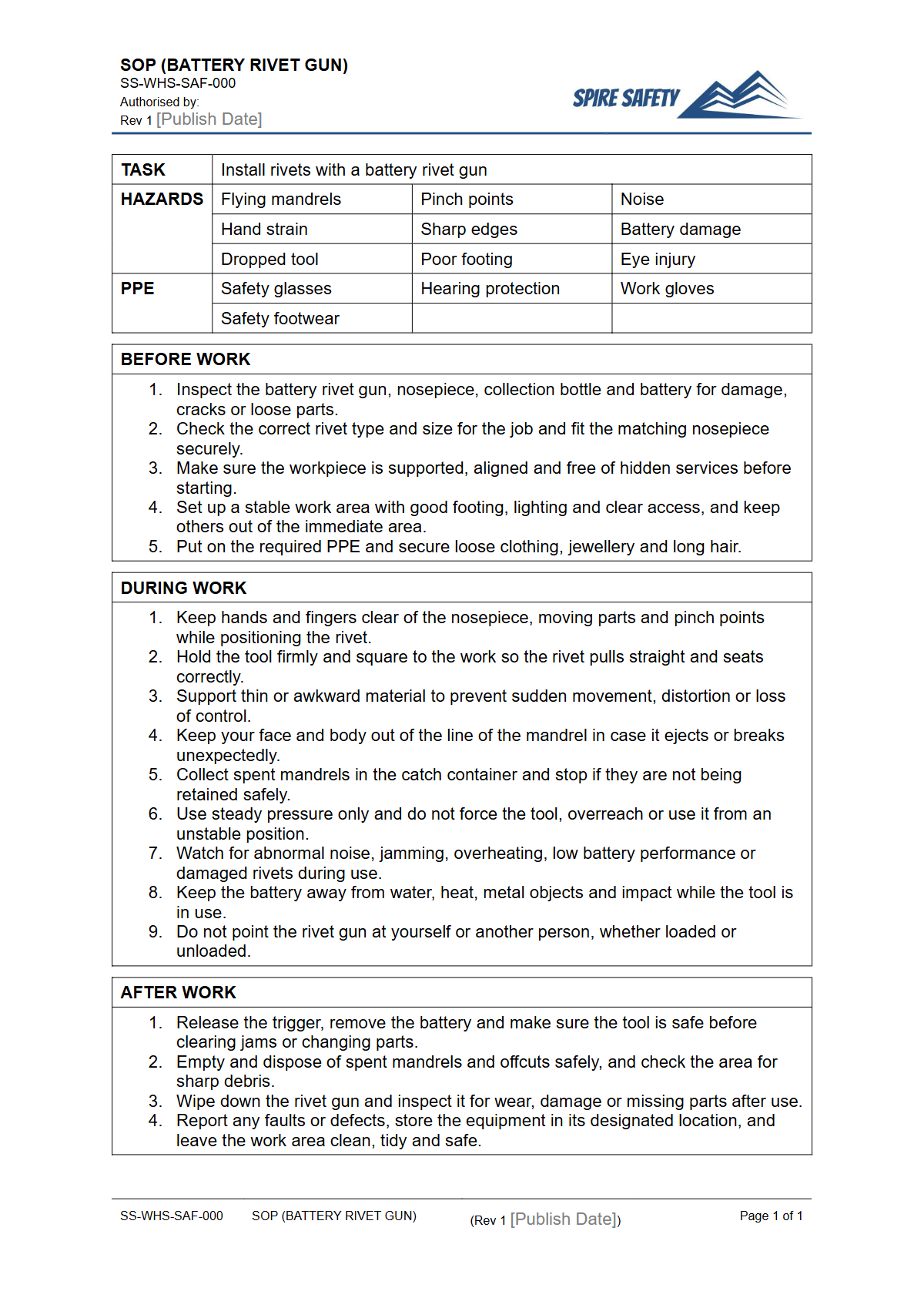
Download our free Safe Operating Procedure (SOP) for battery rivet guns.
Free Safe Operating Procedure (Battery Rivet Gun) Template
DOCX • 126 KB + PDF
Updated Oct 2026
No signup required
Purpose of the Free Safe Operating Procedure (Battery Rivet Gun) Template
A battery rivet gun is a powerful tool used across fabrication, construction, and manufacturing to join materials quickly. However, its operation introduces specific workplace hazards, including projectiles from spent mandrels, ergonomic strain from repetitive use, and risks associated with battery management.
This Free Safe Operating Procedure (Battery Rivet gun) Template provides a structured framework for documenting the required steps to use this equipment safely. Formalising your process helps your organisation meet its primary duty of care by controlling risks and providing clear instructions to workers.
A well-drafted SOP is a critical component of a safe system of work. It details everything from pre-start checks and required Personal Protective Equipment (PPE) to correct operating techniques and post-use cleaning.
Implementing specific procedures for all high-risk equipment is a cornerstone of good safety practice, similar to how one would use a dedicated circular saw SOP to manage the distinct hazards of that tool. This document serves as a clear, repeatable guide to minimise the chance of injury and ensure consistent, safe performance.
Video walkthrough
How to use the Free Safe Operating Procedure (Battery Rivet Gun) Template
This template is designed as a comprehensive starting point, not a finished document. It must be adapted to reflect the specific context of your workplace, including the models of rivet guns in use, the environment they are used in, and your existing safety protocols.
To effectively implement it, download the DOCX file and begin customising the content in consultation with the workers who will be using the equipment. Their direct experience is invaluable for identifying practical risks and effective controls.
Important: We have created this template to be aligned with Australian WHS standards, but it is not a complete, ready-to-use document. You must customise it with your site-specific details, including emergency contacts, specific tool models, and any unique environmental hazards.
Finalise the document by having it reviewed and approved by a competent person within your organisation. Once approved, the SOP should be integrated into your broader WHS management system, forming a key part of your training and operational documentation.
When to use a Battery Rivet Gun SOP
A Safe Operating Procedure for a battery rivet gun should be a central part of the tool's lifecycle in your workplace. It is not a document to be filed away and forgotten.
It should be actively used during worker inductions to ensure new team members understand the correct procedures from day one. It is also an essential tool for delivering specific training and assessing competency before a worker is authorised to use the equipment unsupervised.
The SOP should be readily accessible in the work area for easy reference. It is also a critical document for refresher training to prevent procedural drift and complacency.
Furthermore, it must be reviewed and potentially updated following any incident or near miss involving the tool, or when new models or different types of rivets are introduced. Just as a plasma cutter SOP would be revised after a change in cutting gas or material, this procedure must evolve with your operational needs.
Who should use this SOP
The responsibility for using and enforcing a Safe Operating Procedure is shared across multiple roles within an organisation. A Person Conducting a Business or Undertaking (PCBU) is ultimately responsible for ensuring safe systems of work are in place.
Managers and supervisors have a duty to implement these systems, which includes ensuring workers are trained on the SOP and follow it correctly. They use the SOP as a benchmark for monitoring work and conducting safety observations.
Workers are the primary end-users of the SOP. They must read, understand, and follow the documented procedure every time they operate the battery rivet gun.
They also have a responsibility to report any hazards or suggest improvements to the procedure. Developing and implementing these critical safety documents can be a complex task, and businesses often seek external expertise from WHS consulting professionals to ensure their systems are robust and effective.
Other related procedures, like an air compressor SOP, are often required in the same workshops and follow a similar implementation pathway.
By defining clear steps and responsibilities, this SOP helps create a safer environment for everyone. Explore our complete free WHS resources library for more templates to support your safety management system.
Common mistakes
Common mistakes to avoid
- Using the incorrect size nose piece for the rivet, which can lead to tool jams and dangerous mandrel projectiles.
- Failing to perform pre-start checks, such as inspecting the tool for cracks, loose parts, or a damaged mandrel collector.
- Neglecting to wear mandatory Personal Protective Equipment (PPE), particularly safety glasses with side shields.
- Operating the tool with a bent wrist or in an awkward posture, significantly increasing the risk of ergonomic strain and long-term injury.
Legal references
Legal considerations
The following legal requirements may be relevant to this type of work.
- Work Health and Safety Act (Harmonised) — Provides the primary duties for protecting workers and other people from work health and safety risks.
- Work Health and Safety Regulations (Harmonised) — Sets out requirements supporting the management of workplace hazards and risks.
The following codes may be relevant to this type of work.
- Managing WHS Risks Code of Practice — Provides practical guidance on identifying hazards, assessing risks and applying effective controls.
- Work Health and Safety Consultation, Cooperation and Coordination Code of Practice — Provides practical guidance on consulting workers and coordinating with other duty holders.
- Managing the Work Environment and Facilities Code of Practice — Provides practical guidance on safe work environments, workplace facilities and related controls.
Did you know
Extreme Force
Some high-powered battery rivet guns can generate a pulling force of over 20,000 Newtons (N). This force is essential for setting large structural rivets but also highlights the significant potential for injury if the tool is not used correctly.
Ergonomic Risk
Repetitive use of rivet guns is a well-documented cause of musculoskeletal disorders like carpal tunnel syndrome and tendonitis. Proper tool selection, work-rest cycles, and technique are critical controls outlined in a thorough SOP.
FAQ
Frequently asked questions
01What should be included in a battery rivet gun SOP?
02Is a Safe Operating Procedure a legal requirement in Australia?
03How often should an SOP for a battery rivet gun be reviewed?
04Can a generic power tool SOP be used for a battery rivet gun?
Share this resource
Free Safe Operating Procedure (Battery Rivet Gun) Template
Browse Categories
How To Use It
- 1Download and open in Word or PDF.
- 2Replace the placeholders with your business details.
- 3Get it reviewed by a WHS specialist before rollout.
Need it customised?
Our WHS consultants can adapt this template to your site, run a gap analysis, or audit what you already have in place.
Book a Free Consultation WHS consulting servicesor call 1300 156 382
Related templates
- Free Safe Operating Procedure (Battery Spill Cleanup) Template
- Free Safe Operating Procedure (Battery Storage) Template
- Free Safe Operating Procedure (Battery Tester) Template
- Free Safe Operating Procedure (BBQ Area Cleanup) Template
- Free Safe Operating Procedure (Beading Machine) Template
- Free Safe Operating Procedure (Beam Clamp) Template