
Free Safe Operating Procedure (Battery Load Test) Template
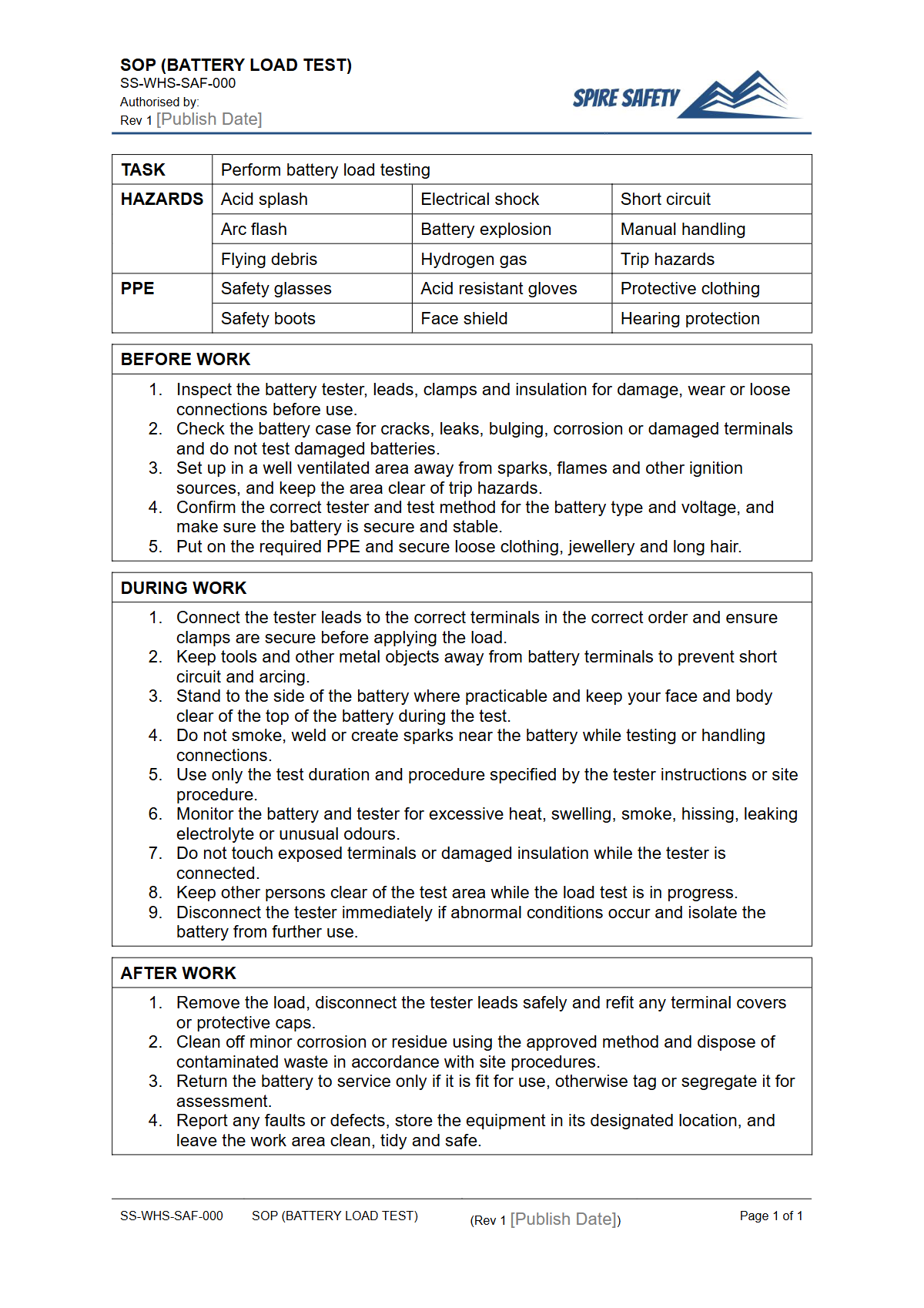
Download our free Safe Operating Procedure (Battery Load Test) template. This customisable DOCX and PDF resource helps outline safe work steps.
Free Safe Operating Procedure (Battery Load Test) Template
DOCX • 126 KB + PDF
Updated Oct 2026
No signup required
Purpose of the Free Safe Operating Procedure (Battery Load Test) Template
This free Safe Operating Procedure (Battery Load Test) template provides a structured framework for businesses to document a safe system of work for testing lead-acid batteries under load. The primary purpose of a Safe Operating Procedure (SOP) is to minimise health and safety risks to workers by providing clear, step-by-step instructions.
Performing a load test involves significant hazards, including electric shock, arc flash, battery explosions from hydrogen gas ignition, and chemical burns from sulphuric acid. A documented SOP ensures that workers follow a consistent, pre-approved process that incorporates all necessary risk controls.
By clearly defining the required PPE, pre-operational checks, task sequence, and emergency procedures, this template helps organisations meet their duty of care. Integrating task-specific SOPs like this one is a fundamental component of effective WHS management systems, demonstrating a proactive approach to workplace safety and risk management.
Video walkthrough
How to use the Free Safe Operating Procedure (Battery Load Test) Template
This document is a template and must be customised to your specific workplace. We have provided a comprehensive starting point, but you are responsible for consulting with your workers and adapting the content to reflect the actual equipment, chemicals, environment, and personnel at your site.
Before use, ensure all sections are reviewed and approved by a competent person. The template guides you through detailing personnel requirements, required PPE (such as safety glasses, face shields, and acid-resistant gloves), risk controls, and a logical sequence for performing the test safely.
Simply download the DOCX file and edit the content to align with your operations. Fill in the site-specific details, equipment models, and emergency contacts.
The process of customising this SOP is similar to how you would adapt other procedural documents, like our Free Air Compressor SOP (Safe Operating Procedure) Template, ensuring it is practical and relevant for your team.
When to use a Safe Operating Procedure
A Safe Operating Procedure for battery load testing should be referenced every time the task is performed, especially by new or less experienced workers. It is essential during routine vehicle or equipment maintenance, when diagnosing electrical system faults, or when verifying the health of new or stored batteries before installation.
This SOP is particularly crucial in environments with a high volume of battery handling, such as automotive workshops, marine service centres, and industrial plant maintenance departments.
The SOP also serves as a valuable training tool during worker induction and for periodic refresher training. It provides a benchmark for safe performance and helps standardise procedures across different shifts or teams. Using a consistent procedure is as important for this task as it is for operating high-energy equipment, which is why we also provide resources like a FREE Plasma Cutter SOP (Safe Operating Procedure) Template.
Who should use this Safe Operating Procedure
This Safe Operating Procedure should be used by any worker tasked with performing battery load tests. This typically includes automotive mechanics, auto electricians, marine technicians, forklift mechanics, and other plant maintenance personnel.
Trainees or apprentices should only perform this task under the direct supervision of a competent and qualified person until they have been assessed as competent themselves. The document can also be used by supervisors and managers to conduct training, assess competency, and carry out workplace inspections or observations.
Ultimately, the information within the SOP is vital for anyone involved in the task, from the person performing the test to the supervisor overseeing the work area. Regular reviews of SOPs and work practices are a key activity during safety assessments, forming part of a comprehensive WHS compliance auditing program to ensure procedures remain effective and are being followed correctly.
Common mistakes
Common mistakes to avoid
- Performing tests in a poorly ventilated area, allowing hydrogen gas to accumulate.
- Connecting or disconnecting the load tester while the battery is still connected to the vehicle's electrical system.
- Failing to wear appropriate PPE, especially eye and face protection.
- Using a load tester that is not rated for the battery's size or type.
Legal references
Legal considerations
The following legal requirements may be relevant to this type of work.
- Work Health and Safety Act (Harmonised) — Provides the primary duties for protecting workers and other people from work health and safety risks.
- Work Health and Safety Regulations (Harmonised) — Sets out requirements supporting the management of workplace hazards and risks.
The following codes may be relevant to this type of work.
- Managing WHS Risks Code of Practice — Provides practical guidance on identifying hazards, assessing risks and applying effective controls.
- Work Health and Safety Consultation, Cooperation and Coordination Code of Practice — Provides practical guidance on consulting workers and coordinating with other duty holders.
- Managing the Work Environment and Facilities Code of Practice — Provides practical guidance on safe work environments, workplace facilities and related controls.
Did you know
Explosive Potential
Lead-acid batteries produce hydrogen and oxygen gas during charging and heavy discharge. This mixture is highly explosive and can be ignited by a single spark, such as one from a poor connection.
Hidden Danger
A battery can have a normal 'open circuit' voltage (12.6V) but still fail a load test. This is because surface charge can mask internal damage or sulphation, making a load test the only reliable way to confirm its health.
FAQ
Frequently asked questions
01What is a battery load test?
02What PPE is required for a battery load test?
03Is this SOP suitable for lithium-ion (Li-ion) batteries?
04Who is considered a 'competent person' to perform a battery load test?
Share this resource
Free Safe Operating Procedure (Battery Load Test) Template
Browse Categories
How To Use It
- 1Download and open in Word or PDF.
- 2Replace the placeholders with your business details.
- 3Get it reviewed by a WHS specialist before rollout.
Need it customised?
Our WHS consultants can adapt this template to your site, run a gap analysis, or audit what you already have in place.
Book a Free Consultation WHS consulting servicesor call 1300 156 382
Related templates
- Free Safe Operating Procedure (Battery Recycling Intake) Template
- Free Safe Operating Procedure (Battery Rivet Gun) Template
- Free Safe Operating Procedure (Battery Spill Cleanup) Template
- Free Safe Operating Procedure (Battery Storage) Template
- Free Safe Operating Procedure (Battery Tester) Template
- Free Safe Operating Procedure (BBQ Area Cleanup) Template