
Free Safe Operating Procedure (Basement Cleaning) Template
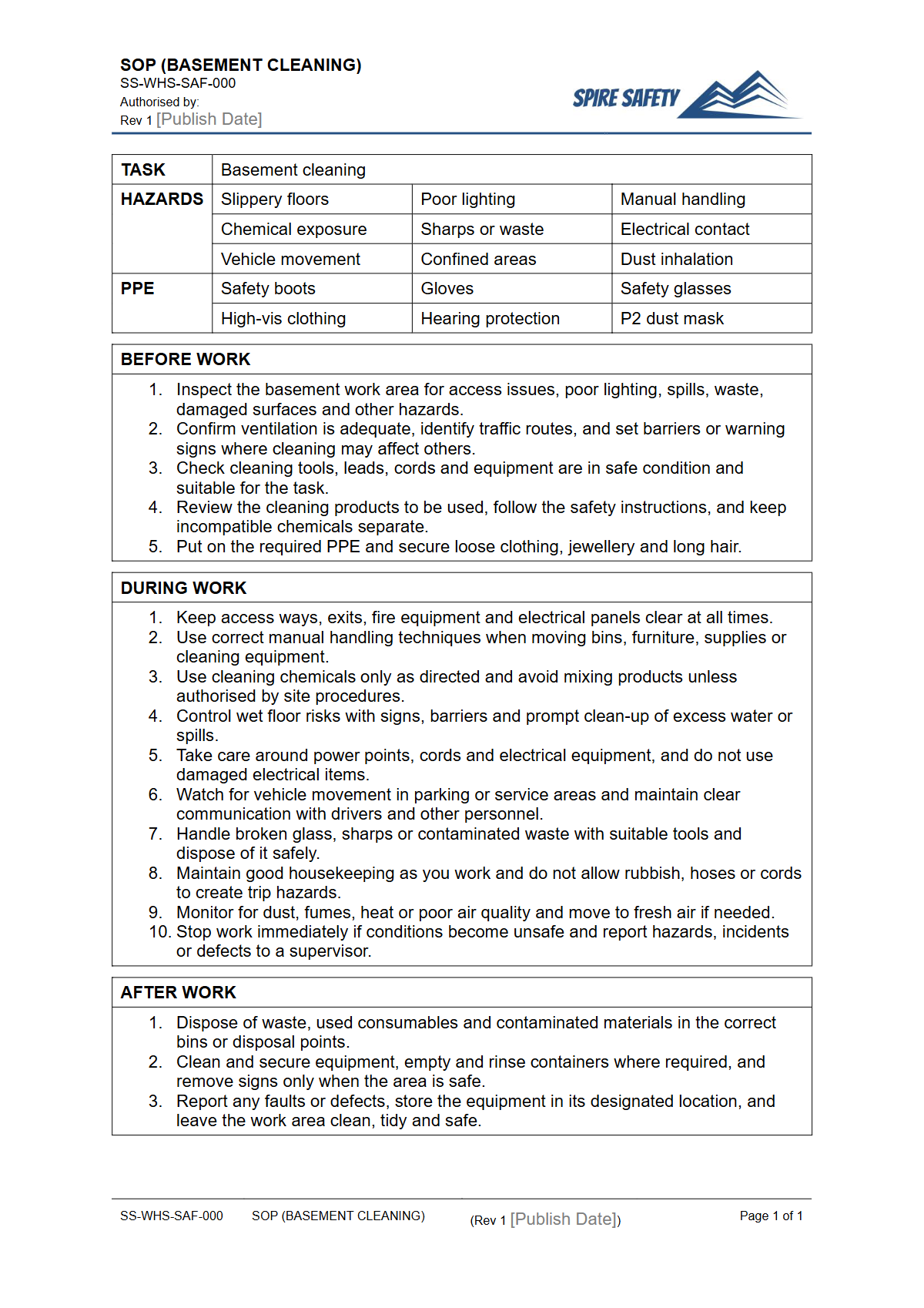
Download our free Safe Operating Procedure (Basement Cleaning) template. This user-friendly DOCX and PDF resource helps outline risks and controls.
Free Safe Operating Procedure (Basement Cleaning) Template
DOCX • 126 KB + PDF
Updated Oct 2026
No signup required
Purpose of the Free Safe Operating Procedure (Basement Cleaning) Template
Effectively managing health and safety during cleaning operations is crucial, and basement environments present unique challenges. Our Free Safe Operating Procedure (Basement Cleaning) Template provides a structured framework for documenting the risks and control measures associated with this task.
It guides you in creating a clear, step-by-step process that helps ensure workers can perform their duties safely and efficiently, minimising the risk of injury from hazards like slips, trips, falls, manual handling, or chemical exposure.
A well-drafted Safe Operating Procedure (SOP) is a fundamental tool for any person conducting a business or undertaking (PCBU). It serves as a practical expression of your commitment to safety, translating risk assessments into actionable instructions.
Implementing robust SOPs is a key component of building comprehensive WHS management systems, demonstrating due diligence and fostering a proactive safety culture within your organisation.
Video walkthrough
How to use the Free Safe Operating Procedure (Basement Cleaning) Template
This template is available in both DOCX and PDF formats for your convenience. The DOCX version is fully editable, allowing you to tailor the content to your specific operational needs.
Simply download the file and open it in a compatible word processor to begin adding your site-specific details, including the types of equipment used, the exact cleaning chemicals on site, and the emergency procedures relevant to your workplace.
Important: This document is a template, not a finished SOP. Before use, you must customise it to reflect your specific workplace environment, equipment, chemicals, and control measures.
We have provided a framework, but you are responsible for ensuring it is site-specific and accurate for your operations. We strongly recommend consulting with the workers who will be performing the tasks during this customisation process.
Your basement cleaning tasks may involve specific equipment that requires its own detailed procedure. For example, if workers need to access high shelves or light fittings, you should ensure they are trained on and have access to a free Step Ladder SOP (Safe Operating Procedure) Template to guide safe use.
When to use it
A Safe Operating Procedure for basement cleaning should be used as a primary training and reference document. It should be readily accessible to all relevant personnel before they undertake the task for the first time.
The SOP forms the basis for worker induction, task-specific training, and competency assessments. It is also a critical reference during incident investigations and regular safety reviews.
The effectiveness of your SOPs should be verified periodically. This can be done through direct observation of work practices or as part of a formal safety audit.
Regular checks ensure the documented procedures are practical, understood, and consistently followed, forming a key part of your WHS compliance auditing program.
Who should use it
This template is designed for use by anyone responsible for workplace safety and operational management. This includes WHS managers, safety officers, team leaders, and supervisors in charge of cleaning or facility maintenance crews.
The final, customised SOP should be used by the frontline workers who perform the basement cleaning tasks, providing them with clear guidance on how to work safely.
Supervisors can use the SOP to ensure consistency in training and to monitor safe work practices. If cleaning involves specialised equipment like high-pressure washers powered by compressed air, you might also require procedures like our free Air Compressor SOP (Safe Operating Procedure) Template to cover all associated hazards.
By clearly defining the safe method for completing a task, you empower your entire team to take ownership of their safety. For more templates and checklists to support your safety management system, browse our complete free WHS resources library.
Common mistakes
Common mistakes to avoid
- Using a generic SOP without site-specific customisation.
- Failing to list the specific Personal Protective Equipment (PPE) for each chemical used.
- Not training workers on the finalised SOP before they start work.
- Neglecting to include emergency procedures for chemical spills or injuries.
Legal references
Legal considerations
The following legal requirements may be relevant to this type of work.
- Work Health and Safety Act (Harmonised) — Provides the primary duties for protecting workers and other people from work health and safety risks.
- Work Health and Safety Regulations (Harmonised) — Sets out requirements supporting the management of workplace hazards and risks.
The following codes may be relevant to this type of work.
- Managing WHS Risks Code of Practice — Provides practical guidance on identifying hazards, assessing risks and applying effective controls.
- Work Health and Safety Consultation, Cooperation and Coordination Code of Practice — Provides practical guidance on consulting workers and coordinating with other duty holders.
- Managing the Work Environment and Facilities Code of Practice — Provides practical guidance on safe work environments, workplace facilities and related controls.
Did you know
Hidden Dangers
Basements can accumulate colourless, odourless gases like radon or carbon monoxide from faulty equipment, making proper ventilation a critical, life-saving control measure.
Slips, Trips & Falls
Slips, trips, and falls are one of the leading causes of workplace injury in Australia, and poorly lit, often cluttered basements present a heightened risk environment.
FAQ
Frequently asked questions
01What hazards are common in basement cleaning?
02Is a Safe Operating Procedure legally required for basement cleaning in Australia?
03How often should a basement cleaning SOP be reviewed?
04Can I use this template for commercial cleaning contracts?
Share this resource
Free Safe Operating Procedure (Basement Cleaning) Template
Browse Categories
How To Use It
- 1Download and open in Word or PDF.
- 2Replace the placeholders with your business details.
- 3Get it reviewed by a WHS specialist before rollout.
Need it customised?
Our WHS consultants can adapt this template to your site, run a gap analysis, or audit what you already have in place.
Book a Free Consultation WHS consulting servicesor call 1300 156 382
Related templates
- Free Safe Operating Procedure (Basement Pump Check) Template
- Free Safe Operating Procedure (Bath Lift) Template
- Free Safe Operating Procedure (Bathroom Aid Cleaning) Template
- Free Safe Operating Procedure (Battery Bank Testing) Template
- Free Safe Operating Procedure (Battery Charging) Template
- Free Safe Operating Procedure (Battery Crimping Tool) Template