
Free Safe Operating Procedure (Battery Bank Testing) Template
Manage electrical hazards effectively with our free Safe Operating Procedure (Battery Bank Testing) Template.
Free Safe Operating Procedure (Battery Bank Testing) Template
DOCX • 126 KB + PDF
Updated Oct 2026
No signup required
Purpose of the Free Safe Operating Procedure (Battery Bank Testing) Template
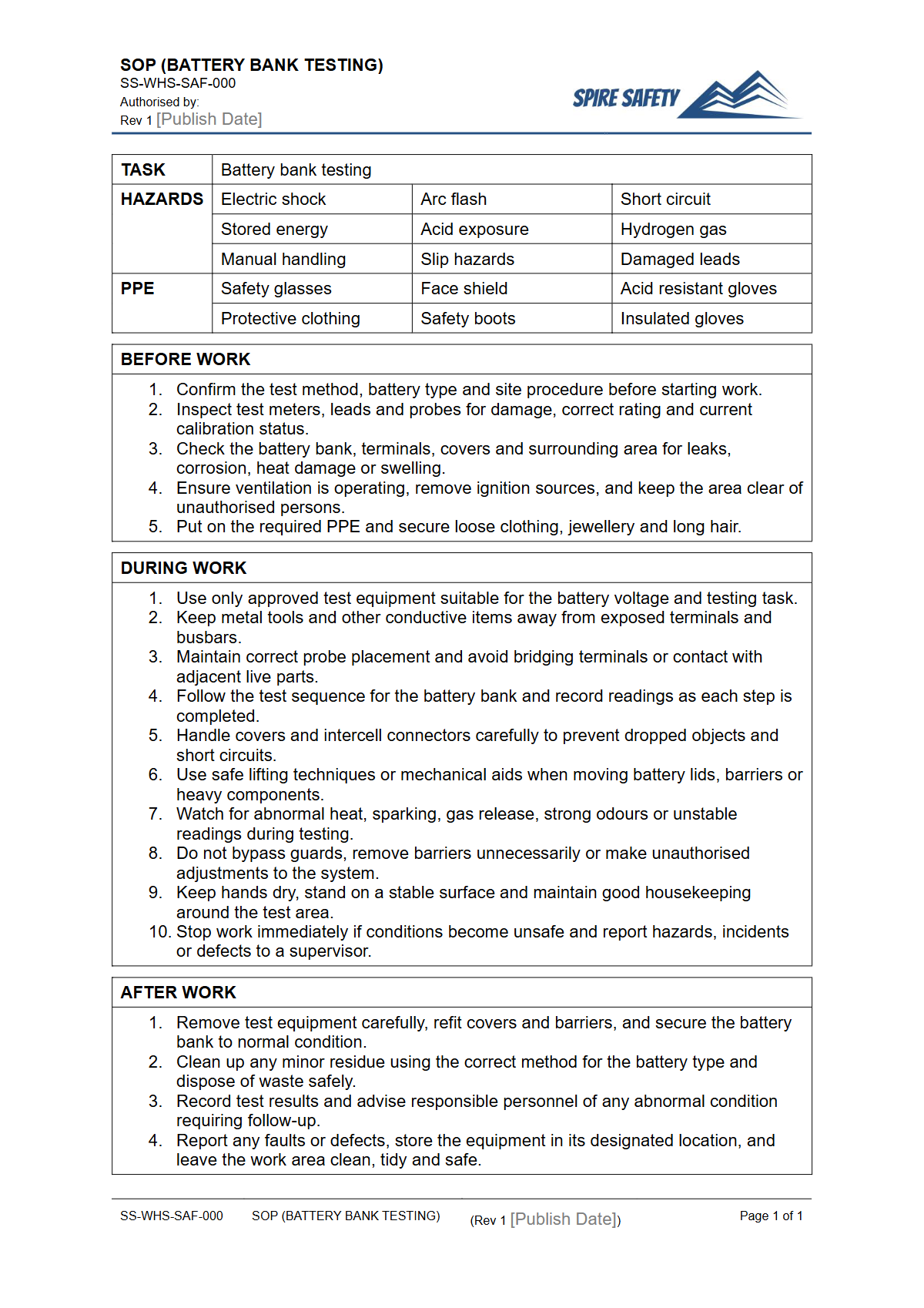
This free Safe Operating Procedure (Battery Bank Testing) template provides a structured framework for businesses to outline the risks and controls associated with testing, maintaining, and inspecting battery banks. Properly managing these tasks is crucial to prevent serious incidents such as electric shock, arc flash, chemical burns from electrolyte, fire, and explosion.
Using this template helps organisations establish and document a consistent, safe method of work, fulfilling a key part of their primary duty of care under Australian WHS laws.
A documented SOP serves as an essential training tool, a reference for competent personnel, and evidence of a formalised risk management process. It guides workers step-by-step, ensuring critical safety checks, personal protective equipment (PPE) requirements, and emergency responses are clearly defined and understood before work begins.
This structured approach is vital for high-risk activities involving stored electrical energy. Developing robust safety documentation can be a core component of your overall framework, which is why many businesses engage with WHS management systems consultants to ensure comprehensive coverage.
Video walkthrough
How to use the Free Safe Operating Procedure (Battery Bank Testing) Template
Our template is a starting point designed for customisation. Download the DOCX or PDF file and adapt it to reflect the specific context of your workplace.
This involves identifying the types of batteries you use (e.g., VRLA, flooded lead-acid, lithium-ion), the specific testing equipment (e.g., multimeter, impedance tester, load tester), and the unique environmental conditions of your site. You must detail your site-specific emergency procedures, including responses to electric shock, chemical spills, and fires.
Important: This document must be customised to your specific workplace, equipment, and processes. We have provided a comprehensive template, but it is your responsibility to ensure the final Safe Operating Procedure is accurate, reflects the actual risks at your site, and is developed in consultation with your workers.
A generic document is not sufficient to control hazards effectively. A periodic WHS compliance auditing program can help verify that your documented procedures are being implemented correctly on the ground.
When to use it
A Safe Operating Procedure for battery bank testing should be used before commencing any related task. It is a critical planning document that forms part of the risk assessment process.
Specifically, it should be reviewed and followed during the commissioning of new battery systems, routine preventative maintenance schedules, and fault-finding or diagnostic activities. It also serves as a foundational document for training new employees or contractors and for conducting periodic competency assessments to ensure skills remain current.
The SOP should be readily available at the location where the work is performed, either as a hard copy or accessible digitally. It is a live document that should be reviewed and updated whenever there is a change in equipment, procedure, personnel, or following any incident or near miss.
For simpler tasks that still carry risk, like accessing equipment on high racking, having specific procedures like a FREE Step Ladder SOP (Safe Operating Procedure) Template is also best practice.
Who should use it
This Safe Operating Procedure is intended for use by competent and authorised personnel who are tasked with working on or near battery banks. This typically includes qualified electricians, specialised battery technicians, and other maintenance workers who have received specific training on the hazards of stored energy and the safe work methods required.
They must be able to demonstrate competence in using the required testing equipment and wearing the correct PPE.
Supervisors, managers, and Persons Conducting a Business or Undertaking (PCBUs) should also use this document to meet their WHS obligations. For them, it is a tool to ensure that a safe system of work has been established, communicated, and implemented.
It provides a benchmark against which to monitor and review work practices, helping to ensure that legal responsibilities for worker safety are being met. The same principles apply to other high-risk workshop tasks, which should also be covered by documents like a FREE Plasma Cutter SOP (Safe Operating Procedure) Template.
By standardising procedures for various pieces of equipment, you build a more robust and predictable safety culture. For instance, the safety principles for electrical isolation in this SOP can be adapted from those used for other common workshop machinery. You can explore examples of this in our Free Air Compressor SOP (Safe Operating Procedure) Template and across our entire free WHS resources library.
Common mistakes
Common mistakes to avoid
- Using uninsulated tools or wearing metallic jewellery (rings, watches) which can cause a short circuit.
- Failing to wear appropriate electrical PPE, such as insulated gloves, eye protection, and arc-rated clothing.
- Neglecting to perform a thorough risk assessment before starting work.
- Working alone on energised or potentially live battery systems without a safety observer.
Legal references
Legal considerations
The following legal requirements may be relevant to this type of work.
- Work Health and Safety Act (Harmonised) — Provides the primary duties for protecting workers and other people from work health and safety risks.
- Work Health and Safety Regulations (Harmonised) — Sets out requirements supporting the management of workplace hazards and risks.
The following codes may be relevant to this type of work.
- Managing WHS Risks Code of Practice — Provides practical guidance on identifying hazards, assessing risks and applying effective controls.
- Work Health and Safety Consultation, Cooperation and Coordination Code of Practice — Provides practical guidance on consulting workers and coordinating with other duty holders.
- Managing the Work Environment and Facilities Code of Practice — Provides practical guidance on safe work environments, workplace facilities and related controls.
Did you know
Arc Flash Temperatures
An arc flash can produce temperatures exceeding 20,000°C, which is hotter than the surface of the sun. This extreme heat can cause severe burns and vaporise metal tools and components instantly.
Stored Energy
Even a small 12-volt car battery can deliver hundreds of amps, enough to cause a serious arc flash or start a fire if short-circuited. Large commercial battery banks store significantly more energy, posing a massive and potentially lethal hazard if not handled correctly.
FAQ
Frequently asked questions
01What are the main hazards of battery bank testing?
02Is this SOP template suitable for all types of batteries?
03Who is qualified to perform battery bank testing?
04Why is a Lockout/Tagout (LOTO) procedure important for battery testing?
Share this resource
Free Safe Operating Procedure (Battery Bank Testing) Template
Browse Categories
How To Use It
- 1Download and open in Word or PDF.
- 2Replace the placeholders with your business details.
- 3Get it reviewed by a WHS specialist before rollout.
Need it customised?
Our WHS consultants can adapt this template to your site, run a gap analysis, or audit what you already have in place.
Book a Free Consultation WHS consulting servicesor call 1300 156 382
Related templates
- Free Safe Operating Procedure (Battery Charging) Template
- Free Safe Operating Procedure (Battery Crimping Tool) Template
- Free Safe Operating Procedure (Battery Load Test) Template
- Free Safe Operating Procedure (Battery Recycling Intake) Template
- Free Safe Operating Procedure (Battery Rivet Gun) Template
- Free Safe Operating Procedure (Battery Spill Cleanup) Template