
Free Safe Operating Procedure (Bath Lift) Template
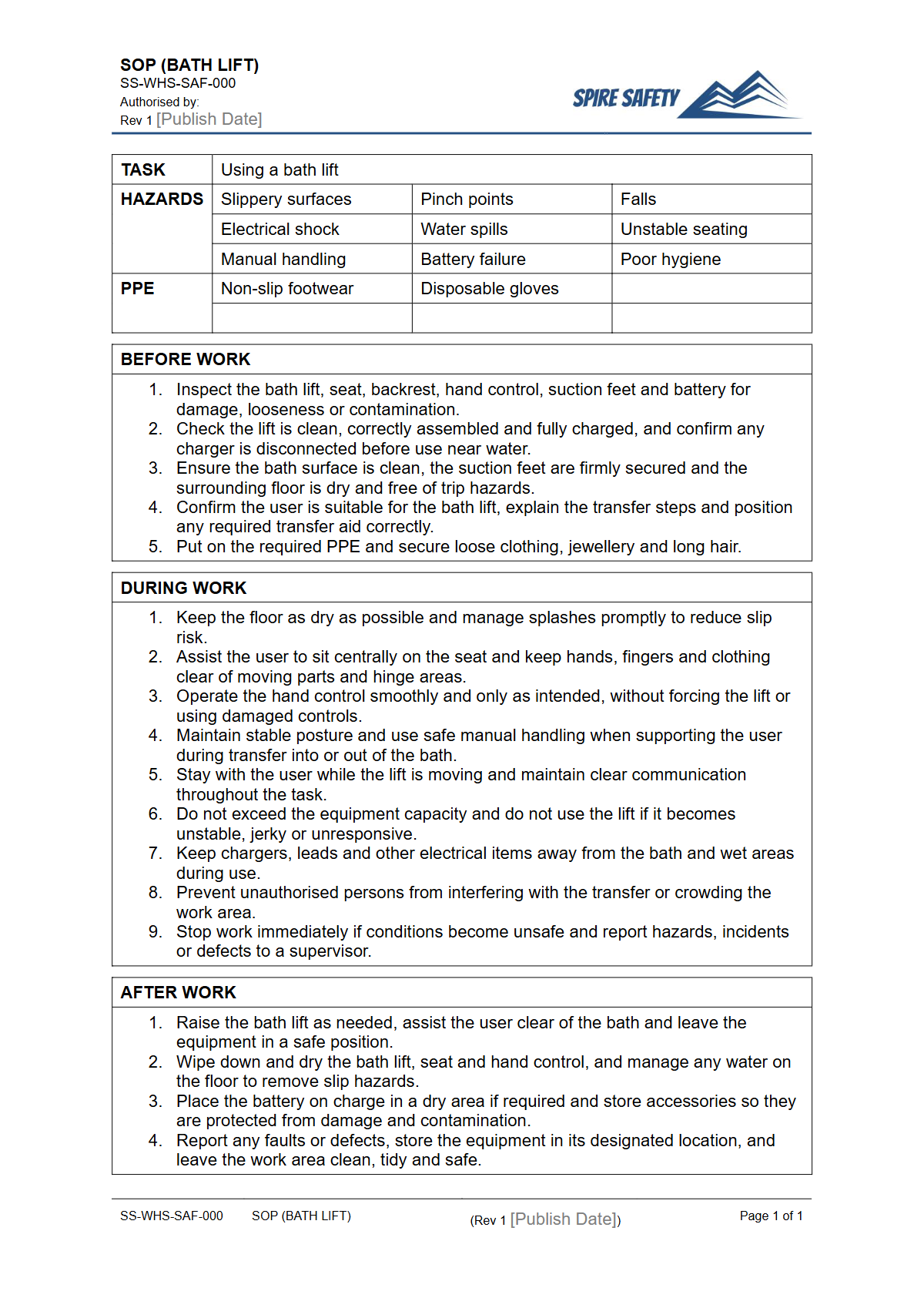
Download our Free Safe Operating Procedure (Bath Lift) Template to manage risks associated with patient lifting.
Free Safe Operating Procedure (Bath Lift) Template
DOCX • 126 KB + PDF
Updated Oct 2026
No signup required
Purpose of the Free Safe Operating Procedure (Bath Lift) Template
Using a bath lift involves significant risks for both care providers and patients if not performed correctly. This Free Safe Operating Procedure (Bath Lift) Template provides a structured framework for documenting the required safety measures, operational steps, and emergency protocols.
Implementing a formal SOP helps reduce the risk of manual handling injuries, ensures consistency in care delivery, and demonstrates a commitment to workplace health and safety. It serves as an essential tool for training, risk management, and operational guidance in healthcare, aged care, and disability support settings.
A well-defined SOP is a cornerstone of a proactive safety culture. It transforms assumed knowledge into a clear, repeatable process that new and existing staff can follow.
By standardising the use of bath lifts, your organisation can minimise errors, protect vulnerable individuals, and ensure equipment is used as intended by the manufacturer. This document is a critical component of your overall safety framework, helping you meet your duty of care obligations under Australian WHS legislation.
Video walkthrough
How to use the Free Safe Operating Procedure (Bath Lift) Template
This template is provided in both DOCX and PDF formats. The DOCX file is fully editable, allowing you to add your company branding and tailor the content to your specific equipment and workplace environment.
The PDF version can be used as a quick reference or for distribution once your customisations are complete.
Important: This is a template, not a finished document. To be effective, you must adapt it to the unique context of your workplace.
This includes referencing the specific make and model of your bath lift, incorporating details from your own risk assessments, and adding site-specific emergency contact information. A generic procedure is not sufficient; customisation is essential for creating a truly useful safety tool. Developing robust documentation like this is a key part of building effective WHS management systems.
Key Components of a Bath Lift SOP
Our template prompts you to detail several critical areas to form a comprehensive procedure. These include:
- Hazard Identification: Listing potential risks such as mechanical failure, slips and falls, crush injuries, and musculoskeletal strain.
- Personal Protective Equipment (PPE): Specifying required PPE, such as non-slip footwear and gloves.
- Pre-Operational Checks: A checklist to verify the lift is in safe working order before each use, including checking batteries, slings, and emergency stop functions.
- Step-by-Step Instructions: A clear, sequential guide for preparing the patient, operating the lift, and completing the transfer safely.
- Post-Operational Tasks: Instructions for cleaning, charging, and storing the equipment correctly.
- Emergency Procedures: Outlining the exact steps to take in case of a malfunction, power failure, or medical emergency during a transfer.
Ensuring these SOPs are actively used and correctly implemented is a common focus during safety reviews. Regular internal checks or external WHS compliance auditing can help verify that documented procedures are being followed in practice, identifying any gaps between policy and reality.
When to Use This Safe Operating Procedure
A Safe Operating Procedure for a bath lift should be a living document integrated into your daily operations. It is most effectively used during:
- Staff Training and Induction: As a primary training tool for new employees to ensure they understand the correct, safe method from day one.
- Refresher Training: For periodic retraining to prevent complacency and reinforce safe work habits.
- Pre-Task Reference: As a quick guide for workers to consult before performing the task, especially if it is not a daily activity for them.
- Incident Investigations: To review procedures and identify contributing factors after an incident or near miss.
Documented procedures should extend to all equipment that poses a risk, not just complex machinery. For instance, even simple items can cause serious injury if used incorrectly, which is why we also provide resources like our FREE Step Ladder SOP Template.
Who Should Use This SOP
This SOP is designed for any person conducting a business or undertaking (PCBU) where bath lifts are used. Key personnel who will use and benefit from this document include:
- Direct Care Workers: Nurses, aged care workers, and disability support staff who operate the equipment daily.
- WHS Managers and Officers: To integrate the procedure into the broader safety management system and use it for risk management activities.
- Facility and Maintenance Managers: To ensure maintenance schedules and pre-use checks align with operational requirements.
- Supervisors and Team Leaders: To oversee staff, conduct competency assessments, and enforce safe work practices.
If you require assistance in adapting this template or developing more complex safety documentation for your healthcare or support facility, our team of specialists can provide expert WHS consulting to ensure your procedures are practical and effective.
By implementing this SOP, you create a safer environment for everyone. Feel free to explore our free WHS resources library for other templates and tools to support your safety goals.
Common mistakes
Common mistakes to avoid
- Using a generic template without customising it for the specific bath lift model and workplace environment.
- Failing to include clear, step-by-step emergency procedures for equipment malfunction or power failure.
- Neglecting to train all relevant workers on the finalised SOP and verify their competency.
- Forgetting to integrate a schedule for regular equipment inspection, maintenance, and record-keeping into the procedure.
Legal references
Legal considerations
The following legal requirements may be relevant to this type of work.
- Work Health and Safety Act (Harmonised) — Provides the primary duties for protecting workers and other people from work health and safety risks.
- Work Health and Safety Regulations (Harmonised) — Sets out requirements supporting the management of workplace hazards and risks.
The following codes may be relevant to this type of work.
- Managing WHS Risks Code of Practice — Provides practical guidance on identifying hazards, assessing risks and applying effective controls.
- Work Health and Safety Consultation, Cooperation and Coordination Code of Practice — Provides practical guidance on consulting workers and coordinating with other duty holders.
- Managing the Work Environment and Facilities Code of Practice — Provides practical guidance on safe work environments, workplace facilities and related controls.
Did you know
A High-Risk Industry
The 'Health care and social assistance' industry has one of the highest rates of serious workers' compensation claims in Australia. Body stressing from hazardous manual tasks, like patient handling, remains a primary cause of these injuries.
FAQ
Frequently asked questions
01What is a Safe Operating Procedure for a bath lift?
02Who is responsible for writing a bath lift SOP?
03How often should a bath lift SOP be reviewed?
04Does using a bath lift eliminate all manual handling risks?
Share this resource
Free Safe Operating Procedure (Bath Lift) Template
Browse Categories
How To Use It
- 1Download and open in Word or PDF.
- 2Replace the placeholders with your business details.
- 3Get it reviewed by a WHS specialist before rollout.
Need it customised?
Our WHS consultants can adapt this template to your site, run a gap analysis, or audit what you already have in place.
Book a Free Consultation WHS consulting servicesor call 1300 156 382
Related templates
- Free Safe Operating Procedure (Bathroom Aid Cleaning) Template
- Free Safe Operating Procedure (Battery Bank Testing) Template
- Free Safe Operating Procedure (Battery Charging) Template
- Free Safe Operating Procedure (Battery Crimping Tool) Template
- Free Safe Operating Procedure (Battery Load Test) Template
- Free Safe Operating Procedure (Battery Recycling Intake) Template