
Free Safe Operating Procedure (Bathroom Aid Cleaning) Template
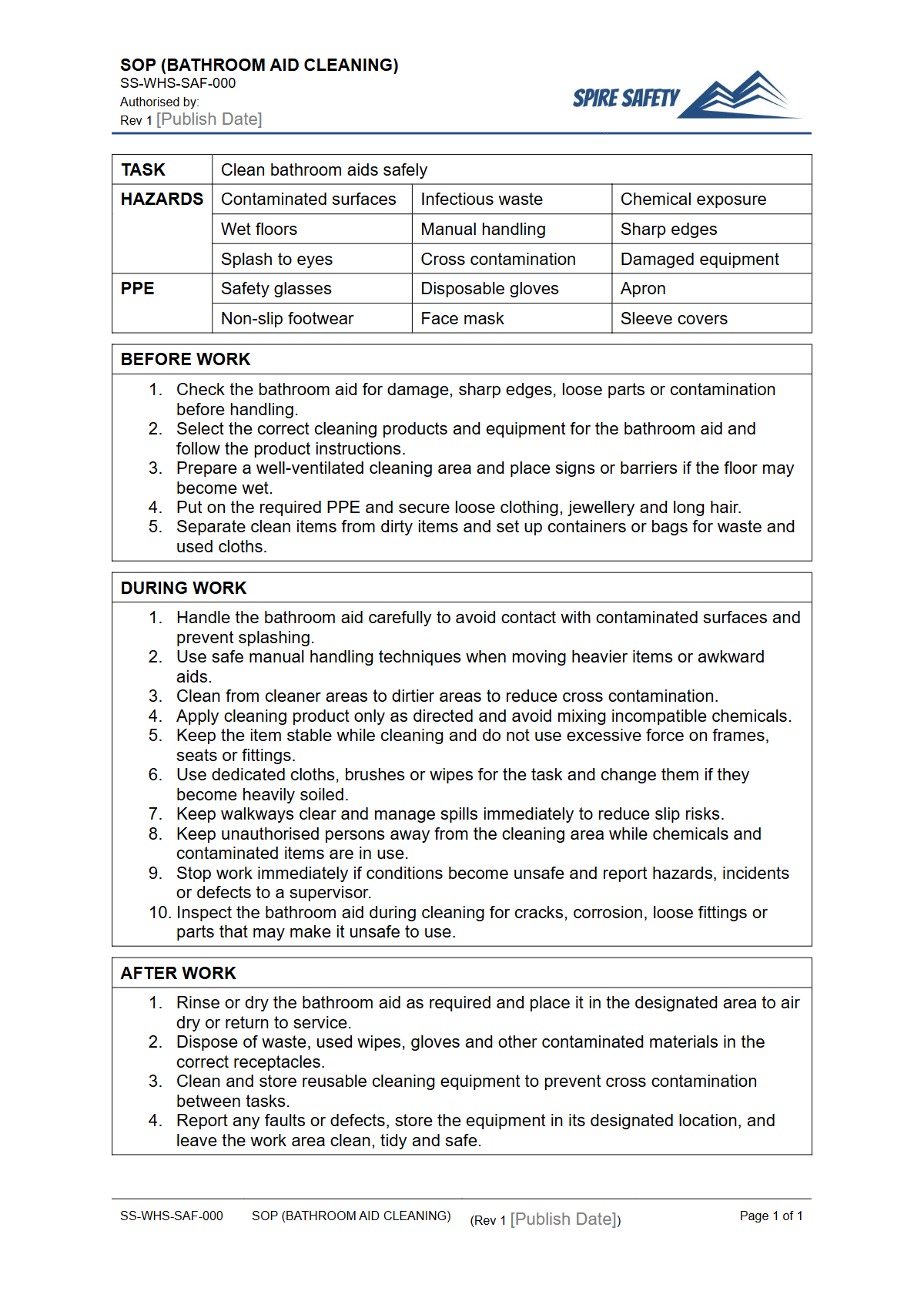
Download our free Safe Operating Procedure (Bathroom Aid Cleaning) template. A structured starting point for aged care and healthcare WHS. Get your DOCX now.
Free Safe Operating Procedure (Bathroom Aid Cleaning) Template
DOCX • 126 KB + PDF
Updated Oct 2026
No signup required
Purpose of the Free Safe Operating Procedure (Bathroom Aid Cleaning) Template
This Safe Operating Procedure (SOP) provides a structured framework for safely cleaning and disinfecting bathroom aids such as commodes, shower chairs, toilet seat raisers, and mobility aids. The primary purpose of this Free Safe Operating Procedure (Bathroom Aid Cleaning) Template is to minimise the risk of injury and illness to workers in healthcare, aged care, and disability support environments.
It addresses key hazards associated with the task, including exposure to biological hazards, manual handling risks when moving equipment, and the safe use of cleaning chemicals.
By establishing a clear, step-by-step process, this SOP helps ensure consistent and effective infection control, protecting both staff and vulnerable clients or residents. A documented procedure is a critical component of risk management, demonstrating that a Person Conducting a Business or Undertaking (PCBU) has provided clear instruction for a routine but hazardous task.
It forms an essential part of your broader safety framework and can be integrated into comprehensive WHS management systems to ensure a holistic approach to workplace safety.
Video walkthrough
How to use the Free Safe Operating Procedure (Bathroom Aid Cleaning) Template
Our template is provided in both DOCX and PDF formats for your convenience. The DOCX file is fully editable, allowing you to adapt it to the specific requirements of your facility.
It is crucial to tailor the document with details relevant to your workplace, including the specific types of bathroom aids used, the exact cleaning and disinfectant chemicals on site, required Personal Protective Equipment (PPE), and emergency contact information.
A generic procedure is not sufficient to manage your WHS obligations. To be effective, this document must be customised to your specific workplace.
We have included prompts within the template for you to add your site-specific details, such as equipment models, chemical names, PPE standards, and emergency protocols. Once customised, the SOP should be used to train all relevant staff and be made easily accessible in the areas where cleaning occurs.
When to use this Safe Operating Procedure
This SOP should be followed every time a worker is required to clean and disinfect a bathroom aid. This includes routine daily or weekly cleaning schedules, as well as immediate cleaning required after use or a contamination event.
The procedure serves as a critical training tool for new employees and a reference guide for experienced staff to ensure consistency and adherence to safety standards.
Furthermore, the SOP should be referenced during safety inductions, toolbox talks, and risk assessments related to hygiene and infection control. Regular review of the procedure, ideally annually or whenever a process changes, is essential.
This can be incorporated into your schedule of regular WHS compliance audits to verify that the documented steps are still relevant and effective.
Who should use this Safe Operating Procedure
This SOP is designed for use by all personnel involved in the cleaning and maintenance of client or resident equipment. This typically includes personal care assistants (PCAs), healthcare workers, support workers, and dedicated cleaning or housekeeping staff.
It provides them with clear, unambiguous instructions to perform their duties safely and effectively.
Supervisors and managers should also use this document to facilitate training, monitor performance, and investigate any incidents related to the task. For organisations needing assistance in developing or implementing robust procedures for complex care environments, engaging specialist WHS consulting can provide valuable expertise.
When preparing the cleaning area, workers may need to retrieve supplies from storage; if items are kept on high shelving, a separate Safe Operating Procedure for step ladder use should also be followed.
This template is one of many documents available to help you build a safer workplace. You can explore our complete free WHS resources library for more templates, checklists, and guides.
Common mistakes
Common mistakes to avoid
- Using incorrect or improperly diluted cleaning chemicals.
- Failing to wear the specified Personal Protective Equipment (PPE), particularly gloves and eye protection.
- Not allowing for the required disinfectant contact time, reducing its effectiveness.
- Poor manual handling techniques when lifting or moving heavy or awkward aids like shower commodes.
Legal references
Legal considerations
The following legal requirements may be relevant to this type of work.
- Work Health and Safety Act (Harmonised) — Provides the primary duties for protecting workers and other people from work health and safety risks.
- Work Health and Safety Regulations (Harmonised) — Sets out requirements supporting the management of workplace hazards and risks.
The following codes may be relevant to this type of work.
- Managing WHS Risks Code of Practice — Provides practical guidance on identifying hazards, assessing risks and applying effective controls.
- Work Health and Safety Consultation, Cooperation and Coordination Code of Practice — Provides practical guidance on consulting workers and coordinating with other duty holders.
- Managing the Work Environment and Facilities Code of Practice — Provides practical guidance on safe work environments, workplace facilities and related controls.
Did you know
Infection Control
Healthcare-Associated Infections (HAIs) are a significant risk in aged care and hospital settings. Proper cleaning and disinfection of shared equipment, guided by a clear SOP, is a primary defence against the spread of pathogens.
Chemical Contact Time
Many disinfectants require a specific 'contact time'—the period they must remain wet on a surface to effectively kill germs. Wiping a surface dry too soon can render the disinfection process ineffective.
FAQ
Frequently asked questions
01What PPE is required for cleaning bathroom aids?
02How often should a Safe Operating Procedure be reviewed?
03Can this SOP template be used for all cleaning chemicals?
04Who is responsible for training staff on this SOP?
Share this resource
Free Safe Operating Procedure (Bathroom Aid Cleaning) Template
Browse Categories
How To Use It
- 1Download and open in Word or PDF.
- 2Replace the placeholders with your business details.
- 3Get it reviewed by a WHS specialist before rollout.
Need it customised?
Our WHS consultants can adapt this template to your site, run a gap analysis, or audit what you already have in place.
Book a Free Consultation WHS consulting servicesor call 1300 156 382
Related templates
- Free Safe Operating Procedure (Battery Bank Testing) Template
- Free Safe Operating Procedure (Battery Charging) Template
- Free Safe Operating Procedure (Battery Crimping Tool) Template
- Free Safe Operating Procedure (Battery Load Test) Template
- Free Safe Operating Procedure (Battery Recycling Intake) Template
- Free Safe Operating Procedure (Battery Rivet Gun) Template