
Free Safe Operating Procedure (Banquet Chair Handling) Template
Minimise manual handling risks in hospitality and events with our Safe Operating Procedure for banquet chair handling. Download your free template today.
Free Safe Operating Procedure (Banquet Chair Handling) Template
DOCX • 126 KB + PDF
Updated Oct 2026
No signup required
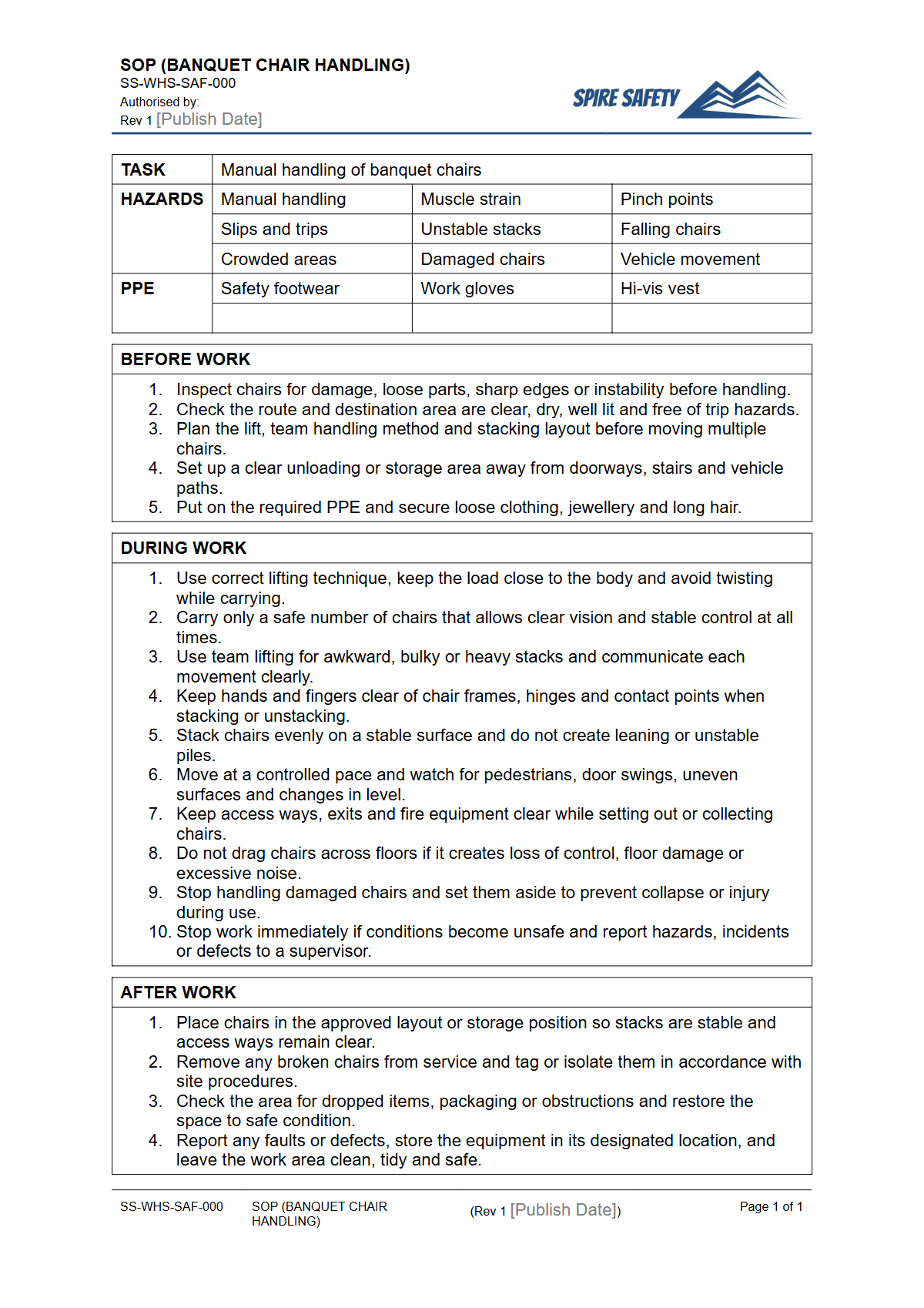
Purpose of the Free Safe Operating Procedure (Banquet Chair Handling) Template
Manually moving, stacking, and setting up banquet chairs is a common task in the hospitality and events industry, but it carries significant risk of musculoskeletal injury. This Free Safe Operating Procedure (Banquet Chair Handling) Template provides a structured framework for documenting a safe system of work.
Its primary purpose is to help organisations reduce the risk of sprains, strains, and back injuries associated with hazardous manual tasks. By outlining clear, step-by-step instructions, this SOP helps standardise safe work practices across all staff.
A well-implemented SOP ensures that every worker, from new hires to experienced team leaders, understands the recognised safe methods for lifting, carrying, and stacking chairs. It details pre-operational checks, the correct use of mechanical aids like chair trolleys, and emergency procedures.
Using this template helps demonstrate a commitment to worker safety and forms an essential component of a comprehensive WHS management system, providing documented evidence of risk control measures.
Video walkthrough
How to use the Free Safe Operating Procedure (Banquet Chair Handling) Template
This resource is available for immediate download in both DOCX and PDF formats. The DOCX file is fully editable, allowing you to adapt the content to your specific operational needs.
The PDF version is useful for quick printing and distribution once you have finalised your procedure.
To effectively use this Safe Operating Procedure for Banquet Chair Handling, you should begin by assessing your unique workplace environment. Identify the types of banquet chairs in use, the trolleys or equipment available, the layout of the storage and function areas, and the competency levels of your staff.
Use this information to populate and refine the sections within the template, adding site-specific details, setting safe stacking limits, and assigning responsibilities.
IMPORTANT: This document is a template and must be customised to be effective. We have provided a structured starting point based on Australian WHS principles, but you must ensure the final SOP reflects the specific hazards and control measures relevant to your workplace.
If you require assistance with risk assessments or procedure customisation, our WHS consulting team can provide expert support.
When to use it
This SOP should be used as a primary reference document for all tasks involving the handling of banquet chairs. It is most effective when integrated into daily operations and training cycles.
Use it during the induction of new employees to establish safe behaviour from day one. It also serves as an excellent tool for pre-start meetings or toolbox talks before a major event setup or pack-down, allowing supervisors to brief the team on the required safety measures.
Furthermore, the procedure should be reviewed periodically or whenever there is a change in equipment, environment, or work methods. Its use is not just for physical tasks; it is also a planning tool for event managers and a reference for supervisors monitoring work practices.
For complex setups, this document can be used alongside other procedures, similar to how a team might reference a FREE Step Ladder SOP Template before retrieving items from high shelving.
Who should use it
This Safe Operating Procedure is designed for a broad range of personnel within any organisation that handles banquet chairs. This includes:
- Event and hospitality staff: The primary users who perform the manual tasks and need to follow the procedure to ensure their own safety and the safety of others.
- Supervisors and Team Leaders: Responsible for enforcing the SOP, training staff, and monitoring compliance on the floor.
- Venue and Operations Managers: Accountable for ensuring adequate risk controls are in place and that resources (like functional chair trolleys) are available.
- WHS Officers and Representatives: Use the SOP as part of workplace inspections, incident investigations, and safety training programs. A completed and implemented SOP can also serve as crucial evidence of proactive risk management during a WHS compliance audit.
By providing clear guidelines, the SOP empowers all individuals to take responsibility for safety, fostering a stronger health and safety culture within the organisation. For more guidance and templates, you can explore our complete free WHS resources library.
Common mistakes
Common mistakes to avoid
- Attempting to carry too many chairs at once to save time.
- Using poor lifting technique, such as bending from the back instead of using the legs.
- Creating chair stacks that are too high, unstable, or block emergency exits.
- Neglecting to use available mechanical aids like chair trolleys or carts.
Legal references
Legal considerations
The following legal requirements may be relevant to this type of work.
- Work Health and Safety Act (Harmonised) — Provides the primary duties for protecting workers and other people from work health and safety risks.
- Work Health and Safety Regulations (Harmonised) — Sets out requirements supporting the management of workplace hazards and risks.
The following codes may be relevant to this type of work.
- Managing WHS Risks Code of Practice — Provides practical guidance on identifying hazards, assessing risks and applying effective controls.
- Work Health and Safety Consultation, Cooperation and Coordination Code of Practice — Provides practical guidance on consulting workers and coordinating with other duty holders.
- Managing the Work Environment and Facilities Code of Practice — Provides practical guidance on safe work environments, workplace facilities and related controls.
Did you know
Manual Handling Injuries
Musculoskeletal disorders resulting from hazardous manual tasks are the most common type of workplace injury in Australia, representing a major proportion of all serious workers' compensation claims.
FAQ
Frequently asked questions
01What are the main WHS hazards of handling banquet chairs?
02How many chairs can be safely stacked and moved at once?
03Is an SOP legally required for handling banquet chairs in Australia?
04Can I use this template for other types of chairs?
Share this resource
Free Safe Operating Procedure (Banquet Chair Handling) Template
Browse Categories
How To Use It
- 1Download and open in Word or PDF.
- 2Replace the placeholders with your business details.
- 3Get it reviewed by a WHS specialist before rollout.
Need it customised?
Our WHS consultants can adapt this template to your site, run a gap analysis, or audit what you already have in place.
Book a Free Consultation WHS consulting servicesor call 1300 156 382
Related templates
- Free Safe Operating Procedure (Banquet Trolley Use) Template
- Free Safe Operating Procedure (Bar Glass Handling) Template
- Free Safe Operating Procedure (Bar Ice Well Cleaning) Template
- Free Safe Operating Procedure (Bar Keg Changeover) Template
- Free Safe Operating Procedure (Barber Chair Cleaning) Template
- Free Safe Operating Procedure (Bare Root Planting) Template