
Free Safe Operating Procedure (Banquet Trolley Use) Template
Download our free Safe Operating Procedure (Banquet Trolley Use) template. This customisable DOCX and PDF helps you outline safe work practices.
Free Safe Operating Procedure (Banquet Trolley Use) Template
DOCX • 126 KB + PDF
Updated Oct 2026
No signup required
Purpose of the Free Safe Operating Procedure (Banquet Trolley Use) Template
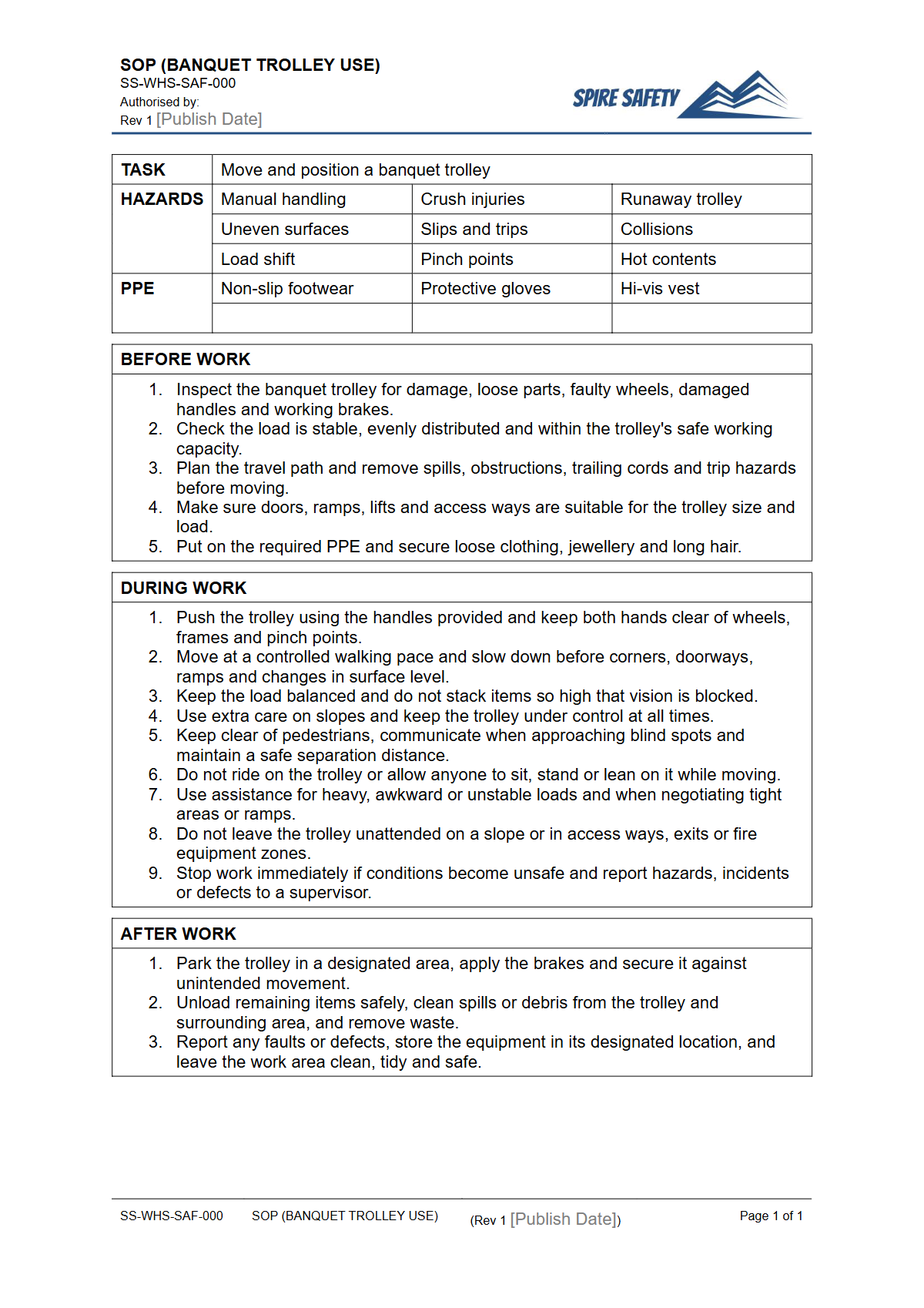
The primary purpose of this Safe Operating Procedure is to help Persons Conducting a Business or Undertaking (PCBUs) fulfil their duty of care. It provides a clear, step-by-step guide for workers on how to safely inspect, load, move, and unload banquet trolleys.
Implementing a specific SOP helps to minimise the risk of musculoskeletal injuries, burns, and other incidents. This document serves as a critical component within comprehensive WHS management systems, demonstrating a commitment to proactive risk management and worker safety.
Video walkthrough
How to use the Free Safe Operating Procedure (Banquet Trolley Use) Template
This document is provided as a fully editable Microsoft Word (DOCX) file, with a PDF version also available, allowing for easy customisation. To use it effectively, you must adapt the content to reflect the specific conditions of your workplace.
This includes adding details about your particular banquet trolley models, the typical loads they carry, the routes they travel (including ramps or uneven surfaces), and the specific control measures your site has in place.
Important: We have provided a framework based on common Australian WHS principles. You must review, edit, and add site-specific information to this template to ensure it is relevant and effective for your organisation’s unique operational risks.
It is not a complete, out-of-the-box solution.
Key Areas to Customise
- Equipment Specifics: List the make and model of your trolleys. Note whether they are heated or non-heated and their load capacity.
- Task Procedures: Detail your specific process for loading hot boxes, securing items, and navigating tight corners or doorways.
- Risk Controls: Document your specific controls, such as designated pathways, 'push, don't pull' policies, and team lifting requirements for heavy loads.
- Emergency Procedures: Outline steps to take in case of a major spill, a tipped trolley, or an equipment fire.
When to use this Safe Operating Procedure
A SOP for banquet trolley use should be a central part of your daily operations and safety training. It should be used during worker induction and onboarding, as the basis for practical training sessions, and as a refresher tool for existing staff.
It is also essential to review and refer back to the SOP following any incident or near miss involving a trolley. The effectiveness of your procedures should be verified through regular WHS compliance auditing to ensure they remain current and effective.
Who should use this SOP
This document is intended for multiple roles within an organisation:
- Managers and Supervisors: To ensure they understand the approved procedure, train their staff correctly, and supervise work effectively.
- WHS/HSE Professionals: To integrate the procedure into the broader safety management system and use it as a basis for risk assessments.
- Workers: As a direct reference guide on how to perform their tasks safely. All staff required to operate banquet trolleys must be trained on the contents of the finalised SOP.
For organisations needing assistance to tailor this document or develop other complex procedures, engaging with specialist WHS consulting services can provide expert guidance and ensure robust risk control.
Key Safety Considerations for Banquet Trolley Use
Before any use, a quick pre-operational check is vital. This includes inspecting the wheels for damage or debris, testing the brakes to ensure they hold firm, and checking the structural integrity of the trolley.
When loading, always place heavier items at the bottom to maintain a low centre of gravity and prevent tipping. When moving through a venue, workers should maintain clear visibility, use spotters for blind corners if necessary, and communicate clearly with colleagues and guests.
While handling trolleys is a primary task, remember to consider associated risks in the work area. For instance, if items need to be retrieved from high shelving in a storeroom, ensure a proper procedure is followed, which might be detailed in a separate document like a free step ladder SOP template.
Explore More WHS Resources
This banquet trolley SOP is one of many documents available to help you build a safer workplace. By implementing clear, practical procedures, you empower your team to manage risks effectively.
Browse our complete free WHS resources library for more templates, checklists, and guides to support your safety management system.
Common mistakes
Common mistakes to avoid
- Assuming the trolley's brakes are always effective without checking before use.
- Pushing the trolley with an obstructed view, significantly increasing collision risk.
- Failing to clean up spills from the trolley immediately, creating slip hazards for others.
- Loading the trolley in a top-heavy manner, making it unstable and prone to tipping.
Legal references
Legal considerations
The following legal requirements may be relevant to this type of work.
- Work Health and Safety Act (Harmonised) — Provides the primary duties for protecting workers and other people from work health and safety risks.
- Work Health and Safety Regulations (Harmonised) — Sets out requirements supporting the management of workplace hazards and risks.
The following codes may be relevant to this type of work.
- Managing WHS Risks Code of Practice — Provides practical guidance on identifying hazards, assessing risks and applying effective controls.
- Work Health and Safety Consultation, Cooperation and Coordination Code of Practice — Provides practical guidance on consulting workers and coordinating with other duty holders.
- Managing the Work Environment and Facilities Code of Practice — Provides practical guidance on safe work environments, workplace facilities and related controls.
Did you know
Manual Handling Risk
Musculoskeletal disorders from hazardous manual tasks are a leading cause of serious workers' compensation claims in Australia. Banquet trolleys, when heavily loaded, can weigh over 150kg, posing a significant risk.
FAQ
Frequently asked questions
01What are the main hazards of using a banquet trolley?
02Is a Safe Operating Procedure for a banquet trolley legally required?
03How often should we review our banquet trolley SOP?
04Can I use this template for other types of trolleys?
Share this resource
Free Safe Operating Procedure (Banquet Trolley Use) Template
Browse Categories
How To Use It
- 1Download and open in Word or PDF.
- 2Replace the placeholders with your business details.
- 3Get it reviewed by a WHS specialist before rollout.
Need it customised?
Our WHS consultants can adapt this template to your site, run a gap analysis, or audit what you already have in place.
Book a Free Consultation WHS consulting servicesor call 1300 156 382
Related templates
- Free Safe Operating Procedure (Bar Glass Handling) Template
- Free Safe Operating Procedure (Bar Ice Well Cleaning) Template
- Free Safe Operating Procedure (Bar Keg Changeover) Template
- Free Safe Operating Procedure (Barber Chair Cleaning) Template
- Free Safe Operating Procedure (Bare Root Planting) Template
- Free Safe Operating Procedure (Barrel Handling) Template