
Free Safe Operating Procedure (Bandsaw - Meat Processing) Template
Streamline safety in your meat processing facility with our free Safe Operating Procedure (SOP) for bandsaws. Download your free DOCX and PDF template now.
Free Safe Operating Procedure (Bandsaw - Meat Processing) Template
DOCX • 156 KB + PDF
Updated Oct 2026
No signup required
Purpose of the Free Safe Operating Procedure (Bandsaw - Meat Processing) Template
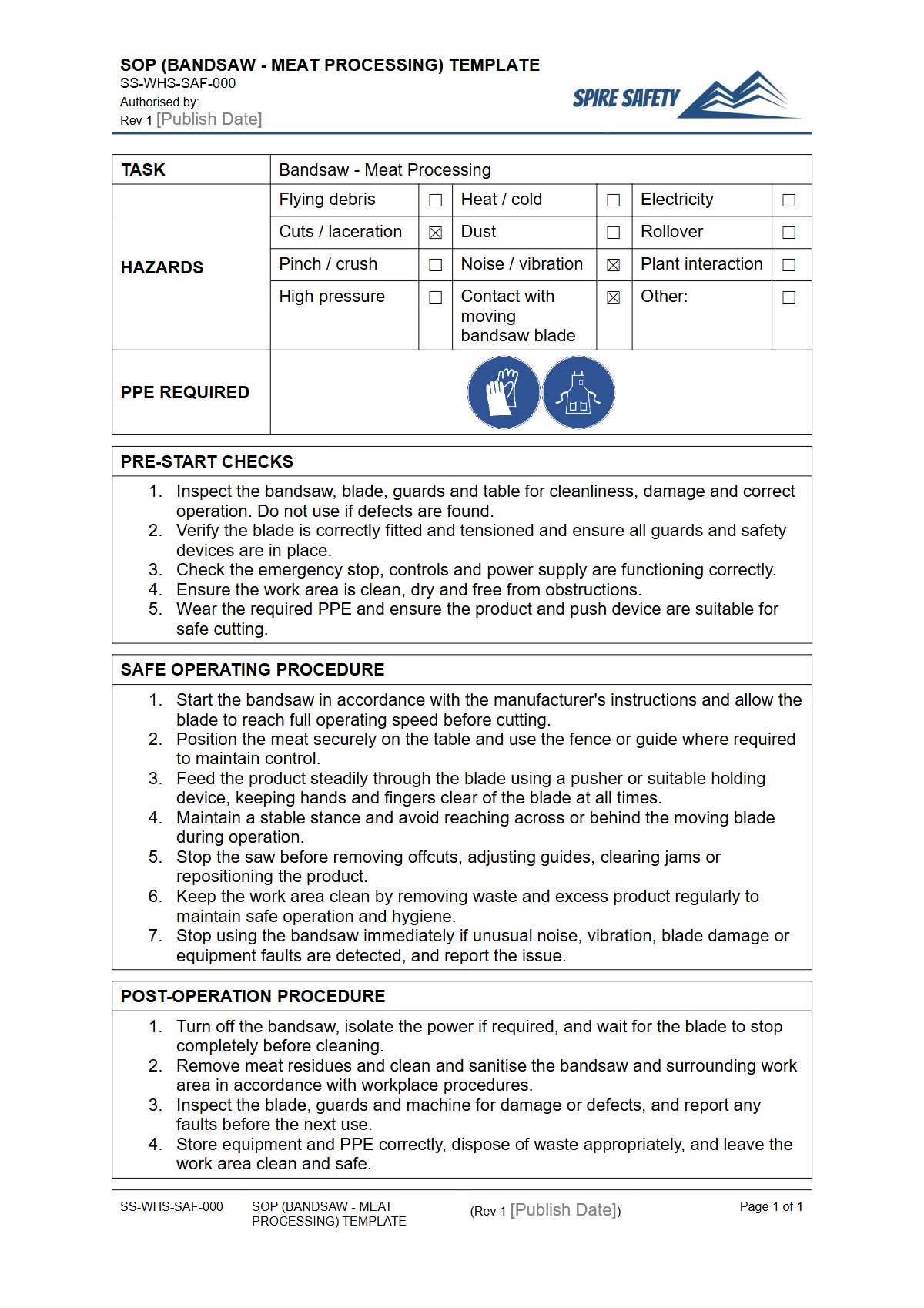
Operating a bandsaw in a meat processing environment presents significant risks, including severe cuts, amputations, and musculoskeletal injuries. This Free Safe Operating Procedure (Bandsaw - Meat Processing) Template provides a structured framework to help your organisation manage these hazards effectively.
It is designed to formalise the steps required for the safe operation, cleaning, and maintenance of meat bandsaws, creating a safer work environment for all employees. Documenting these processes helps standardise performance, assists in training new workers, and demonstrates a commitment to managing workplace health and safety risks.
A well-developed SOP is a critical component of a comprehensive WHS management system. It acts as an administrative control measure, forming a key part of your overall risk management strategy. By clearly outlining pre-operational checks, specific operational steps, emergency procedures, and cleaning protocols, this template helps you systematically address the primary hazards associated with bandsaw use.
This structured approach supports your legal duty of care to provide a safe system of work and can be a vital tool during safety inductions and ongoing competency assessments.
Video walkthrough
How to use the Free Safe Operating Procedure (Bandsaw - Meat Processing) Template
This resource is available for download in both DOCX and PDF formats. The DOCX version is fully editable, allowing you to tailor the content to the specific requirements of your workplace.
The PDF version provides a clean, ready-to-print copy for immediate reference. To use the template effectively, download the DOCX file and begin customising it with information specific to your business, including your company name, the specific make and model of the bandsaw, and the unique environmental conditions of your processing area.
Important: This document is a template and must be customised to your workplace. We have not been to your site or assessed your specific equipment and processes.
Therefore, you must conduct a site-specific risk assessment and adapt the content of this Safe Operating Procedure to reflect the actual machinery, tasks, and control measures in place at your facility. This ensures the final document is relevant, practical, and effective for your workers.
Failure to customise the SOP can render it ineffective and may not adequately control the risks present.
When to use a Safe Operating Procedure for a Meat Bandsaw
A Safe Operating Procedure for a meat bandsaw should be developed, implemented, and referenced before any worker is permitted to operate the equipment. It is a foundational document for training and competency.
Specifically, the SOP should be used during the induction and training of new employees to ensure they understand the hazards and required controls from day one. It should also be a central part of any refresher training programs to reinforce safe work habits among experienced staff.
Furthermore, the SOP must be reviewed and updated following any incident or near-miss, whenever a new bandsaw is introduced, or when work processes are modified.
Regular reviews of your procedures are essential to ensure they remain current and effective. A formal WHS compliance audit can help identify gaps in your safety systems, including the practical application and effectiveness of your SOPs.
This process ensures your safety documentation evolves with your business and continues to meet best practice standards.
Who should use this SOP Template
This Safe Operating Procedure template is intended for a broad range of personnel within a food processing or butchery business. Primarily, it is for the operators of the bandsaw, who must understand and follow the prescribed steps to perform their work safely.
Supervisors and managers are responsible for ensuring the SOP is implemented correctly, that workers are adequately trained, and that compliance is monitored. WHS officers or safety managers can use this template as part of their broader safety framework to ensure consistency and to facilitate risk assessments and training development.
While this procedure is specific to meat bandsaws, the principles of documenting safe operation are universal for high-risk bladed equipment. For tasks involving different types of machinery, you may need other specific procedures.
For instance, in a construction or workshop context, our free Circular Saw SOP template would be a more suitable starting point. Using the correct, task-specific SOP is crucial for effective risk management.
If your organisation requires assistance in developing and implementing a suite of tailored SOPs, engaging professional WHS consulting can provide expert guidance.
By implementing a robust SOP for your meat bandsaw, you create a safer, more predictable, and more efficient work environment. This not only protects your team but also reinforces a positive safety culture. For more templates and safety documents, you can browse our complete free WHS resources library.
Common mistakes
Common mistakes to avoid
- Failing to use a push stick or guide, bringing hands too close to the blade.
- Operating the bandsaw with a dull, damaged, or incorrect type of blade.
- Bypassing or removing fixed guards and other safety interlocks.
- Inadequate cleaning procedures that lead to bacterial growth or leave the machine in an unsafe state.
Legal references
Legal considerations
The following legal requirements may be relevant to this type of work.
- Work Health and Safety Act (Harmonised) — Provides the primary duties for protecting workers and other people from work health and safety risks.
- Work Health and Safety Regulations (Harmonised) — Sets out requirements supporting the management of workplace hazards and risks.
The following codes may be relevant to this type of work.
- Managing WHS Risks Code of Practice — Provides practical guidance on identifying hazards, assessing risks and applying effective controls.
- Work Health and Safety Consultation, Cooperation and Coordination Code of Practice — Provides practical guidance on consulting workers and coordinating with other duty holders.
- Managing the Work Environment and Facilities Code of Practice — Provides practical guidance on safe work environments, workplace facilities and related controls.
Did you know
Blade Speed
The blade on a typical meat bandsaw can travel at speeds of over 1,000 metres per minute. This high speed, combined with its sharpness, is why blade guards and push sticks are critical safety features.
A Common Injury Source
A significant number of bandsaw injuries occur not during cutting, but during cleaning, when guards may be removed. A thorough lockout/tagout (LOTO) procedure is essential to prevent accidental activation during maintenance and cleaning.
FAQ
Frequently asked questions
01What is an SOP for a meat bandsaw?
02Why are meat bandsaws considered high-risk equipment?
03What PPE is required when operating a meat bandsaw?
04How often should bandsaw SOPs be reviewed?
Share this resource
Free Safe Operating Procedure (Bandsaw - Meat Processing) Template
Browse Categories
How To Use It
- 1Download and open in Word or PDF.
- 2Replace the placeholders with your business details.
- 3Get it reviewed by a WHS specialist before rollout.
Need it customised?
Our WHS consultants can adapt this template to your site, run a gap analysis, or audit what you already have in place.
Book a Free Consultation WHS consulting servicesor call 1300 156 382
Related templates
- Free Safe Operating Procedure (Banknote Counter) Template
- Free Safe Operating Procedure (Banquet Chair Handling) Template
- Free Safe Operating Procedure (Banquet Trolley Use) Template
- Free Safe Operating Procedure (Bar Glass Handling) Template
- Free Safe Operating Procedure (Bar Ice Well Cleaning) Template
- Free Safe Operating Procedure (Bar Keg Changeover) Template