
Free Safe Operating Procedure (Balustrade Cleaning) Template
Download our free Safe Operating Procedure (Balustrade Cleaning) template. This customisable DOCX and PDF helps you outline safe work practices.
Free Safe Operating Procedure (Balustrade Cleaning) Template
DOCX • 126 KB + PDF
Updated Oct 2026
No signup required
Purpose of the Free Safe Operating Procedure (Balustrade Cleaning) Template
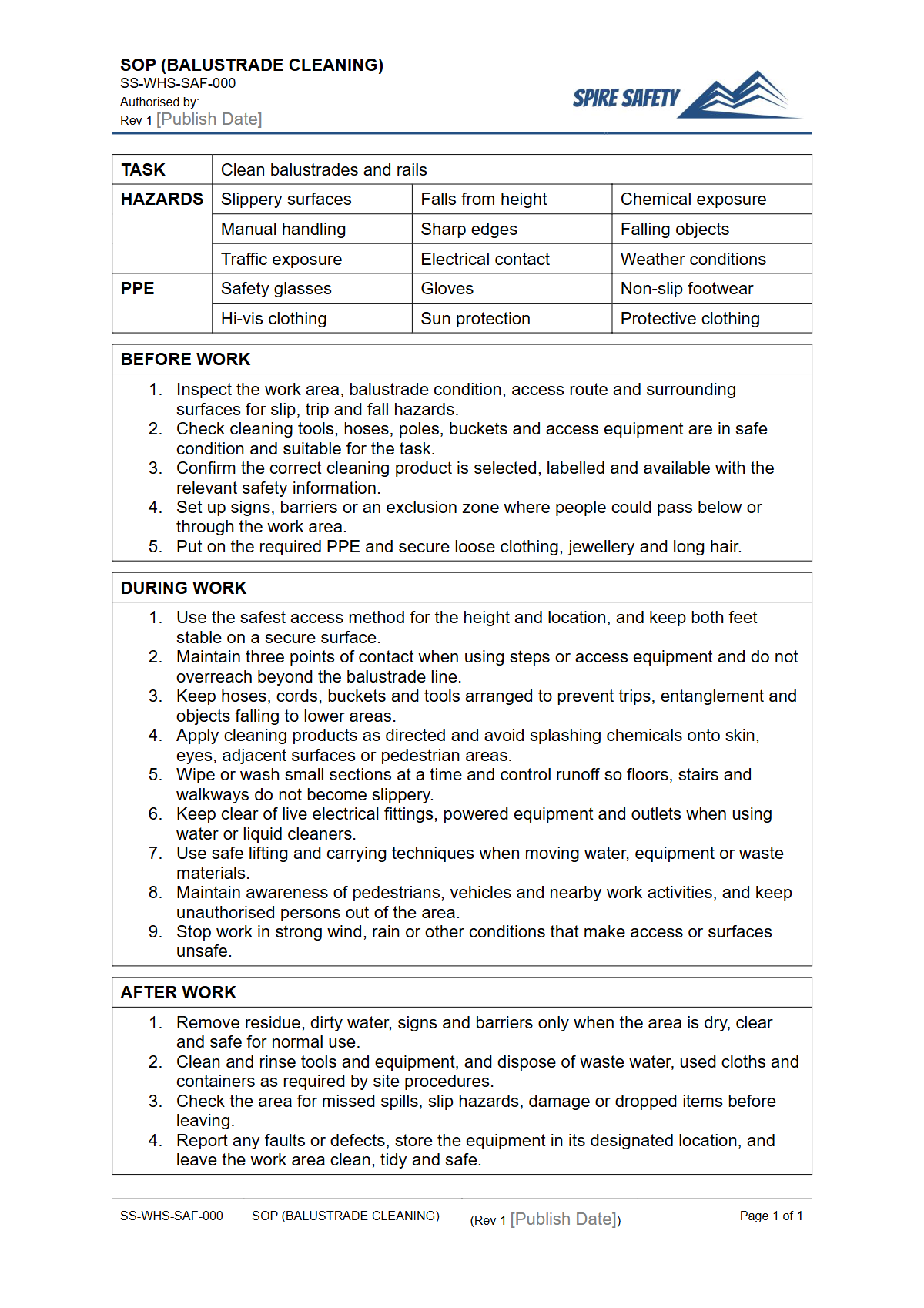
Balustrade cleaning, while seemingly straightforward, involves significant risks that must be managed. This free Safe Operating Procedure (Balustrade Cleaning) template provides a structured framework for documenting the required steps to perform the task safely.
It guides you in controlling hazards such as falls from height, manual handling injuries from moving equipment, exposure to cleaning chemicals, and slips, trips, and falls from wet surfaces. By establishing a clear, repeatable process, this SOP helps organisations meet their duty of care obligations and ensures workers understand the recognised safe method for the job.
A well-defined SOP is a critical tool for any safety management system. It standardises training, simplifies supervision, and provides a clear benchmark for performance.
For tasks involving potential work at height, such as cleaning balustrades on balconies or multi-storey voids, having robust procedures is essential. This often involves specific equipment, and documenting the correct usage is key; for example, our step ladder SOP details the checks required before using such access equipment.
What this Safe Operating Procedure covers:
- Essential pre-start safety checks
- Step-by-step instructions for the cleaning process
- Identification of potential hazards and their control measures
- Requirements for Personal Protective Equipment (PPE)
- Post-task cleanup and emergency procedures
Video walkthrough
How to use the Free Safe Operating Procedure (Balustrade Cleaning) Template
This resource is provided as a fully editable DOCX file, with a PDF version also available for easy printing and distribution. To use it effectively, you must adapt its contents to the specific context of your worksite.
This includes identifying the exact types of balustrades (glass, stainless steel, timber), the specific cleaning agents approved for use, the equipment available, and the unique environmental conditions of the work area. Generic procedures are insufficient; they must reflect the actual risks present in your operations.
Important: This is a template, not a finished document. To be effective, we strongly recommend you customise this SOP in consultation with your workers and other stakeholders.
You must assess your specific site, equipment, and materials to ensure all relevant hazards are identified and controlled. The final document should be integrated into your broader WHS management systems, reviewed by a competent person, and approved before implementation.
When to use it
A Safe Operating Procedure for balustrade cleaning should be used consistently as part of your daily work planning. It is particularly crucial in several situations: during the induction and training of new employees, as a pre-task briefing tool before work commences, and as a reference during refresher training sessions.
It also serves as a foundational document for conducting risk assessments and incident investigations related to the task.
Regular reviews of the SOP are vital to ensure it remains current. Procedures should be re-evaluated whenever there is a change in equipment, chemicals, work environment, or legislation.
This process is often streamlined when conducted alongside scheduled WHS compliance audits, helping to maintain the procedure's relevance and effectiveness over time.
Who should use it
This template is designed for anyone responsible for the safety of cleaning and maintenance operations. This includes Persons Conducting a Business or Undertaking (PCBUs), facility managers, property maintenance supervisors, and commercial cleaning contractors.
Health and Safety Representatives (HSRs) and workers themselves will also find it a valuable resource for understanding and contributing to safe work practices. For PCBUs who require expert assistance in developing and implementing site-specific procedures, our general WHS consulting services can provide tailored support.
Whether you manage a large facility with extensive glass balustrading or are a small contractor servicing residential buildings, this SOP provides a solid foundation for documenting safe systems of work. You can explore more templates and checklists like this one in our free WHS resources library to build out your safety documentation.
Common mistakes
Common mistakes to avoid
- Using a generic SOP without customising it for the specific site, equipment, and chemicals.
- Failing to adequately train workers on the procedures outlined in the finalised SOP.
- Neglecting to provide or enforce the use of the correct Personal Protective Equipment (PPE).
- Overlooking pre-start checks of access equipment like ladders and elevated work platforms.
Legal references
Legal considerations
The following legal requirements may be relevant to this type of work.
- Work Health and Safety Act (Harmonised) — Provides the primary duties for protecting workers and other people from work health and safety risks.
- Work Health and Safety Regulations (Harmonised) — Sets out requirements supporting the management of workplace hazards and risks.
The following codes may be relevant to this type of work.
- Managing WHS Risks Code of Practice — Provides practical guidance on identifying hazards, assessing risks and applying effective controls.
- Work Health and Safety Consultation, Cooperation and Coordination Code of Practice — Provides practical guidance on consulting workers and coordinating with other duty holders.
- Managing the Work Environment and Facilities Code of Practice — Provides practical guidance on safe work environments, workplace facilities and related controls.
Did you know
Fall Risks
Falls from a height are a leading cause of serious and fatal injuries in Australian workplaces. Even a fall from below two metres can result in significant harm.
Chemical Selection
Using the wrong cleaning chemical on stainless steel or powder-coated balustrades can cause permanent staining or corrosion, compromising the material's integrity and appearance.
FAQ
Frequently asked questions
01What hazards should a balustrade cleaning SOP cover?
02Is a Safe Work Method Statement (SWMS) needed for balustrade cleaning?
03How often should we review our balustrade cleaning SOP?
04Can this template be used for cleaning glass pool fencing?
Share this resource
Free Safe Operating Procedure (Balustrade Cleaning) Template
Browse Categories
How To Use It
- 1Download and open in Word or PDF.
- 2Replace the placeholders with your business details.
- 3Get it reviewed by a WHS specialist before rollout.
Need it customised?
Our WHS consultants can adapt this template to your site, run a gap analysis, or audit what you already have in place.
Book a Free Consultation WHS consulting servicesor call 1300 156 382
Related templates
- Free Safe Operating Procedure (Bandsaw - Meat Processing) Template
- Free Safe Operating Procedure (Banknote Counter) Template
- Free Safe Operating Procedure (Banquet Chair Handling) Template
- Free Safe Operating Procedure (Banquet Trolley Use) Template
- Free Safe Operating Procedure (Bar Glass Handling) Template
- Free Safe Operating Procedure (Bar Ice Well Cleaning) Template