
Free Safe Operating Procedure (Bale Twine Removal) Template
Download our free Safe Operating Procedure (Bale Twine Removal) Template.
Free Safe Operating Procedure (Bale Twine Removal) Template
DOCX • 126 KB + PDF
Updated Oct 2026
No signup required
Purpose of the Free Safe Operating Procedure (Bale Twine Removal) Template
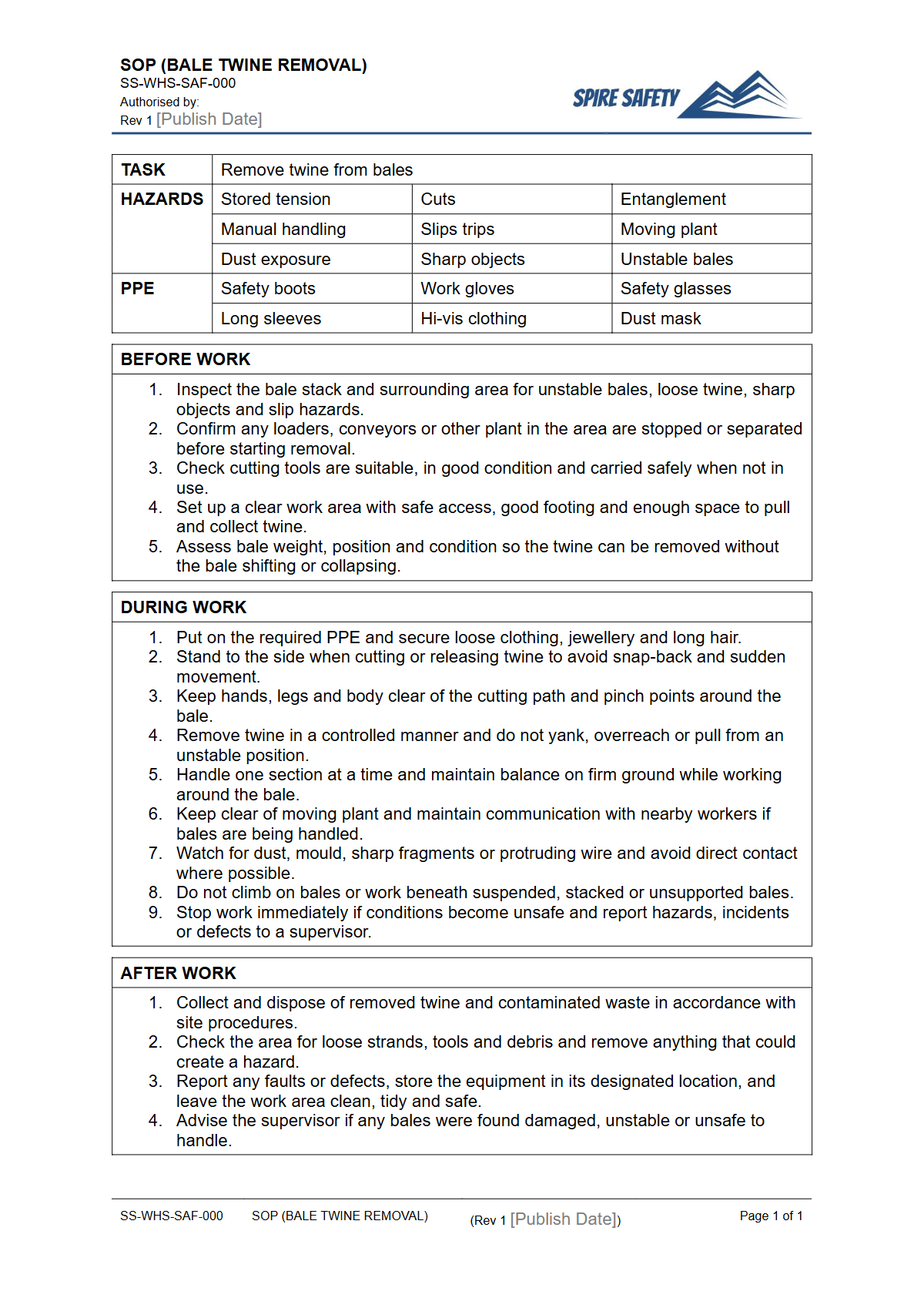
This Free Safe Operating Procedure (Bale Twine Removal) Template provides a structured framework for documenting the required steps to safely remove twine from hay, silage, or other compressed material bales. Removing twine, while seemingly simple, presents several hazards including cuts from sharp tools, musculoskeletal injuries from awkward postures and forceful exertion, and entanglement risks if machinery is involved.
Using a documented SOP helps your organisation manage these risks, ensuring workers are provided with clear, consistent instructions for performing the task safely. This template is designed as a starting point, aligned with Australian WHS principles, to help you formalise your safety processes.
Video walkthrough
How to use the Free Safe Operating Procedure (Bale Twine Removal) Template
This Safe Operating Procedure is provided as a fully editable DOCX file, with a PDF version also available for easy printing and distribution. To use it effectively, you must adapt its contents to the specific context of your workplace.
This includes identifying the particular types of bales, tools, and equipment used on your site, and detailing your site-specific controls. An SOP is a critical component of your safety management system, but it doesn't stand alone.
It should be integrated into your broader risk management and training programs. Building robust WHS management systems ensures that procedures like this are properly implemented, monitored, and improved over time.
Important Customisation Note
This is a template document. To make it effective and relevant for your business, you must customise it.
We are not responsible for the outcomes if you use this template without tailoring it to your specific operational needs, the equipment in use, the workers involved, and the unique risks of your site.
When to use this Safe Operating Procedure
A Bale Twine Removal SOP should be used as the primary reference document for this task. It is essential for inducting new workers and conducting refresher training for existing staff to ensure consistent, safe work practices.
The procedure should also be consulted during risk assessments and incident investigations related to this task. For example, the task of twine removal is often performed just before the bale is moved or processed.
If a telehandler is used for this subsequent step, workers must also be familiar with the procedures outlined in our free Telehandler SOP template to manage the interface between the two activities safely.
Who should use it
This procedure is intended for all personnel involved in handling baled materials where twine removal is required. This includes agricultural workers, farmhands, stock and station agents, warehouse operators, and any other worker tasked with the job.
Supervisors and managers should use the SOP to guide their training, supervision, and performance monitoring. WHS professionals can use this template as a foundational document to build upon when developing site-specific procedures as part of their safety toolkit.
If accessing bales stacked at height is part of the process, ensure all associated risks are managed, referencing documents like our Step Ladder SOP where appropriate.
Key Hazards and Control Measures
This SOP template prompts you to consider several key hazards. The most common is lacerations from knives or other cutting tools.
The procedure guides you to specify the type of approved cutting tool (e.g., a safety knife with a concealed or retractable blade) and the correct handling technique. Musculoskeletal disorders from hazardous manual tasks are another significant risk, arising from bending, reaching, and forcefully pulling on twine.
The SOP should detail controls such as warming up, using correct posture, and mechanical aids where feasible. If bales are delivered and handled via trucks, procedures must also account for vehicle movement, a process which can be detailed with resources like a Body Truck SOP to ensure traffic management is considered.
Ensuring Ongoing Effectiveness
A Safe Operating Procedure is not a 'set and forget' document. Its effectiveness relies on regular review and updates.
Your organisation should schedule periodic reviews of the SOP, typically annually or after any incident, near miss, or change in equipment or process. This review process confirms the procedure remains accurate and effective in controlling risks.
Involving workers who perform the task in the review is crucial for gathering practical feedback. Verifying that the procedure is being followed correctly can be part of your workplace inspection program or formal WHS compliance auditing activities. You can find more templates to support your safety system in our free WHS resources library.
Common mistakes
Common mistakes to avoid
- Using a dull, damaged, or inappropriate cutting tool (e.g., a pocket knife) instead of a designated safety knife.
- Pulling on stuck twine with excessive force or in an awkward posture, leading to sprains and strains.
- Leaving cut pieces of twine on the ground, creating a significant trip hazard for people and animals.
- Failing to wear appropriate personal protective equipment (PPE), particularly cut-resistant gloves and safety glasses.
Legal references
Legal considerations
The following legal requirements may be relevant to this type of work.
- Work Health and Safety Act (Harmonised) — Provides the primary duties for protecting workers and other people from work health and safety risks.
- Work Health and Safety Regulations (Harmonised) — Sets out requirements supporting the management of workplace hazards and risks.
The following codes may be relevant to this type of work.
- Managing WHS Risks Code of Practice — Provides practical guidance on identifying hazards, assessing risks and applying effective controls.
- Work Health and Safety Consultation, Cooperation and Coordination Code of Practice — Provides practical guidance on consulting workers and coordinating with other duty holders.
- Managing the Work Environment and Facilities Code of Practice — Provides practical guidance on safe work environments, workplace facilities and related controls.
Did you know
Manual Handling Risks
Musculoskeletal disorders resulting from hazardous manual tasks are a leading cause of serious workers' compensation claims in Australia, making procedural controls for tasks like handling bales critical.
Sharp Object Injuries
Lacerations from knives and cutting tools are common injuries in agricultural and warehousing settings. These are often preventable through the use of appropriate safety knives and documented handling procedures.
FAQ
Frequently asked questions
01What should be included in a Bale Twine Removal SOP?
02Is a specific type of knife required for cutting bale twine?
03How often should our Bale Twine Removal SOP be reviewed?
04Who is responsible for training workers on this SOP?
Share this resource
Free Safe Operating Procedure (Bale Twine Removal) Template
Browse Categories
How To Use It
- 1Download and open in Word or PDF.
- 2Replace the placeholders with your business details.
- 3Get it reviewed by a WHS specialist before rollout.
Need it customised?
Our WHS consultants can adapt this template to your site, run a gap analysis, or audit what you already have in place.
Book a Free Consultation WHS consulting servicesor call 1300 156 382
Related templates
- Free Safe Operating Procedure (Ball Court Cleaning) Template
- Free Safe Operating Procedure (Ball Joint Removal) Template
- Free Safe Operating Procedure (Balustrade Cleaning) Template
- Free Safe Operating Procedure (Bandsaw - Meat Processing) Template
- Free Safe Operating Procedure (Banknote Counter) Template
- Free Safe Operating Procedure (Banquet Chair Handling) Template