
Free Safe Operating Procedure (Ball Court Cleaning) Template
Download our free Safe Operating Procedure (Ball Court Cleaning) Template. A structured starting point for managing risks associated with court maintenance.
Free Safe Operating Procedure (Ball Court Cleaning) Template
DOCX • 126 KB + PDF
Updated Oct 2026
No signup required
Purpose of the Free Safe Operating Procedure (Ball Court Cleaning) Template
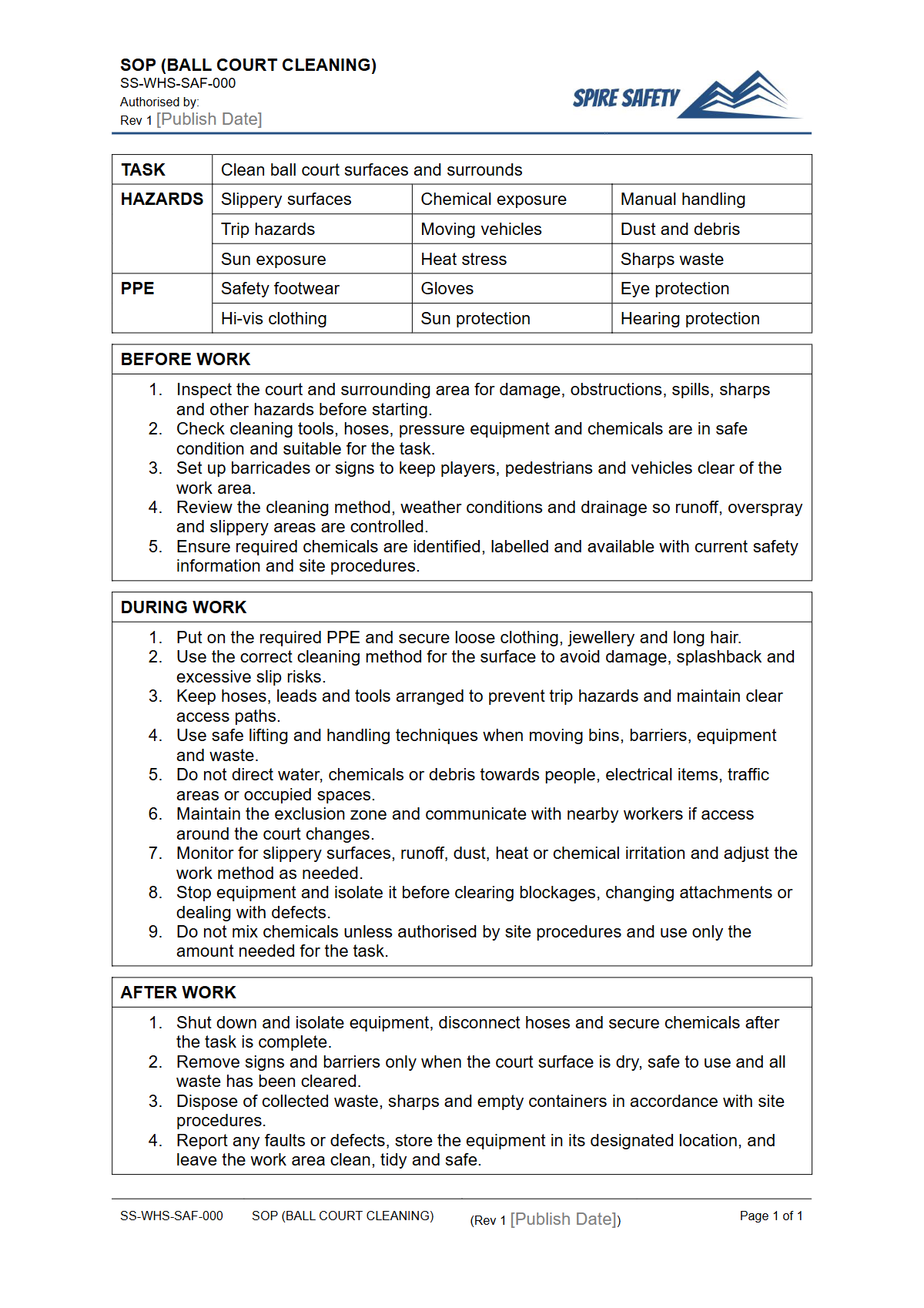
Maintaining sports facilities like tennis, basketball, or netball courts requires a structured approach to safety. This Free Safe Operating Procedure (Ball Court Cleaning) Template provides a documented process to help manage the specific risks involved.
The primary purpose of a Safe Operating Procedure (SOP) is to ensure tasks are performed consistently and safely every time, reducing the likelihood of incidents and injuries. Cleaning ball courts can present numerous hazards, including slips on wet surfaces, trips over hoses or equipment, manual handling injuries from moving equipment, and exposure to cleaning chemicals.
By implementing a detailed SOP, you establish a clear set of instructions for workers. This document outlines the required personal protective equipment (PPE), pre-operational checks for equipment, step-by-step cleaning instructions, and emergency procedures.
Formalising the process helps meet your primary duty of care under WHS legislation and forms a critical component of your overall WHS management system. It provides a foundation for training, competency assessment, and incident investigation, promoting a safer work environment for everyone involved.
Video walkthrough
How to use the Free Safe Operating Procedure (Ball Court Cleaning) Template
This downloadable template is provided in both DOCX and PDF formats, offering a comprehensive starting point for your organisation. It is structured based on Australian WHS principles but is not a finished document.
You must adapt it to reflect the specific circumstances of your workplace. Effective customisation involves a thorough risk assessment of your ball court cleaning tasks.
Note: To ensure this document is effective, we recommend you customise it by:
- Consulting directly with the workers and supervisors who perform the cleaning tasks. Their hands-on experience is invaluable for identifying practical risks and controls.
- Listing the specific types of equipment used (e.g., brand and model of pressure washers, blowers, or sweepers). If your team uses compressors for certain tools, you may also need a specific air compressor SOP.
- Identifying the exact cleaning chemicals used and referencing their Safety Data Sheets (SDS).
- Detailing site-specific emergency procedures, including the location of first aid kits, emergency stops, and spill kits.
- Adding your company branding and document control information (version number, review date).
Once customised, the SOP should be used to train all relevant personnel before they undertake the task. The goal is to create a practical tool that reflects how work is actually and safely done at your site.
When to use it
A Safe Operating Procedure for ball court cleaning should be developed and implemented before any worker is assigned the task for the first time. It serves as a core training document for new employees or for existing workers taking on new responsibilities.
The SOP should be readily accessible in the work area for easy reference during operations.
Furthermore, the SOP is a dynamic document. It should be reviewed and potentially updated:
- Annually, as part of a scheduled document review cycle.
- After any incident, near miss, or reported hazard associated with the task.
- When new equipment, chemicals, or cleaning methods are introduced.
- If legislative requirements or industry best practices change.
Regular reviews ensure the procedure remains relevant and effective. Holding periodic toolbox talks to refresh workers on the SOP's key points is also a valuable practice.
This proactive use helps embed a culture of safety and continuous improvement within your organisation.
Who should use it
This SOP is intended for a range of personnel within an organisation responsible for facility maintenance and safety. This includes:
- WHS Managers and Advisors: To ensure that documented, safe systems of work are in place and aligned with the organisation's overall safety framework. They may oversee the development and review process.
- Facility and Operations Managers: To manage the day-to-day safety of maintenance tasks, schedule work, and ensure resources like correct PPE are available.
- Supervisors: To provide direct instruction, training, and supervision to workers, ensuring the procedures outlined in the SOP are followed correctly.
- Cleaning and Maintenance Workers: As the end-users, this document provides them with clear, step-by-step instructions to perform their job safely.
Engaging a WHS professional can help ensure your SOPs are robust and fit for purpose. Expert WHS consulting services can assist in developing, implementing, and auditing your safe work procedures to confirm they meet expected standards.
The process of creating and using SOPs should be collaborative. For tasks that involve working from ladders to clean high fences or lights, a separate step ladder SOP template may also be required to address specific fall hazards.
Regular WHS compliance audits can verify that this SOP and others are being used effectively across the business. You can find more templates like this in our free WHS resources library.
Common mistakes
Common mistakes to avoid
- Using a generic template without customising it for specific site hazards and equipment.
- Failing to consult with the workers who actually perform the cleaning task.
- Neglecting to provide practical training on the finalised SOP.
- Treating the SOP as a 'set and forget' document instead of reviewing and updating it regularly.
Legal references
Legal considerations
The following legal requirements may be relevant to this type of work.
- Work Health and Safety Act (Harmonised) — Provides the primary duties for protecting workers and other people from work health and safety risks.
- Work Health and Safety Regulations (Harmonised) — Sets out requirements supporting the management of workplace hazards and risks.
The following codes may be relevant to this type of work.
- Managing WHS Risks Code of Practice — Provides practical guidance on identifying hazards, assessing risks and applying effective controls.
- Work Health and Safety Consultation, Cooperation and Coordination Code of Practice — Provides practical guidance on consulting workers and coordinating with other duty holders.
- Managing the Work Environment and Facilities Code of Practice — Provides practical guidance on safe work environments, workplace facilities and related controls.
Did you know
Slips, Trips, and Falls
Slips, trips, and falls are a leading cause of serious workplace injuries in Australia. Maintaining clear, dry, and unobstructed access ways during cleaning operations is a critical control measure.
Consultation is Key
Under model WHS laws, PCBUs have a duty to consult with workers on matters relating to their health and safety. Involving your cleaning team in drafting the SOP is not just good practice—it's a legal obligation.
FAQ
Frequently asked questions
01What are the main hazards of ball court cleaning?
02Does this Safe Operating Procedure cover pressure washing?
03How often should a Safe Operating Procedure be reviewed?
04Is a Safe Operating Procedure a legal requirement in Australia?
Share this resource
Free Safe Operating Procedure (Ball Court Cleaning) Template
Browse Categories
How To Use It
- 1Download and open in Word or PDF.
- 2Replace the placeholders with your business details.
- 3Get it reviewed by a WHS specialist before rollout.
Need it customised?
Our WHS consultants can adapt this template to your site, run a gap analysis, or audit what you already have in place.
Book a Free Consultation WHS consulting servicesor call 1300 156 382
Related templates
- Free Safe Operating Procedure (Ball Joint Removal) Template
- Free Safe Operating Procedure (Balustrade Cleaning) Template
- Free Safe Operating Procedure (Bandsaw - Meat Processing) Template
- Free Safe Operating Procedure (Banknote Counter) Template
- Free Safe Operating Procedure (Banquet Chair Handling) Template
- Free Safe Operating Procedure (Banquet Trolley Use) Template