
Free Safe Operating Procedure (Balcony Drain Clearing) Template
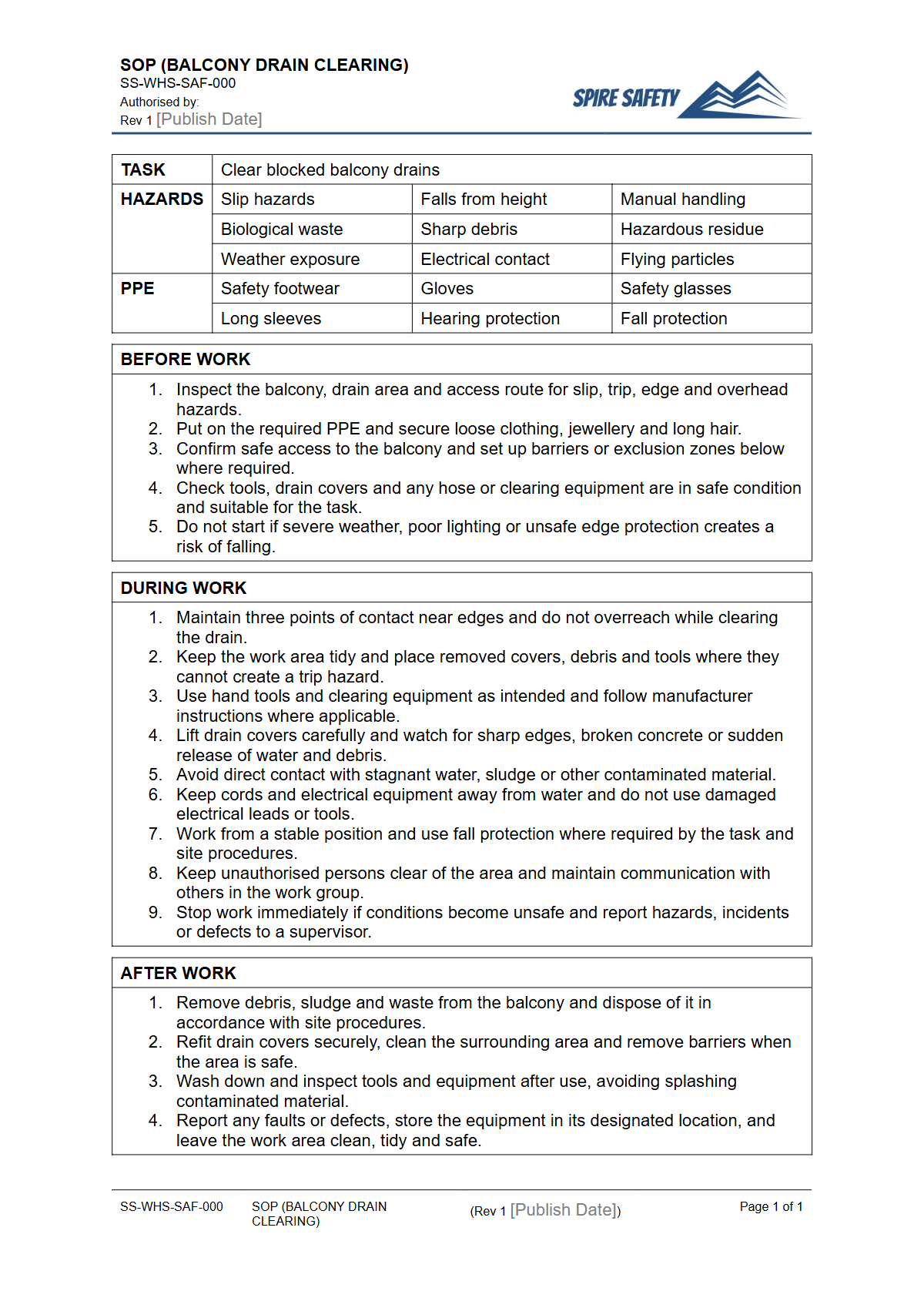
Download our free Safe Operating Procedure (SOP) for balcony drain clearing. This customisable template helps you outline safe work steps.
Free Safe Operating Procedure (Balcony Drain Clearing) Template
DOCX • 126 KB + PDF
Updated Oct 2026
No signup required
Purpose of the Free Safe Operating Procedure (Balcony Drain Clearing) Template
Clearing a blocked balcony drain may seem like a simple maintenance task, but it involves several risks that must be managed to ensure worker safety. Hazards can include working at heights, manual handling, slips and trips from water spillage, and exposure to biological contaminants in stagnant water.
Our Free Safe Operating Procedure (Balcony Drain Clearing) Template provides a structured framework to document the step-by-step process for performing this task safely, aligned with Australian WHS principles.
This Safe Operating Procedure (SOP) helps organisations identify potential hazards and implement effective control measures before work begins. It formalises the expected safe behaviour and work sequence, serving as a critical tool for worker training and supervision.
Using a standardised procedure ensures that safety is consistently addressed, reducing the likelihood of incidents and injuries. For tasks involving ladders, this document should be used in conjunction with a specific step ladder SOP to cover all aspects of fall prevention.
Video walkthrough
How to use the Free Safe Operating Procedure (Balcony Drain Clearing) Template
This downloadable document is a starting point, not a finished solution. It must be adapted to reflect the specific equipment, environment, and risks present in your workplace.
A competent person should lead this customisation process in consultation with the workers who will be performing the task.
Important: This is a template that we have created to be customised to your business. You must ensure it is tailored to your specific site conditions, machinery, equipment, and the chemicals you use.
A site-specific risk assessment should be conducted to ensure all foreseeable hazards are identified and controlled.
Consult and Customise
Begin by reviewing the template with your team. Discuss the steps involved in drain clearing at your specific sites.
Are there unique architectural features, access issues, or environmental factors to consider? Add, remove, or modify steps to create a procedure that accurately reflects your operational reality.
An SOP is a vital part of a broader WHS management system that documents how your organisation manages risk.
Conduct a Risk Assessment
Before finalising the SOP, perform a thorough risk assessment for the task. Identify all potential hazards, assess the level of risk, and determine the most effective control measures.
This process informs the critical safety instructions within the SOP, including required Personal Protective Equipment (PPE), pre-start checks, and emergency procedures. For particularly difficult blockages, some may use high-pressure water systems; this would require its own risk assessment and procedure, similar in detail to a Safe Operating Procedure for waterjet cutter operations.
Specify PPE and Equipment
Use the designated section in the template to list all required PPE, such as waterproof gloves, safety glasses, non-slip footwear, and high-visibility clothing if working near public areas. Also, list all tools and equipment required for the job, from hand tools and buckets to extension poles or ladders, ensuring they are inspected and in good condition before use.
When to use it
A Safe Operating Procedure for balcony drain clearing should be used as a primary reference document for the task. It is most effective when integrated into your daily work practices. Use it for:
- Training and Induction: Train new and existing workers on the approved procedure to ensure they understand the safety requirements before undertaking the task.
- Pre-start Toolboxes: Review the SOP during pre-start meetings or toolbox talks as a refresher before work commences, especially for periodic maintenance schedules.
- Supervision and Monitoring: Supervisors can use the SOP as a checklist to monitor work practices and confirm that safety procedures are being followed correctly.
- Incident Investigation: If an incident occurs, the SOP serves as a benchmark for what should have happened, helping to identify any procedural gaps or deviations.
Maintaining clear, documented procedures is also fundamental for demonstrating due diligence. These documents are often reviewed as part of any formal WHS compliance audit to verify that safety processes are in place and being implemented.
Who should use it
This template is designed for use by a range of individuals and organisations responsible for property and facilities maintenance, including:
- Facilities Managers and Maintenance Staff: For day-to-day management and execution of maintenance tasks in commercial, residential, or industrial buildings.
- Body Corporate and Strata Managers: To establish standardised, safe procedures for contractors or employees maintaining common property.
- Cleaning and Maintenance Contractors: To develop their own internal safety documents and demonstrate their commitment to WHS compliance to clients.
- WHS Managers and Advisors: As a tool to assist operational teams in formalising safe work practices across their sites.
For high-risk properties or situations involving complex access challenges, seeking external guidance may be necessary. Professional WHS consulting can help develop highly tailored solutions that address unique site-specific hazards.
You can also explore our extensive free WHS resources library for other templates that support your safety goals.
Common mistakes
Common mistakes to avoid
- Using inappropriate or damaged equipment, such as domestic-grade ladders for commercial work.
- Failing to wear correct PPE, particularly waterproof gloves and eye protection, leading to skin irritation or eye injuries.
- Not adequately securing the work area below, posing a risk of falling objects to residents or the public.
- Underestimating the risk of biological hazards present in stagnant water and decaying organic matter.
Legal references
Legal considerations
The following legal requirements may be relevant to this type of work.
- Work Health and Safety Act (Harmonised) — Provides the primary duties for protecting workers and other people from work health and safety risks.
- Work Health and Safety Regulations (Harmonised) — Sets out requirements supporting the management of workplace hazards and risks.
The following codes may be relevant to this type of work.
- Managing WHS Risks Code of Practice — Provides practical guidance on identifying hazards, assessing risks and applying effective controls.
- Work Health and Safety Consultation, Cooperation and Coordination Code of Practice — Provides practical guidance on consulting workers and coordinating with other duty holders.
- Managing the Work Environment and Facilities Code of Practice — Provides practical guidance on safe work environments, workplace facilities and related controls.
Did you know
Water Damage Costs
Blocked drains are a leading cause of water ingress and structural damage in buildings. The Insurance Council of Australia reports that water damage is one of the most common types of property claims.
Slips, Trips and Falls
According to Safe Work Australia, slips, trips, and falls are a major cause of workplace injuries, making up a significant portion of serious workers' compensation claims each year.
FAQ
Frequently asked questions
01What hazards are involved in clearing balcony drains?
02Does this SOP template cover working at heights?
03Who is responsible for ensuring this SOP is followed?
04How often should a balcony drain clearing SOP be reviewed?
Share this resource
Free Safe Operating Procedure (Balcony Drain Clearing) Template
Browse Categories
How To Use It
- 1Download and open in Word or PDF.
- 2Replace the placeholders with your business details.
- 3Get it reviewed by a WHS specialist before rollout.
Need it customised?
Our WHS consultants can adapt this template to your site, run a gap analysis, or audit what you already have in place.
Book a Free Consultation WHS consulting servicesor call 1300 156 382
Related templates
- Free Safe Operating Procedure (Bale Breaker) Template
- Free Safe Operating Procedure (Bale Twine Removal) Template
- Free Safe Operating Procedure (Ball Court Cleaning) Template
- Free Safe Operating Procedure (Ball Joint Removal) Template
- Free Safe Operating Procedure (Balustrade Cleaning) Template
- Free Safe Operating Procedure (Bandsaw - Meat Processing) Template