
Free Safe Operating Procedure (Bale Breaker) Template
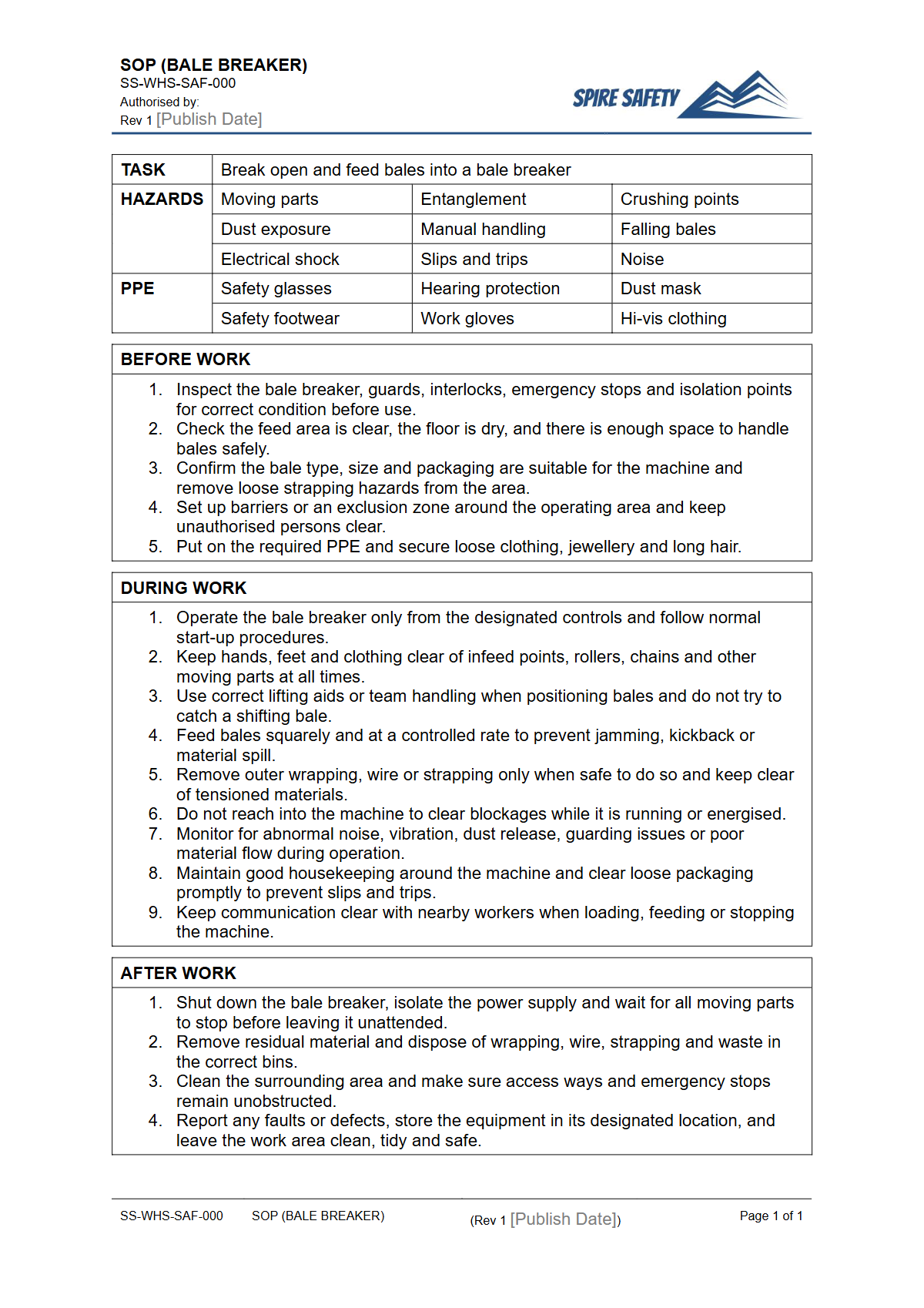
Download our free Safe Operating Procedure (Bale Breaker) Template to document safe work practices. This customisable DOCX and PDF is a great starting point.
Free Safe Operating Procedure (Bale Breaker) Template
DOCX • 126 KB + PDF
Updated Oct 2026
No signup required
Purpose of the Free Safe Operating Procedure (Bale Breaker) Template
Effectively managing workplace risks is crucial for any organisation, especially when dealing with high-risk plant. Our Free Safe Operating Procedure (Bale Breaker) Template provides a structured framework for documenting the step-by-step process required to operate a bale breaker safely.
Bale breakers, used to decompress and break apart bales of materials like paper, plastic, or agricultural products, pose significant hazards including entanglement, crushing from moving parts, and high-pressure hydraulic fluid injection. This template is designed to help you formally identify these hazards and outline the specific control measures to protect your workers.
Using a documented SOP is a fundamental part of a robust safety system. It serves as a critical training tool, a reference for operators, and clear evidence of your organisation's commitment to safety.
Integrating this procedure into your broader WHS management systems helps ensure that safe work practices are consistently applied and systematically reviewed. This document helps translate your risk assessment findings into practical, actionable instructions for your team.
Video walkthrough
How to use the Free Safe Operating Procedure (Bale Breaker) Template
This resource is available as a fully editable DOCX file and a print-ready PDF. The template provides a comprehensive starting point based on Australian WHS principles.
However, it is not a complete, off-the-shelf solution. It is essential that you customise this document to align with the specific circumstances of your workplace.
Every worksite is different, and your SOP must reflect the unique equipment, environment, and procedures relevant to your operations.
Important: We have created this template as a guide. You MUST customise it to suit your specific make and model of bale breaker, the materials being processed, your state or territory's regulations, and your own site-specific risk controls and emergency procedures.
We recommend this customisation is undertaken by a competent person in direct consultation with the machine operators and supervisors.
Once customised, the SOP should be used as a primary document for training and competency assessment. It should be easily accessible to all relevant workers, either as a hard copy near the equipment or on your company's digital network.
While this SOP is for a bale breaker, you may also find our Free Air Compressor SOP (Safe Operating Procedure) Template useful for other common plant in your facility.
Key areas for customisation include:
- Plant and Equipment Details: Specify the make, model, and serial number of the bale breaker.
- Pre-Operational Checks: Detail the exact daily checks required, such as inspecting guarding, emergency stops, hydraulic hoses, and control panel functions.
- Step-by-Step Instructions: Clearly outline the sequence for loading materials, initiating the cycle, managing output, and clearing minor jams safely. This section should incorporate specific lockout-tagout procedures.
- Personal Protective Equipment (PPE): List the mandatory PPE for operators and others in the vicinity, such as high-impact safety glasses, steel-capped boots, and hearing protection.
- Emergency Procedures: Document the exact steps for emergency shutdown, power isolation, and who to contact in an emergency.
When to use a Bale Breaker Safe Operating Procedure
A Safe Operating Procedure for a bale breaker is a living document, not a set-and-forget task. It should be actively used during worker induction and task-specific training to ensure a baseline understanding of safe operation.
It also serves as an excellent tool for refresher training to prevent complacency. The SOP should be a reference point during routine operations and be a key document reviewed during formal WHS compliance auditing to verify that procedures are being followed.
Furthermore, the SOP must be reviewed and updated after any incident or near-miss, or whenever the equipment or process is modified.
Who should use this Safe Operating Procedure
Responsibility for safety is shared across an organisation. A Person Conducting a Business or Undertaking (PCBU) is ultimately responsible for providing a safe workplace, which includes ensuring safe systems of work like SOPs are in place.
Managers and supervisors are tasked with implementing the SOP, providing adequate training, and monitoring compliance on the floor. Safety officers and WHS professionals will use this template as a building block for the organisation's safety framework, much like our free Brake Press SOP template is used in fabrication shops.
Most importantly, the operators of the bale breaker are the primary end-users of the SOP. They must be thoroughly trained on its contents and have the opportunity to provide feedback based on their hands-on experience, as their involvement is critical to creating a truly effective and practical procedure.
Similar principles apply to operators of other heavy equipment, as outlined in our FREE Telehandler SOP Template. Feel free to explore our entire free WHS resources library for more templates to support your safety initiatives.
Common mistakes
Common mistakes to avoid
- Using a generic, non-customised template that doesn't match the specific machine model.
- Failing to include specific, step-by-step lockout-tagout procedures for clearing jams or maintenance.
- Neglecting to train workers on the SOP and confirm their understanding.
- Forgetting to review and update the SOP after a near miss, incident, or change in process.
Legal references
Legal considerations
The following legal requirements may be relevant to this type of work.
- Work Health and Safety Act (Harmonised) — Provides the primary duties for protecting workers and other people from work health and safety risks.
- Work Health and Safety Regulations (Harmonised) — Sets out requirements supporting the management of workplace hazards and risks.
The following codes may be relevant to this type of work.
- Managing WHS Risks Code of Practice — Provides practical guidance on identifying hazards, assessing risks and applying effective controls.
- Work Health and Safety Consultation, Cooperation and Coordination Code of Practice — Provides practical guidance on consulting workers and coordinating with other duty holders.
- Managing the Work Environment and Facilities Code of Practice — Provides practical guidance on safe work environments, workplace facilities and related controls.
Did you know
Entanglement Risk
Entanglement in machinery, particularly agricultural and recycling equipment like balers, is a leading cause of serious and fatal injuries. A single loose piece of clothing, hair, or jewellery can be caught in a rotating part in less than a second.
Hydraulic Injection Injuries
A pinhole leak in a high-pressure hydraulic hose can release fluid at over 400 km/h. If this fluid penetrates the skin, it can cause severe tissue damage, gangrene, and amputation, making it a critical, though often overlooked, hazard.
FAQ
Frequently asked questions
01What is a Safe Operating Procedure for a bale breaker?
02What hazards should be included in a bale breaker SOP?
03Who is responsible for writing and implementing a bale breaker SOP?
04How often should a bale breaker SOP be reviewed?
Share this resource
Free Safe Operating Procedure (Bale Breaker) Template
Browse Categories
How To Use It
- 1Download and open in Word or PDF.
- 2Replace the placeholders with your business details.
- 3Get it reviewed by a WHS specialist before rollout.
Need it customised?
Our WHS consultants can adapt this template to your site, run a gap analysis, or audit what you already have in place.
Book a Free Consultation WHS consulting servicesor call 1300 156 382
Related templates
- Free Safe Operating Procedure (Bale Twine Removal) Template
- Free Safe Operating Procedure (Ball Court Cleaning) Template
- Free Safe Operating Procedure (Ball Joint Removal) Template
- Free Safe Operating Procedure (Balustrade Cleaning) Template
- Free Safe Operating Procedure (Bandsaw - Meat Processing) Template
- Free Safe Operating Procedure (Banknote Counter) Template