
Free Safe Operating Procedure (Bakery Tray Handling) Template
Download our free Safe Operating Procedure for Bakery Tray Handling. This template helps manage manual handling risks in bakeries. Get your free DOCX now.
Free Safe Operating Procedure (Bakery Tray Handling) Template
DOCX • 126 KB + PDF
Updated Oct 2026
No signup required
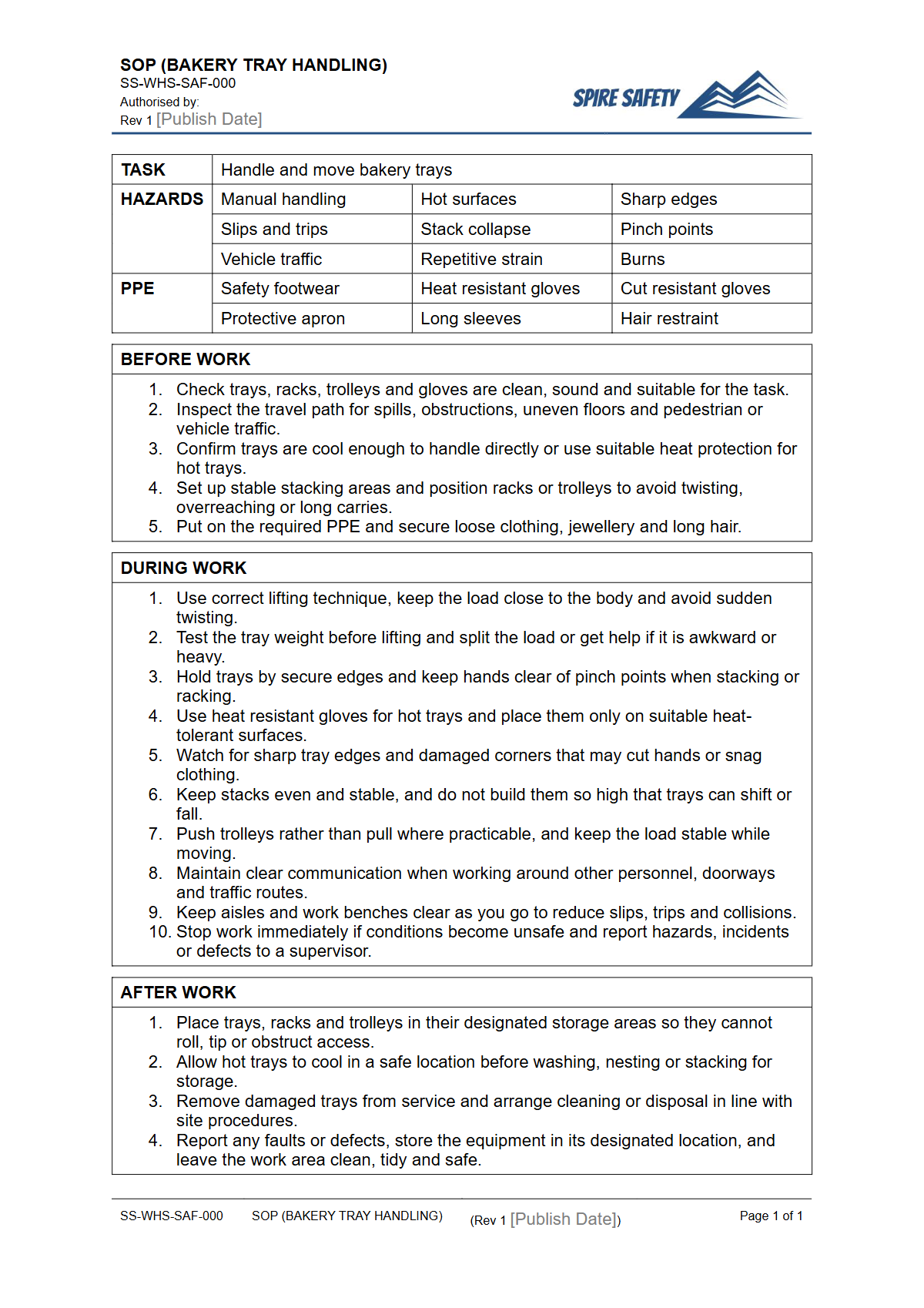
Purpose of the Free Safe Operating Procedure (Bakery Tray Handling) Template
Handling hot, heavy, or awkward bakery trays is a daily task that carries significant work health and safety risks. This free Safe Operating Procedure (Bakery Tray Handling) template provides a structured starting point for Australian bakeries, patisseries, and food production facilities to document a safe system of work.
Its primary purpose is to help you control hazards and minimise the risk of injury to your workers.
Key risks associated with handling bakery trays include musculoskeletal disorders (MSDs) from lifting and carrying, severe burns from contact with hot surfaces, and slips, trips, and falls. A documented SOP is a practical tool for meeting your WHS obligations, ensuring consistent training, and providing a clear, step-by-step guide for workers to follow.
This document formalises your organisation's commitment to safety for a specific, high-risk task. Similar to documenting procedures for tasks like step ladder use, a specific SOP ensures that even routine activities are performed safely every time.
Video walkthrough
How to use the Free Safe Operating Procedure (Bakery Tray Handling) Template
This template provides a solid foundation, but it is not a complete, out-of-the-box solution. We strongly recommend that you customise every section to reflect the specific equipment, processes, and risks unique to your workplace. A generic procedure is not effective.
Your customisation should be informed by a thorough risk assessment conducted in consultation with your workers.
To adapt the template:
- Identify Specifics: Detail the types of trays, ovens, and transport trolleys used in your facility.
- Assess Your Environment: Consider your workplace layout, including flooring surfaces, lighting, and potential congestion points.
- Define PPE: Specify the exact Personal Protective Equipment required, such as the type of heat-resistant gloves and standard of non-slip footwear.
- Outline Steps: Break down the entire process from loading unbaked goods to removing hot trays and transporting them for cooling or packaging. Include steps for cleaning and storage.
- Emergency Procedures: Clearly state the immediate actions to take in case of a burn, sprain, strain, or other injury.
Once customised, this document becomes a vital component in your safety framework. An effective SOP is a building block for comprehensive WHS management systems that protect your people and your business.
When to use it
A Safe Operating Procedure for bakery tray handling should be a living document integrated into your daily operations. It is most effective when used for:
- Worker Training: Use it as the primary training document for new employees (induction) and for refresher training with existing staff to ensure standards are maintained.
- Supervision and Monitoring: Supervisors can use the SOP as a benchmark to observe work practices and provide corrective guidance.
- Hazard and Incident Investigation: When an incident or near miss occurs, the SOP serves as a reference to determine if procedures were followed and whether they need to be updated.
- Workplace Audits: It provides clear criteria against which to audit your processes, ensuring your documented system matches on-the-ground reality.
If you're unsure how to begin the risk assessment process needed to customise this SOP, consider seeking guidance through specialist WHS consulting. Expert advice can help you identify hazards you may have overlooked.
Who should use it
The development and implementation of this SOP involves several key roles within an organisation:
- PCBUs and Business Owners: The Person Conducting a Business or Undertaking has the primary duty of care and is ultimately responsible for ensuring a safe system of work is provided and maintained.
- WHS Managers and Safety Officers: These individuals typically lead the development, customisation, and review of the SOP, ensuring it aligns with legislation and best practice.
- Supervisors and Team Leaders: They are responsible for implementing the SOP on the floor, delivering training, and ensuring workers adhere to the documented procedure.
- Workers: As the people performing the task, their input during the consultation and drafting phase is invaluable for creating a practical and effective procedure.
Regular review of your SOPs is crucial for maintaining a safe workplace. This review process can be integrated into your overall safety program and verified through periodic WHS compliance auditing to ensure ongoing effectiveness and identify areas for improvement.
The scope of this procedure can also extend to related tasks, such as loading and unloading trays from delivery vehicles. For vehicles that require specific operational controls, a separate document like our free Body Truck SOP might be necessary. To discover more templates and checklists for your business, explore our complete free WHS resources library.
Common mistakes
Common mistakes to avoid
- Failing to customise the template for specific oven types, trolley designs, and workplace layouts.
- Neglecting to train workers on the final, customised procedure or verify their competency.
- Overlooking ergonomic factors such as tray weight, repetitive movements, and awkward postures.
- Not including procedures for cleaning and storing trays and trolleys, which can introduce new hazards.
Legal references
Legal considerations
The following legal requirements may be relevant to this type of work.
- Work Health and Safety Act (Harmonised) — Provides the primary duties for protecting workers and other people from work health and safety risks.
- Work Health and Safety Regulations (Harmonised) — Sets out requirements supporting the management of workplace hazards and risks.
The following codes may be relevant to this type of work.
- Managing WHS Risks Code of Practice — Provides practical guidance on identifying hazards, assessing risks and applying effective controls.
- Work Health and Safety Consultation, Cooperation and Coordination Code of Practice — Provides practical guidance on consulting workers and coordinating with other duty holders.
- Managing the Work Environment and Facilities Code of Practice — Provides practical guidance on safe work environments, workplace facilities and related controls.
Did you know
Manual Handling Injuries
According to Safe Work Australia, manual handling injuries, formally known as musculoskeletal disorders (MSDs), are the most common type of workplace injury in the country, accounting for a significant portion of all serious workers' compensation claims.
Burn Severity
Contact with a surface at 70°C can cause a serious third-degree burn in just one second. Many bakery ovens and trays operate at well over 200°C, making appropriate thermal PPE and safe handling procedures critical.
FAQ
Frequently asked questions
01What are the main hazards of handling bakery trays?
02Why do I need a specific SOP for bakery tray handling?
03How often should a Safe Operating Procedure be reviewed?
04Is this template enough for WHS compliance?
Share this resource
Free Safe Operating Procedure (Bakery Tray Handling) Template
Browse Categories
How To Use It
- 1Download and open in Word or PDF.
- 2Replace the placeholders with your business details.
- 3Get it reviewed by a WHS specialist before rollout.
Need it customised?
Our WHS consultants can adapt this template to your site, run a gap analysis, or audit what you already have in place.
Book a Free Consultation WHS consulting servicesor call 1300 156 382
Related templates
- Free Safe Operating Procedure (Balcony Drain Clearing) Template
- Free Safe Operating Procedure (Bale Breaker) Template
- Free Safe Operating Procedure (Bale Twine Removal) Template
- Free Safe Operating Procedure (Ball Court Cleaning) Template
- Free Safe Operating Procedure (Ball Joint Removal) Template
- Free Safe Operating Procedure (Balustrade Cleaning) Template