
Free Safe Operating Procedure (Bain Marie) Template
Download our Free Safe Operating Procedure (Bain Marie) Template (DOCX & PDF).
Free Safe Operating Procedure (Bain Marie) Template
DOCX • 126 KB + PDF
Updated Oct 2026
No signup required
Purpose of the Free Safe Operating Procedure (Bain Marie) Template
A bain marie is essential in many commercial kitchens for keeping food at a safe, warm temperature. However, it also presents significant workplace hazards, including severe burns, scalds, electrical risks, and musculoskeletal injuries.
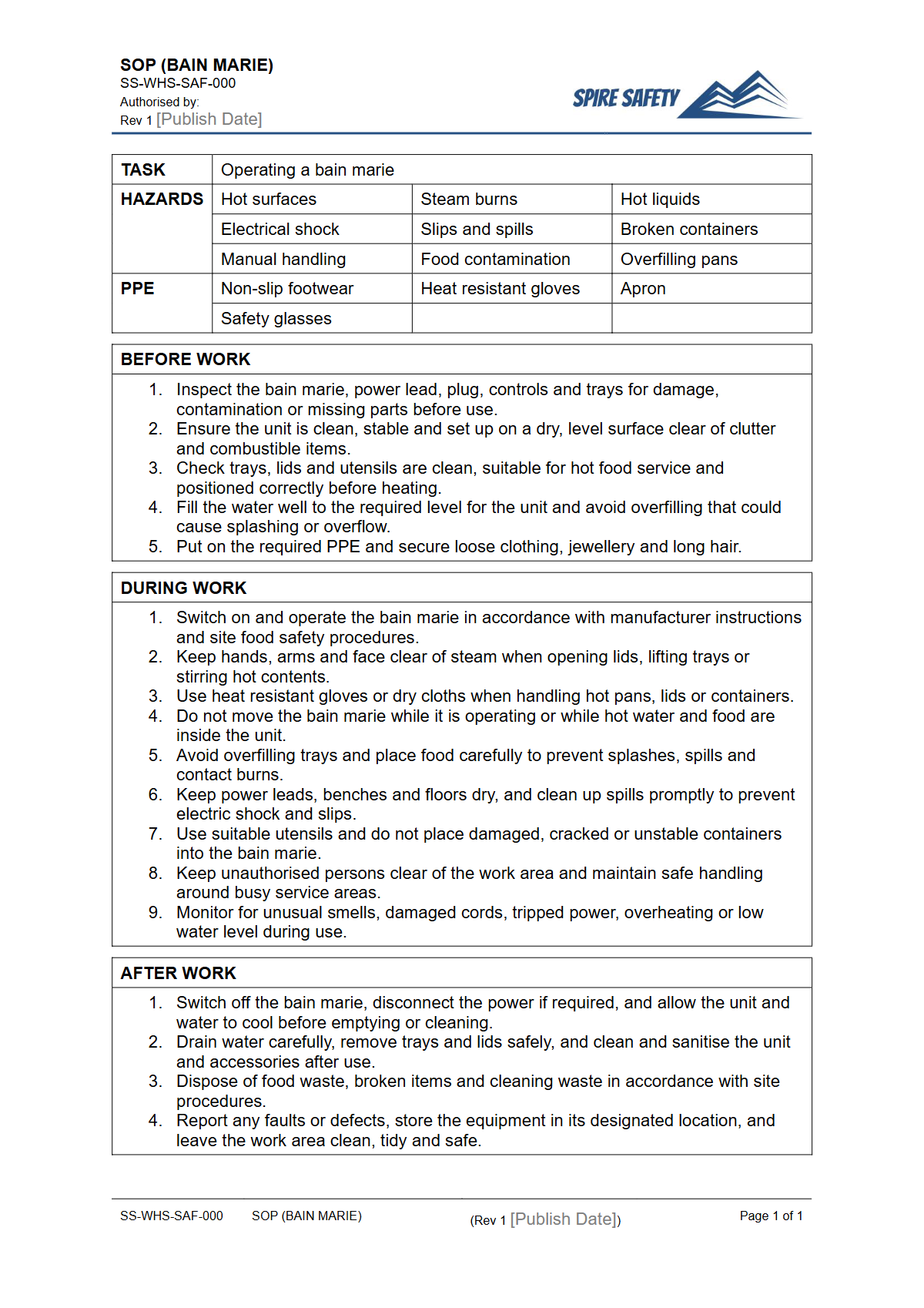
This Free Safe Operating Procedure (Bain Marie) Template provides a structured framework for documenting the safe use of this equipment. It helps your organisation detail step-by-step instructions, define required personal protective equipment (PPE), and outline emergency responses, ensuring workers are protected from harm.
Implementing a formal SOP is a practical way for a Person Conducting a Business or Undertaking (PCBU) to meet their primary duty of care under WHS legislation. It serves as a key administrative control, forming an integral part of your overall WHS management systems by ensuring tasks are performed safely and consistently.
Video walkthrough
How to use the Free Safe Operating Procedure (Bain Marie) Template
This template is provided in an easily editable DOCX format for full customisation. To use it effectively, you must adapt its contents to reflect the specific bain marie models in your workplace, the environment they are used in, and your organisation’s existing policies.
Review each section and add or remove information to make it relevant to your operations.
Important: This document is a template only. You must customise it by undertaking a risk assessment in consultation with your workers to identify all site-specific hazards.
For assistance with tailoring this document to your unique operational needs and ensuring it aligns with your safety goals, consider seeking professional WHS consulting services.
Key Hazards and Control Measures
A thorough risk assessment should inform the contents of your SOP. Common hazards associated with bain marie operation include:
Burns and Scalds
Contact with hot surfaces, hot water, or steam can cause serious burns. Controls include using insulated gloves when handling hot food pans, using designated utensils, and ensuring workers maintain a safe distance during operation and when adding or removing water.
Electrical Hazards
Faulty wiring, improper use of extension cords, and contact with water create a risk of electric shock. Your SOP should mandate pre-operational checks of cords and plugs, prohibit the use of damaged equipment, and ensure all electrical components are kept dry and are regularly tested and tagged.
Manual Handling
Lifting and carrying heavy pans of hot food or water can lead to strains and sprains. Controls include specifying maximum pan weights, encouraging team lifts for heavy items, and ensuring a clear, unobstructed path between the bain marie and serving areas.
Slips, Trips, and Falls
Water spillage during filling or cleaning creates a significant slip hazard. The procedure should include immediate clean-up of spills, use of non-slip flooring, and ensuring the area is well-lit and free of clutter. If items are stored on high shelves nearby, they should be accessed using appropriate equipment covered by its own procedure, such as a step ladder SOP.
When to Use This SOP
A bain marie SOP should be a living document used in several key situations:
- Worker Training and Induction: As a primary training tool for new staff before they are authorised to use the equipment.
- Routine Operations: As a day-to-day reference guide for all kitchen staff to ensure consistency in safe practices.
- Refresher Training: For periodic retraining sessions to reinforce safe behaviour and introduce any procedural updates.
- Incident Investigation: As a benchmark to review whether established procedures were followed after a near miss or injury.
Creating a specific SOP for each piece of equipment is a cornerstone of good safety practice. Just as a maintenance department may require an air compressor SOP for pressure vessels or a circular saw SOP for cutting tasks, a commercial kitchen needs documented procedures for its own specialised equipment.
Who Should Implement This Procedure
Safety is a shared responsibility, and different roles have distinct duties in implementing the SOP:
- Managers/Supervisors: Are responsible for ensuring the SOP is customised, implemented, and understood by all relevant workers. They must provide adequate training, ensure PPE is available and used, and monitor compliance. The effectiveness of these procedures is a key focus during any formal WHS compliance auditing.
- Workers: Must follow the established procedures outlined in the SOP, use PPE as instructed, and report any hazards or equipment faults to their supervisor immediately.
- PCBU: Holds the ultimate responsibility for providing a safe working environment, which includes ensuring that safe systems of work, such as SOPs, are developed, implemented, and reviewed.
Common mistakes
Common mistakes to avoid
- Using the downloaded template without customising it to the specific model and workplace environment.
- Failing to adequately train all workers on the finalised SOP, especially casual or new staff.
- Neglecting regular checks of water levels, which can cause the heating element to fail or food to cool.
- Not documenting pre-operational checks, leading to the use of faulty or unsafe equipment.
Legal references
Legal considerations
The following legal requirements may be relevant to this type of work.
- Work Health and Safety Act (Harmonised) — Provides the primary duties for protecting workers and other people from work health and safety risks.
- Work Health and Safety Regulations (Harmonised) — Sets out requirements supporting the management of workplace hazards and risks.
The following codes may be relevant to this type of work.
- Managing WHS Risks Code of Practice — Provides practical guidance on identifying hazards, assessing risks and applying effective controls.
- Work Health and Safety Consultation, Cooperation and Coordination Code of Practice — Provides practical guidance on consulting workers and coordinating with other duty holders.
- Managing the Work Environment and Facilities Code of Practice — Provides practical guidance on safe work environments, workplace facilities and related controls.
Did you know
Mary's Bath
The term 'bain-marie' is French for 'Mary's bath', believed to be named after Mary the Jewess, an ancient alchemist who invented the double boiler to gently heat substances.
The Temperature Danger Zone
According to Australian food safety standards, hot food must be kept at 60°C or hotter to prevent the growth of harmful bacteria. A bain marie is a key tool for maintaining this safe temperature.
FAQ
Frequently asked questions
01What is a Safe Operating Procedure (SOP) for a bain marie?
02Is using this template enough for WHS compliance?
03What PPE is typically needed when using a bain marie?
04How often should we review our bain marie SOP?
Share this resource
Free Safe Operating Procedure (Bain Marie) Template
Browse Categories
How To Use It
- 1Download and open in Word or PDF.
- 2Replace the placeholders with your business details.
- 3Get it reviewed by a WHS specialist before rollout.
Need it customised?
Our WHS consultants can adapt this template to your site, run a gap analysis, or audit what you already have in place.
Book a Free Consultation WHS consulting servicesor call 1300 156 382
Related templates
- Free Safe Operating Procedure (Bakery Cooling Racks) Template
- Free Safe Operating Procedure (Bakery Rack Handling) Template
- Free Safe Operating Procedure (Bakery Tray Handling) Template
- Free Safe Operating Procedure (Balcony Drain Clearing) Template
- Free Safe Operating Procedure (Bale Breaker) Template
- Free Safe Operating Procedure (Bale Twine Removal) Template