
Free Safe Operating Procedure (Baggage Handling) Template
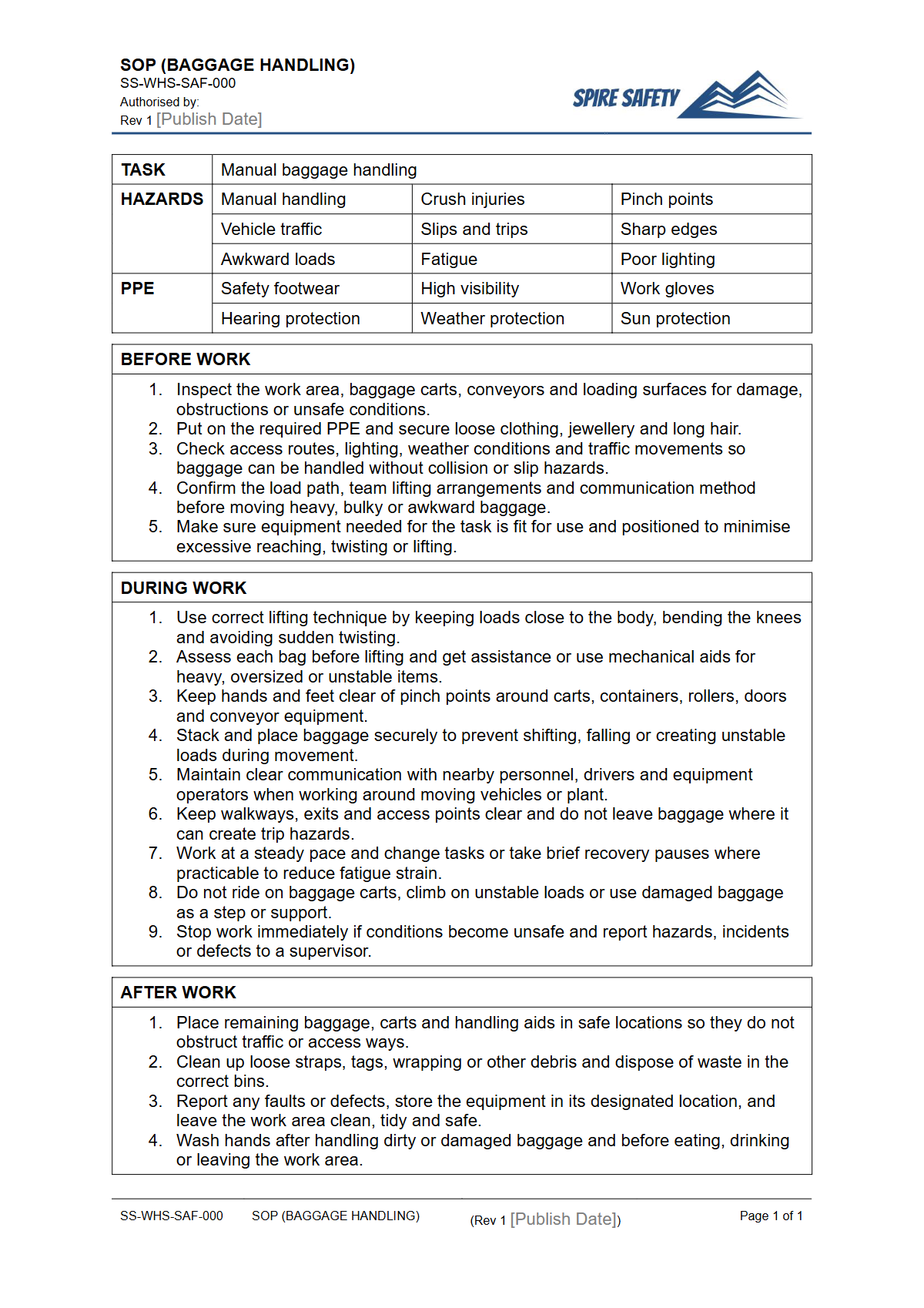
Download our free Safe Operating Procedure (SOP) for baggage handling. This template helps outline safe work practices to manage manual handling risks.
Free Safe Operating Procedure (Baggage Handling) Template
DOCX • 126 KB + PDF
Updated Oct 2026
No signup required
Purpose of the Free Safe Operating Procedure (Baggage Handling) Template
Baggage handling is a high-risk activity involving repetitive lifting, carrying, and twisting, often in confined spaces and under time pressure. Developing a safe system of work for handling luggage and cargo requires a structured approach.
This Free Safe Operating Procedure (Baggage Handling) Template provides a solid foundation for organisations in the aviation, transport, and logistics sectors to document and standardise their processes. Its primary purpose is to help PCBUs (Persons Conducting a Business or Undertaking) manage risks associated with manual tasks, thereby reducing the likelihood of musculoskeletal disorders (MSDs) like sprains and strains among ground crew and baggage handlers.
This Safe Operating Procedure template is designed to be a key component of your safety framework. It prompts you to outline step-by-step instructions for tasks, specify required Personal Protective Equipment (PPE), detail potential hazards, and list corresponding control measures.
Using this structured document helps ensure that safety requirements are clearly communicated to all workers, supporting training, inductions, and ongoing competency. A well-developed SOP can also integrate seamlessly into broader WHS management systems, ensuring a consistent approach to safety across your organisation.
Video walkthrough
How to use the Free Safe Operating Procedure (Baggage Handling) Template
This downloadable document provides a comprehensive starting point, aligned with Australian WHS principles for managing hazardous manual tasks. To make it effective for your specific operation, customisation is essential.
You should methodically work through each section, replacing the placeholder text with details relevant to your worksite, the specific aircraft or vehicles being serviced, and the types of baggage handling systems in use (e.g., carousels, conveyors, ULDs).
Important: This is a template, not a finished document. For it to be useful, we recommend you customise it to reflect the specific equipment, environment, and tasks at your workplace. Consultation is a critical step in this process.
Engage with your baggage handlers, ramp agents, and supervisors to ensure the procedures reflect the practical realities of the job. Their input is invaluable for identifying risks and developing workable controls.
Just as you would detail specific operational checks in a body truck SOP, this template prompts you to list the unique hazards and controls for your baggage handling tasks.
When to use a Baggage Handling SOP
A Safe Operating Procedure for baggage handling should be a living document, used consistently throughout your operations. It is not a document to be filed away and forgotten. It should be used:
- During worker induction and training: To provide new and existing employees with clear, standardised instructions on how to perform tasks safely.
- Before commencing work: As a pre-task checklist or reference guide for workers to refresh their understanding of safe work methods.
- For risk management activities: The SOP serves as a record of identified hazards and control measures, forming a crucial part of your risk assessment process.
- During incident investigations: To determine if procedures were followed and to identify areas where the SOP may need improvement.
- For performance and compliance reviews: Supervisors can use the SOP as a benchmark to observe work practices and provide coaching. Regular reviews and checks against best practice, often facilitated through WHS compliance auditing, will ensure the SOP remains effective.
Who should use this Safe Operating Procedure
This SOP is intended for all personnel involved in or responsible for the movement of passenger baggage and cargo. This includes a wide range of roles within the airport and logistics environment:
- Baggage Handlers and Ground Crew: The primary users who must follow the procedures for lifting, loading, unloading, and sorting luggage.
- Ramp Agents and Team Leaders: Responsible for overseeing tasks, ensuring procedures are followed, and providing on-the-job guidance.
- WHS Managers and Safety Officers: For developing, implementing, reviewing, and updating the procedure as part of the overall safety management system.
- Training Coordinators: To use as source material for developing training programs and competency assessments.
The principles of this document are applicable across various settings where manual handling of luggage occurs, from international airports to regional aerodromes and transport hubs. While this document focuses on manual baggage handling, you may need separate procedures for equipment, such as a Telehandler SOP, if used in your operations.
Explore our complete free WHS resources library for more templates to support your safety system.
Common mistakes
Common mistakes to avoid
- Failing to customise the template with site-specific details, rendering it generic and ineffective.
- Neglecting to consult with baggage handlers and ground crew when drafting or reviewing the procedure.
- Not providing adequate training to ensure all workers understand and can apply the SOP correctly.
- Treating the SOP as a 'set and forget' document instead of reviewing and updating it regularly.
Legal references
Legal considerations
The following legal requirements may be relevant to this type of work.
- Work Health and Safety Act (Harmonised) — Provides the primary duties for protecting workers and other people from work health and safety risks.
- Work Health and Safety Regulations (Harmonised) — Sets out requirements supporting the management of workplace hazards and risks.
The following codes may be relevant to this type of work.
- Managing WHS Risks Code of Practice — Provides practical guidance on identifying hazards, assessing risks and applying effective controls.
- Work Health and Safety Consultation, Cooperation and Coordination Code of Practice — Provides practical guidance on consulting workers and coordinating with other duty holders.
- Managing the Work Environment and Facilities Code of Practice — Provides practical guidance on safe work environments, workplace facilities and related controls.
Did you know
Manual Handling Statistics
According to Safe Work Australia, the transport, postal, and warehousing industry has one of the highest rates of serious claims for work-related injuries, with body stressing (manual handling) being a primary cause.
Team Lifting
While often seen as a simple control, team lifting requires proper coordination and training to be effective. An SOP should specify when team lifting is required and outline the correct technique to prevent injury.
FAQ
Frequently asked questions
01What are the main health and safety risks in baggage handling?
02How often should a Baggage Handling SOP be reviewed?
03Does this SOP template cover automated baggage handling systems?
04Who is responsible for ensuring the Baggage Handling SOP is followed?
Share this resource
Free Safe Operating Procedure (Baggage Handling) Template
Browse Categories
How To Use It
- 1Download and open in Word or PDF.
- 2Replace the placeholders with your business details.
- 3Get it reviewed by a WHS specialist before rollout.
Need it customised?
Our WHS consultants can adapt this template to your site, run a gap analysis, or audit what you already have in place.
Book a Free Consultation WHS consulting servicesor call 1300 156 382
Related templates
- Free Safe Operating Procedure (Baggage Reconciliation) Template
- Free Safe Operating Procedure (Baggage Transfer) Template
- Free Safe Operating Procedure (Baggage Tug) Template
- Free Safe Operating Procedure (Bagging Machine) Template
- Free Safe Operating Procedure (Baghouse Cleaning) Template
- Free Safe Operating Procedure (Bain Marie) Template