
Free Safe Operating Procedure (Baggage Reconciliation) Template
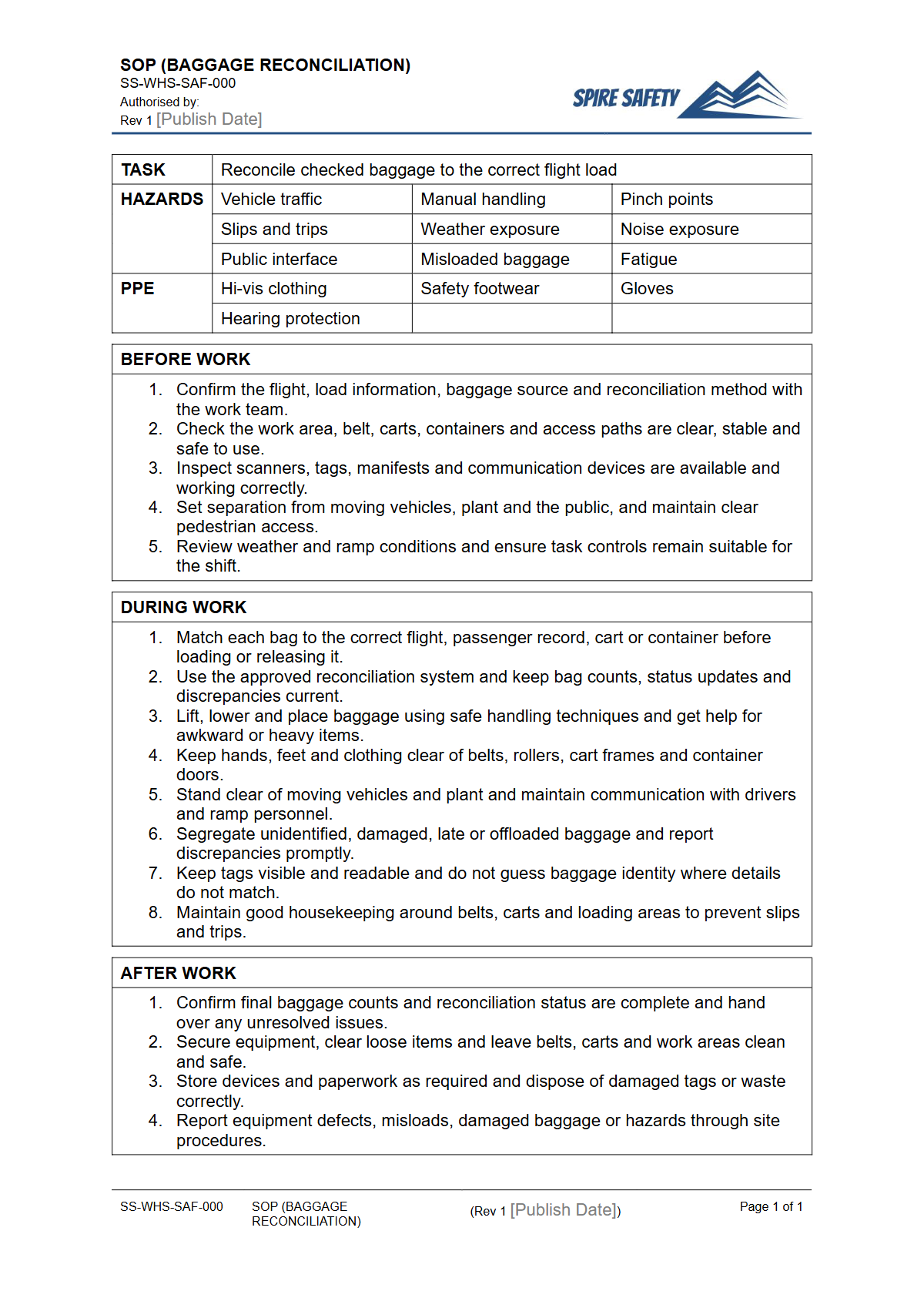
Download our free Safe Operating Procedure for Baggage Reconciliation.
Free Safe Operating Procedure (Baggage Reconciliation) Template
DOCX • 126 KB + PDF
Updated Oct 2026
No signup required
Purpose of the Free Safe Operating Procedure (Baggage Reconciliation) Template
Establishing a clear, documented process is essential for safety and efficiency in airport ground operations. Our free Safe Operating Procedure (Baggage Reconciliation) template provides a solid foundation for your organisation to define and manage the risks associated with matching passengers to their checked luggage.
This task, while routine, involves significant hazards including manual tasks, vehicle interactions, and time pressure.
The primary purpose of this SOP is to provide a clear, step-by-step guide for workers to follow, minimising their exposure to health and safety risks. It forms a critical component of a comprehensive WHS management system by formalising risk controls for identified hazards.
Key risks addressed include musculoskeletal injuries from manual handling, collisions with ground service equipment like those covered in a Body Truck SOP, and slip, trip, and fall hazards in a dynamic work environment. A well-implemented SOP helps ensure operational consistency, aids in training, and demonstrates due diligence in managing workplace safety.
Video walkthrough
How to use the Free Safe Operating Procedure (Baggage Reconciliation) Template
To get the most value from this free Safe Operating Procedure (Baggage Reconciliation) template, it must be adapted to the unique context of your operation. The downloaded DOCX file is fully editable.
You should add specific details about your worksite, the types of baggage handling equipment used, your particular reconciliation software or system, and site-specific emergency procedures.
Important Note: This document is a template we have created to serve as a starting point. It must be customised by a competent person to suit your specific business, state regulations, and the actual tasks being performed.
A regular review process, potentially as part of a WHS compliance audit, is essential to keep the document current and effective.
When to use this Safe Operating Procedure
This SOP should be a core document used in daily operations. It is essential for several key activities within your safety framework.
- Worker Training and Induction: Providing new and existing staff with clear instructions on the approved method for performing baggage reconciliation tasks safely.
- Pre-Task Planning: Serving as a reference for supervisors and teams before commencing work, especially for non-routine operations or changed conditions.
- Incident Investigation: Acting as a benchmark for safe practice when investigating why an incident or near miss occurred.
- Performance and Competency Reviews: Assessing whether workers are adhering to established safety protocols.
- Continuous Improvement: Forming the basis for discussions on how to make the task safer and more efficient.
Who should use this Safe Operating Procedure
This procedure is designed for a range of personnel within an aviation or transport organisation. Key users include:
- Baggage Handlers and Ground Crew: The primary users who perform the task and must follow the prescribed steps to ensure their own safety and that of their colleagues.
- Ramp Supervisors and Team Leaders: Responsible for ensuring their teams understand and comply with the SOP, and for conducting pre-shift briefings.
- Work Health and Safety (WHS) Managers: Use the SOP as a tool for risk management, training verification, and auditing safety performance.
- Training Coordinators: Integrate the SOP into induction programs and ongoing competency training modules.
For organisations needing assistance to develop or implement such procedures, specialist WHS consulting can provide valuable expertise and support. The SOP may also be useful for maintenance staff who need to understand operational procedures when working on related equipment, such as conveyor systems that may require access via platforms or ladders, as might be detailed in a free Step Ladder SOP template.
By formalising your processes with this SOP, you create a safer, more predictable work environment. For more templates and safety guides aligned with Australian WHS practices, explore our complete free WHS resources library.
Common mistakes
Common mistakes to avoid
- Using the template without customising it for specific worksite conditions and equipment.
- Failing to provide adequate training and competency checks for all workers who perform the task.
- Not consulting with workers (the people doing the job) when drafting or reviewing the procedure.
- Neglecting to review and update the SOP after an incident, near miss, or change in process.
Legal references
Legal considerations
The following legal requirements may be relevant to this type of work.
- Work Health and Safety Act (Harmonised) — Provides the primary duties for protecting workers and other people from work health and safety risks.
- Work Health and Safety Regulations (Harmonised) — Sets out requirements supporting the management of workplace hazards and risks.
The following codes may be relevant to this type of work.
- Managing WHS Risks Code of Practice — Provides practical guidance on identifying hazards, assessing risks and applying effective controls.
- Work Health and Safety Consultation, Cooperation and Coordination Code of Practice — Provides practical guidance on consulting workers and coordinating with other duty holders.
- Managing the Work Environment and Facilities Code of Practice — Provides practical guidance on safe work environments, workplace facilities and related controls.
Did you know
Manual Handling Impact
The transport, postal, and warehousing industry has one of the highest rates of serious claims for work-related musculoskeletal disorders in Australia, highlighting the importance of proper procedures for tasks like baggage handling.
Security and Safety
Accurate baggage reconciliation is not just a safety process; it's a critical international aviation security requirement to ensure that no unaccompanied baggage is loaded onto an aircraft.
FAQ
Frequently asked questions
01What is a Safe Operating Procedure for baggage reconciliation?
02Is this baggage reconciliation SOP a legal document?
03Who is responsible for creating and implementing an SOP?
04How often should a baggage reconciliation SOP be reviewed?
Share this resource
Free Safe Operating Procedure (Baggage Reconciliation) Template
Browse Categories
How To Use It
- 1Download and open in Word or PDF.
- 2Replace the placeholders with your business details.
- 3Get it reviewed by a WHS specialist before rollout.
Need it customised?
Our WHS consultants can adapt this template to your site, run a gap analysis, or audit what you already have in place.
Book a Free Consultation WHS consulting servicesor call 1300 156 382
Related templates
- Free Safe Operating Procedure (Baggage Transfer) Template
- Free Safe Operating Procedure (Baggage Tug) Template
- Free Safe Operating Procedure (Bagging Machine) Template
- Free Safe Operating Procedure (Baghouse Cleaning) Template
- Free Safe Operating Procedure (Bain Marie) Template
- Free Safe Operating Procedure (Bakery Cooling Racks) Template