
Free Safe Operating Procedure (Aviation Fuel Sampling) Template
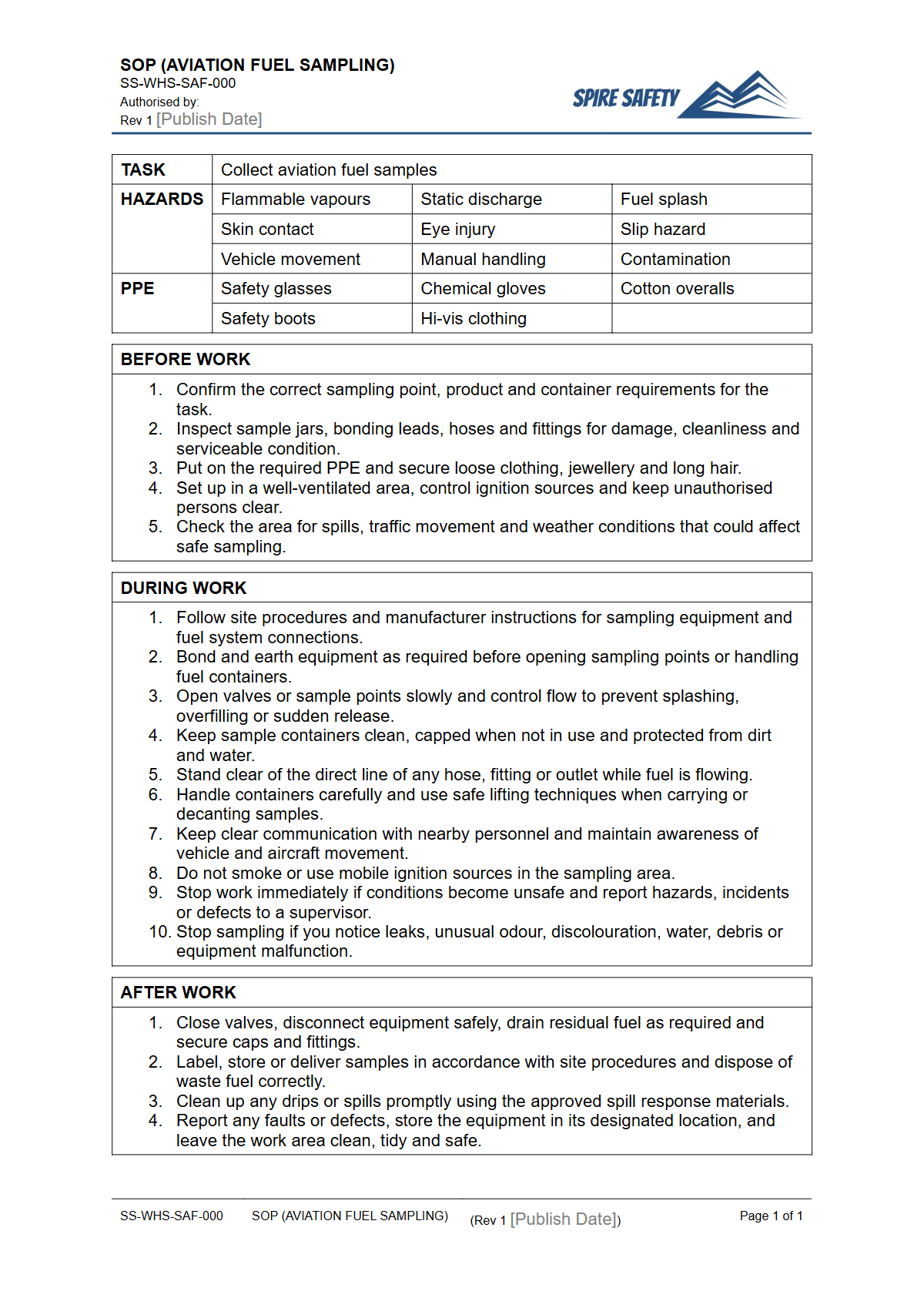
Download our free Safe Operating Procedure (Aviation Fuel Sampling) Template. This structured Word & PDF document helps outline safe work practices.
Free Safe Operating Procedure (Aviation Fuel Sampling) Template
DOCX • 126 KB + PDF
Updated Oct 2026
No signup required
Purpose of the Free Safe Operating Procedure (Aviation Fuel Sampling) Template
Aviation fuel sampling is a critical process for ensuring aircraft safety, verifying fuel quality, and preventing catastrophic engine failure caused by contaminants like water, sediment, or microbial growth. This free Safe Operating Procedure (Aviation Fuel Sampling) Template provides a structured starting point for documenting the required steps to perform this task safely.
Using a detailed SOP helps your organisation manage the significant risks associated with handling highly flammable liquids, including fire, explosion, and health exposure hazards. Formalising this process is a key part of demonstrating how you provide and maintain a safe system of work. Well-documented procedures are a cornerstone of effective safety protocols and form a vital part of more comprehensive WHS management systems.
Video walkthrough
How to use the Free Safe Operating Procedure (Aviation Fuel Sampling) Template
This template is provided in both an editable DOCX format and a print-ready PDF. To use it effectively, you must adapt its contents to reflect the specific equipment, environment, and personnel at your worksite.
The document includes sections for you to detail essential safety information, including required Personal Protective Equipment (PPE), pre-task hazard identification, and emergency procedures. The core of the document is a step-by-step procedural guide that you should populate with the exact sequence of actions for sampling from your specific aircraft, fuel storage tanks, or refuelling vehicles.
Depending on the equipment used, you may need to integrate procedures from other SOPs, such as our free Body Truck SOP for tasks involving fuel bowsers.
Important Customisation Note
This document provides a framework aligned with Australian WHS principles. However, it is not a complete, out-of-the-box solution.
We have provided this template as a starting point. You must customise it by consulting with workers and incorporating site-specific details, including the types of aircraft, fuel types (e.g., Avgas, Jet A-1), sampling equipment, and your organisation's emergency response plans.
A generic procedure is insufficient for ensuring safety and compliance.
When to use it
A Safe Operating Procedure for aviation fuel sampling should be developed and implemented before any personnel are permitted to perform the task. It serves as a primary training document for new workers and a reference for experienced staff.
The SOP should be readily accessible at the location where sampling occurs. It is also a critical tool for supervisors to monitor work and for managers to conduct safety observations.
Regular reviews of the SOP are essential, particularly after any incident, near miss, or when changes are made to equipment, chemicals, or processes. The effectiveness of your SOPs will often be assessed during a formal WHS compliance auditing process.
Who should use it
This template is designed for use by anyone responsible for operational safety in an aviation environment. This includes:
- WHS Managers and Safety Officers: To develop, implement, and review safety documentation.
- Operations and Ground Handling Managers: To ensure their teams have clear, standardised instructions for high-risk tasks.
- Supervisors and Team Leaders: For training their teams and overseeing the safe execution of work.
- Workers: Aircraft Maintenance Engineers (AMEs), Licensed Aircraft Maintenance Engineers (LAMEs), Authorised Ground Handlers, and Refuellers should all be trained on and use the finalised SOP as their guide for performing the task correctly and safely.
The principles of documenting safe procedures extend to all tasks on the tarmac or in the hangar. For example, if sampling requires accessing points at height, a corresponding procedure like our Step Ladder SOP should also be referenced.
Similarly, you may need procedures for associated ground support equipment, for which our template for an Air Compressor SOP could serve as a useful example. Explore our entire free WHS resources library for more templates to support your safety system.
Common mistakes
Common mistakes to avoid
- Using a dirty or inappropriate sample jar, which can introduce contaminants and invalidate the test.
- Failing to properly bond the aircraft and sampling equipment, creating a serious static electricity and ignition risk.
- Not allowing the fuel sample to settle for the required time before inspection, making it difficult to spot water or sediment.
- Poor housekeeping, such as not immediately cleaning up small spills, which creates fire and slip hazards.
Legal references
Legal considerations
The following legal requirements may be relevant to this type of work.
- Work Health and Safety Act (Harmonised) — Provides the primary duties for protecting workers and other people from work health and safety risks.
- Work Health and Safety Regulations (Harmonised) — Sets out requirements supporting the management of workplace hazards and risks.
The following codes may be relevant to this type of work.
- Managing WHS Risks Code of Practice — Provides practical guidance on identifying hazards, assessing risks and applying effective controls.
- Work Health and Safety Consultation, Cooperation and Coordination Code of Practice — Provides practical guidance on consulting workers and coordinating with other duty holders.
- Managing the Work Environment and Facilities Code of Practice — Provides practical guidance on safe work environments, workplace facilities and related controls.
Did you know
Ice Hazard
Even a small amount of water in jet fuel can be extremely dangerous. At high altitudes, this water can freeze into ice crystals, blocking fuel filters and lines and potentially starving the engines of fuel.
Static Spark
The simple act of fuel flowing through a hose can generate enough static electricity to create a spark powerful enough to ignite fuel vapours. This is why bonding and grounding procedures are a non-negotiable part of any aviation refuelling or sampling SOP.
FAQ
Frequently asked questions
01What are the main hazards of aviation fuel sampling?
02How often should an aviation fuel sampling SOP be reviewed?
03What kind of PPE is required for sampling jet fuel?
04Why is taking a fuel sample so important in aviation?
Share this resource
Free Safe Operating Procedure (Aviation Fuel Sampling) Template
Browse Categories
How To Use It
- 1Download and open in Word or PDF.
- 2Replace the placeholders with your business details.
- 3Get it reviewed by a WHS specialist before rollout.
Need it customised?
Our WHS consultants can adapt this template to your site, run a gap analysis, or audit what you already have in place.
Book a Free Consultation WHS consulting servicesor call 1300 156 382
Related templates
- Free Safe Operating Procedure (Avocado Harvesting) Template
- Free Safe Operating Procedure (Awning Maintenance) Template
- Free Safe Operating Procedure (Backflow Device Check) Template
- Free Safe Operating Procedure (Bag Dump Station) Template
- Free Safe Operating Procedure (Baggage Belt Cleanup) Template
- Free Safe Operating Procedure (Baggage Cart Loading) Template