
Free Safe Operating Procedure (Bag Dump Station) Template
Download our free Safe Operating Procedure (Bag Dump Station) template.
Free Safe Operating Procedure (Bag Dump Station) Template
DOCX • 126 KB + PDF
Updated Oct 2026
No signup required
Purpose of the Free Safe Operating Procedure (Bag Dump Station) Template
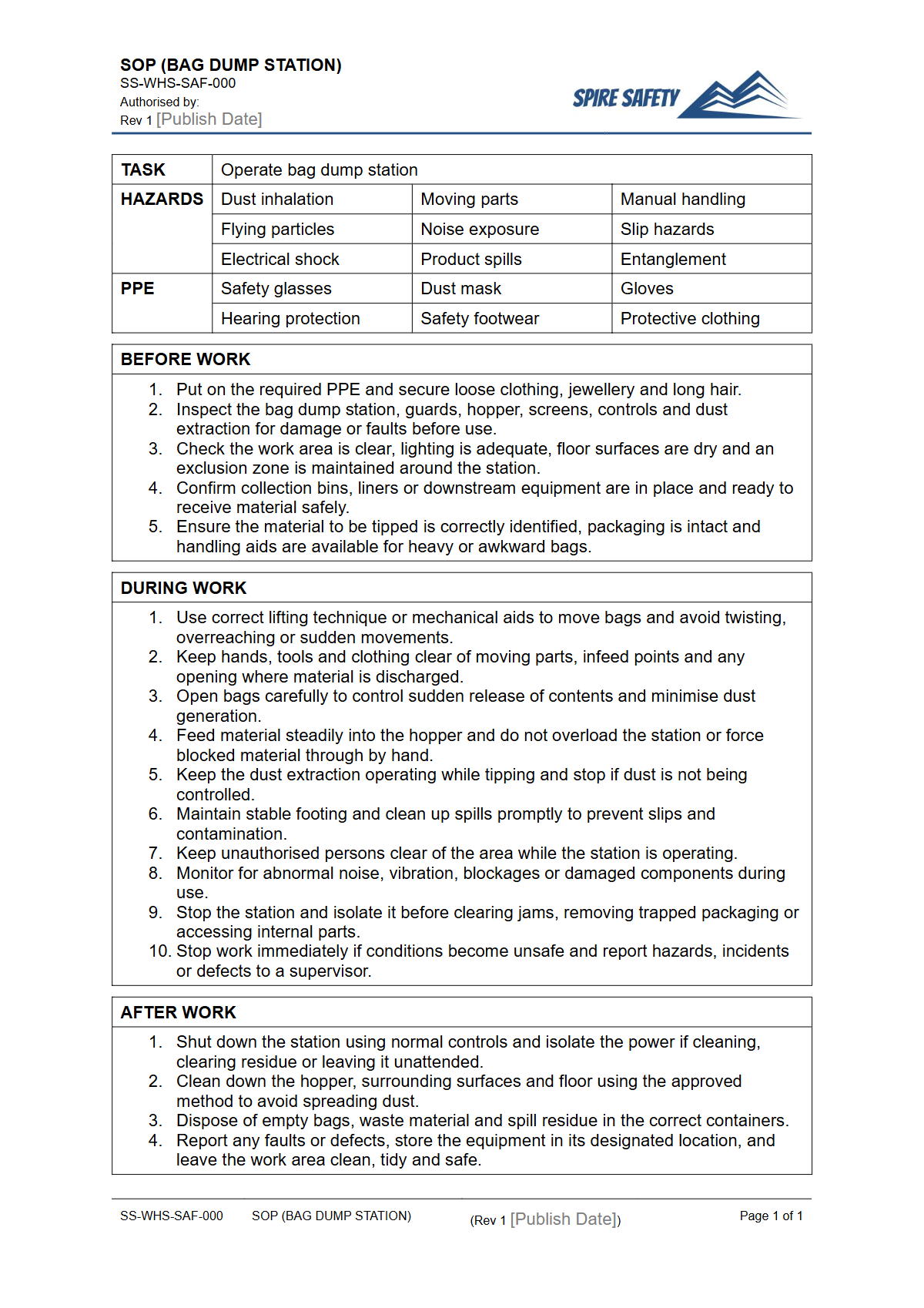
Operating a bag dump station involves significant risks, including exposure to hazardous dusts, manual handling injuries, and mechanical hazards. This Free Safe Operating Procedure (Bag Dump Station) Template provides a structured starting point for documenting the required safety measures for your workplace.
Developing a clear, comprehensive SOP is a fundamental step in controlling these risks and ensuring workers can perform the task safely and consistently. It formalises pre-operational checks, step-by-step operating instructions, and shutdown procedures, helping to fulfil your duty of care under Australian WHS laws.
A well-defined SOP is a critical element of a site's safety framework. It serves as a key training document for new operators and a reference for experienced staff.
Integrating this procedure into your broader safety program demonstrates a proactive approach to risk management. Properly documented procedures are essential for building robust WHS management systems that protect workers and support organisational compliance.
Video walkthrough
How to use the Free Safe Operating Procedure (Bag Dump Station) Template
This template is designed for easy customisation. Download the DOCX file and adapt it to the specific make and model of your bag dump station, the materials being handled, and your unique site conditions.
Pay close attention to sections covering Personal Protective Equipment (PPE), dust collection system operation, and lockout-tagout (LOTO) procedures for cleaning and maintenance.
Important: This is a template, not a finished document. You must customise it to reflect the specific hazards and control measures relevant to your workplace.
We are not responsible for the outcomes if you fail to adapt this document to your specific operational context. For example, your station might rely on compressed air for its pulse-jet filter cleaning system; in this case, you should integrate safety protocols detailed in documents like a Free Air Compressor SOP (Safe Operating Procedure) Template.
What to include when customising your SOP:
- Plant & Equipment Details: Specify the manufacturer, model, and location of the equipment.
- Required PPE: List all mandatory PPE, such as P2/P3 respirators, safety glasses, gloves, and protective clothing, based on your risk assessment and the Safety Data Sheet (SDS) of the material.
- Step-by-Step Instructions: Detail every action from pre-start checks (e.g., inspecting the dust collector, checking door seals) to operation (loading bags, slitting, emptying) and shutdown.
- Emergency Procedures: Outline steps for managing spills, dust exposure, equipment malfunction, or fire.
- Maintenance and Cleaning: Specify safe procedures for filter changes, clearing blockages, and general housekeeping, including LOTO requirements.
When to use it
A Safe Operating Procedure for a bag dump station should be used consistently. It is a vital document for the initial training and competency assessment of any worker assigned to operate the equipment.
It should also be readily accessible in the work area for quick reference. The SOP is a critical tool during incident investigations to determine if procedures were followed and if they remain adequate.
Furthermore, SOPs should be reviewed periodically—typically annually or whenever there is a change in equipment, processes, materials, or relevant legislation—to ensure they remain current and effective. A scheduled review process can form part of your regular WHS compliance auditing program.
Who should use it
This Safe Operating Procedure is intended for several key roles within an organisation:
- Operators: As the primary users, operators must be trained on and follow the SOP to ensure their own safety and that of their colleagues.
- Supervisors and Managers: They are responsible for ensuring operators are trained, deemed competent, and adhere to the established procedure. They also lead the implementation and enforcement of the SOP.
- WHS Personnel: Safety professionals use the SOP as a basis for risk assessments, training development, and incident investigations.
- Maintenance Staff: Workers who service, clean, or repair the bag dump station must follow specific safety steps outlined in the SOP, particularly regarding energy isolation and LOTO.
By clearly defining responsibilities, the SOP ensures everyone understands their role in maintaining a safe system of work. This principle applies to all types of machinery, as seen in other procedural documents like our Free Brake Press SOP (Safe Operating Procedure) Template.
Key Hazards Associated with Bag Dump Stations
Effectively managing safety requires a clear understanding of the hazards. Bag dump stations, while designed to control dust, can still present several risks if not used or maintained correctly. The primary hazards include:
- Airborne Contaminants: The most significant hazard is the inhalation of fine powders and dusts, which can lead to respiratory illnesses. This is especially critical when handling hazardous substances like silica, chemicals, or allergens.
- Manual Handling Injuries: Lifting, carrying, and positioning heavy bags (often 20-25 kg) can cause musculoskeletal disorders, including back strains and sprains.
- Mechanical Hazards: Moving parts within the station or its integrated conveyors can create pinch points and entanglement risks if guards or interlocks are bypassed.
- Ergonomic Risks: Repetitive motions and awkward postures while loading and emptying bags can contribute to long-term strain injuries.
Identifying and controlling these hazards is a core WHS duty. If you need assistance with comprehensive risk assessments for your plant, consider engaging professional WHS consulting services.
By downloading and customising this template, you are taking a proactive step towards creating a safer work environment. Explore our complete free WHS resources library for more templates and guides to support your safety management system.
Common mistakes
Common mistakes to avoid
- Bypassing or disabling safety interlocks on the access door to speed up the process.
- Failing to turn on, or properly maintain, the integrated dust collection system, leading to worker exposure.
- Using incorrect manual handling techniques (e.g., twisting while lifting) when loading bags onto the station.
- Neglecting to wear appropriate Respiratory Protective Equipment (RPE) specified for the material being handled.
Legal references
Legal considerations
The following legal requirements may be relevant to this type of work.
- Work Health and Safety Act (Harmonised) — Provides the primary duties for protecting workers and other people from work health and safety risks.
- Work Health and Safety Regulations (Harmonised) — Sets out requirements supporting the management of workplace hazards and risks.
The following codes may be relevant to this type of work.
- Managing WHS Risks Code of Practice — Provides practical guidance on identifying hazards, assessing risks and applying effective controls.
- Work Health and Safety Consultation, Cooperation and Coordination Code of Practice — Provides practical guidance on consulting workers and coordinating with other duty holders.
- Managing the Work Environment and Facilities Code of Practice — Provides practical guidance on safe work environments, workplace facilities and related controls.
Did you know
Dust Dangers
Many common powders, like flour or sawdust, can be explosive when suspended in air as a fine dust cloud in an enclosed space. Bag dump station dust collectors are critical not just for health, but also for preventing potential dust explosions.
Manual Handling Impact
In Australia, work-related musculoskeletal disorders account for a significant portion of serious workers' compensation claims. Repetitive lifting of 25kg bags is a major risk factor that SOPs aim to control through proper technique and mechanical aids.
FAQ
Frequently asked questions
01What is a Safe Operating Procedure for a bag dump station?
02What are the main risks when operating a bag dump station?
03How often should a bag dump station SOP be reviewed?
04Is specific training required to use a bag dump station?
Share this resource
Free Safe Operating Procedure (Bag Dump Station) Template
Browse Categories
How To Use It
- 1Download and open in Word or PDF.
- 2Replace the placeholders with your business details.
- 3Get it reviewed by a WHS specialist before rollout.
Need it customised?
Our WHS consultants can adapt this template to your site, run a gap analysis, or audit what you already have in place.
Book a Free Consultation WHS consulting servicesor call 1300 156 382
Related templates
- Free Safe Operating Procedure (Baggage Belt Cleanup) Template
- Free Safe Operating Procedure (Baggage Cart Loading) Template
- Free Safe Operating Procedure (Baggage Handling) Template
- Free Safe Operating Procedure (Baggage Reconciliation) Template
- Free Safe Operating Procedure (Baggage Transfer) Template
- Free Safe Operating Procedure (Baggage Tug) Template