
Free Safe Operating Procedure (Avocado Harvesting) Template
Download our free Safe Operating Procedure (Avocado Harvesting) template.
Free Safe Operating Procedure (Avocado Harvesting) Template
DOCX • 126 KB + PDF
Updated Oct 2026
No signup required
Purpose of the Free Safe Operating Procedure (Avocado Harvesting) Template
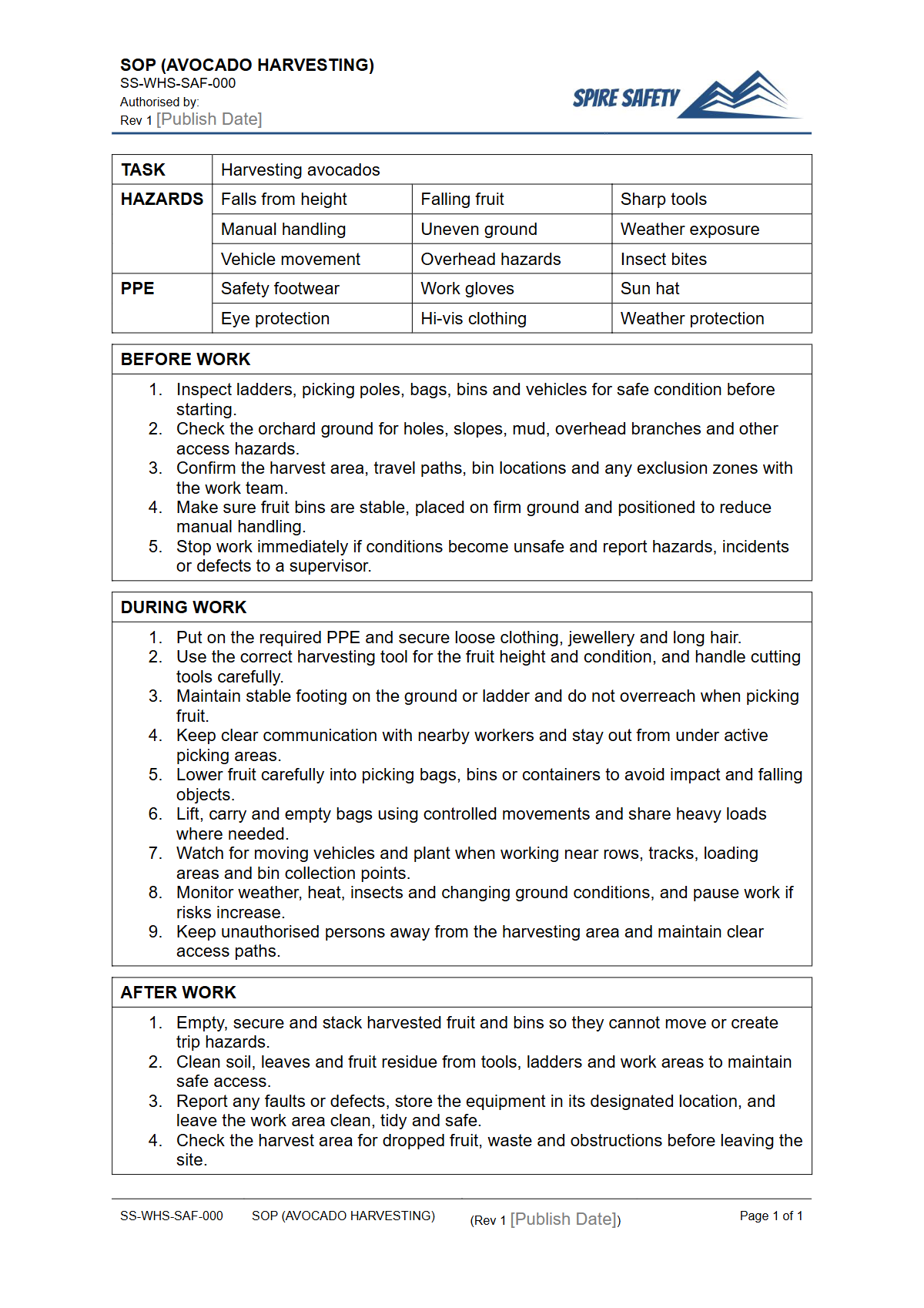
This Safe Operating Procedure for avocado harvesting provides a structured starting point for documenting a safe system of work for this common horticultural task. Using a clear SOP helps manage significant risks associated with harvesting, including falls from height, manual handling injuries, and interaction with mobile plant.
Our free template is designed to help persons conducting a business or undertaking (PCBUs) in the agricultural sector meet their duties by outlining logical steps, required personal protective equipment (PPE), and key safety considerations. Implementing documented procedures is a fundamental part of effective WHS management systems, ensuring tasks are performed consistently and safely.
Video walkthrough
How to use the Free Safe Operating Procedure (Avocado Harvesting) Template
To get the most value from this resource, it must be adapted to the specific conditions of your orchard and the equipment used. This template is a foundation, not a final document.
Begin by downloading the DOCX file and reviewing its contents against your current harvesting practices. You should consult with your workers—the people actually picking the avocados—to ensure the procedure is practical, accurate, and reflects the realities of the job.
For tasks involving specific high-risk equipment, this SOP should be used alongside other dedicated procedures, such as our free Telehandler SOP template if one is used for moving fruit bins.
1. Customise the SOP
Edit the document to include details specific to your site. This includes specifying the types of ladders or elevated work platforms (EWPs) used, the make and model of any vehicles, the layout of the orchard, and any unique environmental hazards like uneven ground or overhead powerlines.
When detailing work at height, referencing a specific procedure like our free Step Ladder SOP template can add another layer of safety control.
2. Train Your Team
Once customised, the SOP must be used to train all relevant workers. This training should be documented, and you must verify that each worker understands the procedure before they begin harvesting.
Training is not a one-off event; it should be part of worker induction and regular refresher programs. The goal is to ensure the safe procedure becomes standard behaviour.
3. Review and Improve
A Safe Operating Procedure is a living document. It should be reviewed annually, or more frequently if circumstances change.
A review is mandatory after a near-miss or incident, when new equipment is introduced, or if legislation is updated. Continuous review and improvement help keep your safety systems effective.
When to use a Safe Operating Procedure
This SOP should be used as a primary reference document for all avocado harvesting activities. It is a critical tool for pre-work risk assessments, toolbox talks, and new worker inductions.
It provides the benchmark for how the task should be performed safely. The procedure should also cover associated tasks like moving harvested fruit, which may require coordination with transport vehicles.
For these related tasks, you may need a separate procedure, such as a free Body Truck SOP template, to manage loading and transport risks.
Who should use it
This resource is designed for anyone responsible for safety in an agricultural setting. Farm managers, supervisors, and WHS officers can use this template to develop and implement formal safety procedures.
Workers and harvesting teams should use the finalised SOP as their guide for performing the task safely. Having documented procedures is also crucial for demonstrating due diligence during safety inspections or a WHS compliance audit. If you lack the internal expertise to adapt and implement these procedures effectively, seeking external guidance from qualified professionals can be a valuable step.
Expert WHS consulting can help bridge gaps in your safety management system.
This document is just one of many resources available to help you build a safer workplace. For more templates, checklists, and guides covering a wide range of tasks and equipment, explore our complete free WHS resources library.
Common mistakes
Common mistakes to avoid
- Using a generic template without customising it for specific orchard conditions and equipment.
- Failing to adequately train workers on the SOP and verify their understanding before work starts.
- Not reviewing or updating the procedure after an incident or when new machinery is introduced.
- Neglecting to consult with workers who perform the harvesting tasks during the SOP's development.
Legal references
Legal considerations
The following legal requirements may be relevant to this type of work.
- Work Health and Safety Act (Harmonised) — Provides the primary duties for protecting workers and other people from work health and safety risks.
- Work Health and Safety Regulations (Harmonised) — Sets out requirements supporting the management of workplace hazards and risks.
The following codes may be relevant to this type of work.
- Managing WHS Risks Code of Practice — Provides practical guidance on identifying hazards, assessing risks and applying effective controls.
- Work Health and Safety Consultation, Cooperation and Coordination Code of Practice — Provides practical guidance on consulting workers and coordinating with other duty holders.
- Managing the Work Environment and Facilities Code of Practice — Provides practical guidance on safe work environments, workplace facilities and related controls.
Did you know
Falls from Height
Falls from ladders and elevated work platforms are a leading cause of serious injuries and fatalities in the Australian horticulture industry. A documented safe system of work is a primary control measure.
Manual Task Risks
A full bin of avocados can weigh over 400kg, posing significant musculoskeletal injury risks during transport and loading. Mechanical aids are essential to control these hazardous manual task risks.
FAQ
Frequently asked questions
01What should be included in an SOP for avocado harvesting?
02Is using a template enough for WHS compliance?
03How often should we review our avocado harvesting SOP?
04Who is responsible for creating a Safe Operating Procedure?
Share this resource
Free Safe Operating Procedure (Avocado Harvesting) Template
Browse Categories
How To Use It
- 1Download and open in Word or PDF.
- 2Replace the placeholders with your business details.
- 3Get it reviewed by a WHS specialist before rollout.
Need it customised?
Our WHS consultants can adapt this template to your site, run a gap analysis, or audit what you already have in place.
Book a Free Consultation WHS consulting servicesor call 1300 156 382
Related templates
- Free Safe Operating Procedure (Awning Maintenance) Template
- Free Safe Operating Procedure (Backflow Device Check) Template
- Free Safe Operating Procedure (Bag Dump Station) Template
- Free Safe Operating Procedure (Baggage Belt Cleanup) Template
- Free Safe Operating Procedure (Baggage Cart Loading) Template
- Free Safe Operating Procedure (Baggage Handling) Template