
Free Safe Operating Procedure (Awning Maintenance) Template
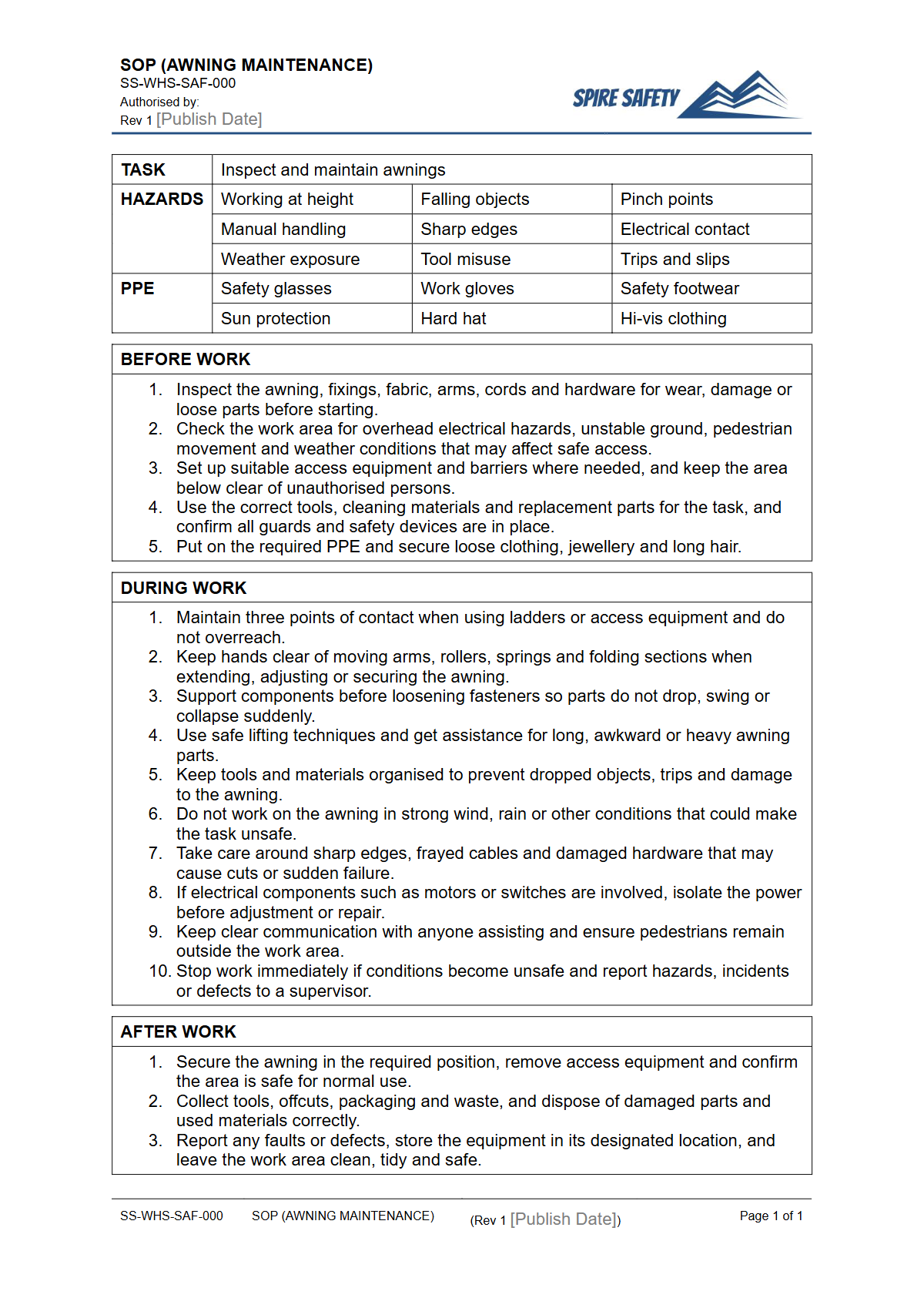
Download our free Safe Operating Procedure for awning maintenance. This DOCX and PDF template helps you outline safe work methods for cleaning and repairs.
Free Safe Operating Procedure (Awning Maintenance) Template
DOCX • 126 KB + PDF
Updated Oct 2026
No signup required
Purpose of the Free Safe Operating Procedure (Awning Maintenance) Template
The purpose of this Free Safe Operating Procedure (Awning Maintenance) Template is to help you establish a clear, documented process for maintaining awnings safely. This task often involves significant risks, such as working at height, manual handling, and potential interaction with electricity if awnings are motorised.
By formalising the procedure, you provide workers with clear instructions, identify necessary safety equipment, and create a training resource that supports your overall WHS management system. A key hazard during awning maintenance is the use of access equipment; for related guidance, you can refer to our dedicated step ladder SOP.
Video walkthrough
How to use the Free Safe Operating Procedure (Awning Maintenance) Template
This resource is provided in both DOCX and PDF formats. The DOCX version is fully editable, allowing you to adapt it to your specific operational needs, equipment, and work environment.
It is structured to align with Australian WHS practice, providing a solid foundation for your site-specific documentation.
Important: This is a template, not a finished document. You must customise it to reflect the specific types of awnings you service (e.g., retractable, fixed, cantilevered), the tools and chemicals used, the unique environmental conditions of your workplace, and your organisation's internal safety policies.
We recommend a competent person reviews and approves the final document before implementation.
When to use it
This SOP should be used whenever maintenance, cleaning, or repair work is performed on awnings. This includes scheduled preventative maintenance checks, responsive repairs, and seasonal cleaning activities.
It serves as a pre-work checklist to ensure all safety measures are in place and as a reference guide during the task. Integrating such procedures is a fundamental part of establishing effective WHS management systems, demonstrating proactive risk management to workers and regulators.
Who should use it
This document is designed for use by Persons Conducting a Business or Undertaking (PCBUs), facility managers, maintenance supervisors, and the workers who perform the awning maintenance tasks. Supervisors should use it to induct and train workers, ensuring they understand the risks and required controls before commencing work.
Workers should use it to guide their work practices and confirm they are following the agreed-upon safe method. For more complex risk environments, engaging professional WHS consulting services can help ensure your procedures are robust and effective.
Developing Your Procedure
When customising this template, consider all phases of the job, including:
- Pre-start checks of tools and equipment.
- Site assessment for hazards like overhead powerlines or uneven ground.
- Securing the work area to protect the public.
- Safe use of cleaning agents, including reviewing Safety Data Sheets (SDS).
- Procedures for working at height.
- Waste disposal and site clean-up.
Regularly reviewing and updating your SOPs is crucial for maintaining their relevance and effectiveness. Changes in equipment, chemicals, or work environments should trigger a review.
This process can be formalised through internal checks or independent WHS compliance auditing to identify any gaps in your safety systems.
Developing SOPs for all key tasks is a sign of a mature safety culture. Whether workers are using simple access equipment, cleaning chemicals, or powered tools, a documented procedure is vital.
For example, our free air compressor SOP template offers a similar structure for another common piece of maintenance equipment.
This document is one of many resources designed to support Australian businesses in managing workplace safety. You can explore a wide range of templates, checklists, and guides in our free WHS resources library to build out your safety documentation.
Common mistakes
Common mistakes to avoid
- Forgetting to include electrical safety precautions and lockout/tagout procedures for motorised awnings.
- Failing to properly assess risks associated with working at height, such as unstable ladders or adverse weather.
- Using generic procedures that don't account for site-specific hazards like pedestrian traffic or overhead power lines.
- Neglecting to specify the correct Personal Protective Equipment (PPE) for tasks involving chemicals or fall risks.
Legal references
Legal considerations
The following legal requirements may be relevant to this type of work.
- Work Health and Safety Act (Harmonised) — Provides the primary duties for protecting workers and other people from work health and safety risks.
- Work Health and Safety Regulations (Harmonised) — Sets out requirements supporting the management of workplace hazards and risks.
The following codes may be relevant to this type of work.
- Managing WHS Risks Code of Practice — Provides practical guidance on identifying hazards, assessing risks and applying effective controls.
- Work Health and Safety Consultation, Cooperation and Coordination Code of Practice — Provides practical guidance on consulting workers and coordinating with other duty holders.
- Managing the Work Environment and Facilities Code of Practice — Provides practical guidance on safe work environments, workplace facilities and related controls.
Did you know
Working at Height Risks
Falls from a height of two to three metres account for a significant portion of fatalities and serious injuries in Australian workplaces, highlighting the danger of even seemingly low-height tasks.
The Value of Maintenance
Regular cleaning and maintenance not only improve the appearance of an awning but can also prevent fabric degradation and frame corrosion, significantly extending its service life and preventing hazards from component failure.
FAQ
Frequently asked questions
01What should be included in a Safe Operating Procedure for awning maintenance?
02Who is responsible for creating an SOP for awning maintenance?
03How often should an awning maintenance SOP be reviewed?
04Is this template suitable for all types of awnings?
Share this resource
Free Safe Operating Procedure (Awning Maintenance) Template
Browse Categories
How To Use It
- 1Download and open in Word or PDF.
- 2Replace the placeholders with your business details.
- 3Get it reviewed by a WHS specialist before rollout.
Need it customised?
Our WHS consultants can adapt this template to your site, run a gap analysis, or audit what you already have in place.
Book a Free Consultation WHS consulting servicesor call 1300 156 382
Related templates
- Free Safe Operating Procedure (Backflow Device Check) Template
- Free Safe Operating Procedure (Bag Dump Station) Template
- Free Safe Operating Procedure (Baggage Belt Cleanup) Template
- Free Safe Operating Procedure (Baggage Cart Loading) Template
- Free Safe Operating Procedure (Baggage Handling) Template
- Free Safe Operating Procedure (Baggage Reconciliation) Template