
Free Safe Operating Procedure (Automatic Door Service) Template
Download our free Safe Operating Procedure (Automatic Door Service) template. This professional Word & PDF resource helps document hazards and controls.
Free Safe Operating Procedure (Automatic Door Service) Template
DOCX • 126 KB + PDF
Updated Oct 2026
No signup required
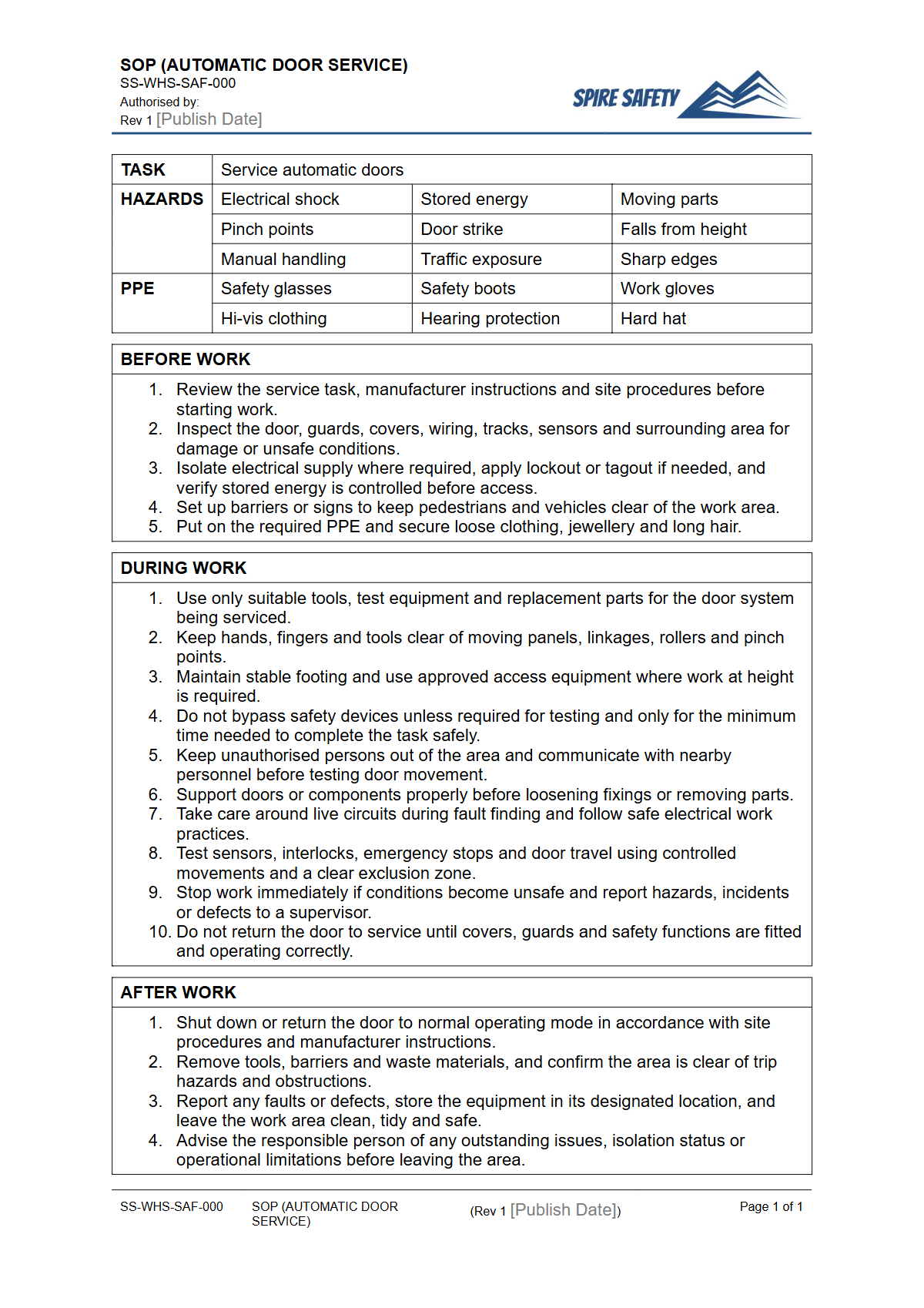
Purpose of the Free Safe Operating Procedure (Automatic Door Service) Template
Servicing automatic doors involves significant risks, including electrical shock, unexpected movement, and crush hazards. This Free Safe Operating Procedure (Automatic Door Service) Template provides a structured framework for documenting the step-by-step process to perform maintenance, repair, and installation tasks safely.
It helps organisations identify potential hazards, implement effective risk controls, and establish a clear, repeatable process for technicians. A documented SOP is a fundamental component of providing a safe system of work under Australian WHS legislation.
Using a standardised procedure ensures that all technicians, regardless of experience, follow the same safety-critical steps. This SOP prompts consideration of key safety actions like pre-start checks, isolating energy sources (lock-out, tag-out), manual handling, and post-service testing.
It serves as an essential tool for training, competency assessment, and incident investigation. Integrating task-specific SOPs like this one is a core element of building robust WHS management systems that protect workers and ensure operational consistency.
Video walkthrough
How to use the Free Safe Operating Procedure (Automatic Door Service) Template
This template is provided in an editable DOCX format for easy customisation. After downloading, a competent person must review and adapt the document to align with your specific operational context.
This involves detailing the exact models of automatic doors your team services, the specific tools and equipment used, and the unique environmental conditions of your worksites.
Important: This document is a template and must be customised. It is not a complete or ready-to-use Safe Operating Procedure.
We provide it as a starting point, and you are responsible for ensuring it is adapted to the specific plant, tasks, and hazards in your workplace. You must consult with your workers and conduct a site-specific risk assessment to ensure all potential hazards are identified and controlled.
When to use this Safe Operating Procedure
This SOP should be used as a primary reference document before, during, and after any service work on automatic doors. It is particularly important in several key scenarios:
- Technician Training: Use the SOP as a foundational document for inducting new technicians and for refresher training on safety protocols.
- Pre-Task Planning: Supervisors and technicians should review the SOP before commencing work to refresh their understanding of the required steps and safety controls.
- On-Site Reference: Having a copy available (digitally or physically) allows technicians to reference the correct procedure if they encounter an unexpected situation.
- Audits and Inspections: The SOP serves as evidence that a formalised process for safe work exists, which is often reviewed during internal or external safety audits. An effective way to verify that procedures are followed correctly is through periodic WHS compliance auditing.
Who should use it
This Safe Operating Procedure is designed for use by several key roles within an organisation that installs or maintains automatic doors:
- Service Technicians and Electricians: The primary users who perform the hands-on maintenance, repair, and installation tasks.
- Apprentices and Trainees: Provides a clear, step-by-step guide for learning how to perform the job safely under supervision.
- Supervisors and Team Leaders: Used to manage work, assign tasks, and ensure that safety standards are being met by their teams.
- WHS Managers and Advisors: A critical document for inclusion in the overall safety management system, used for risk management, training development, and compliance monitoring. For complex equipment or tasks, developing multiple procedures can be necessary, such as a separate Safe Operating Procedure for step ladder use if access requires working at height.
Developing comprehensive WHS documentation can be challenging. If your organisation requires assistance in creating tailored procedures or implementing a full safety system, our team offers expert WHS consulting to guide you through the process.
By implementing this SOP, your business takes a proactive step towards managing the risks associated with automatic door servicing. For more templates and safety resources, explore our complete free WHS resources library.
Common mistakes
Common mistakes to avoid
- Forgetting to de-energise and lock out the power source before commencing any physical work.
- Failing to test all safety features, such as sensors and emergency stops, after service is complete.
- Using an inappropriate ladder or standing on unstable objects to access door mechanisms.
- Not establishing an exclusion zone or using barriers to prevent public access during testing and maintenance.
Legal references
Legal considerations
The following legal requirements may be relevant to this type of work.
- Work Health and Safety Act (Harmonised) — Provides the primary duties for protecting workers and other people from work health and safety risks.
- Work Health and Safety Regulations (Harmonised) — Sets out requirements supporting the management of workplace hazards and risks.
The following codes may be relevant to this type of work.
- Managing WHS Risks Code of Practice — Provides practical guidance on identifying hazards, assessing risks and applying effective controls.
- Work Health and Safety Consultation, Cooperation and Coordination Code of Practice — Provides practical guidance on consulting workers and coordinating with other duty holders.
- Managing the Work Environment and Facilities Code of Practice — Provides practical guidance on safe work environments, workplace facilities and related controls.
Did you know
The Importance of LOTO
A significant percentage of electrical incidents during maintenance occur because equipment was not properly isolated. Always follow lock-out, tag-out (LOTO) procedures to de-energise and secure machinery before starting work.
Australian Standard for Powered Doors
The standard AS 5007-2007 outlines specific safety requirements for powered doors for pedestrian access and egress in Australia, covering aspects like activation systems and safety sensors.
FAQ
Frequently asked questions
01What are the main hazards when servicing automatic doors?
02Is a Safe Operating Procedure legally required for automatic door maintenance in Australia?
03How often should an Automatic Door Service SOP be reviewed?
04Can this template be used for all types of automatic doors?
Share this resource
Free Safe Operating Procedure (Automatic Door Service) Template
Browse Categories
How To Use It
- 1Download and open in Word or PDF.
- 2Replace the placeholders with your business details.
- 3Get it reviewed by a WHS specialist before rollout.
Need it customised?
Our WHS consultants can adapt this template to your site, run a gap analysis, or audit what you already have in place.
Book a Free Consultation WHS consulting servicesor call 1300 156 382
Related templates
- Free Safe Operating Procedure (Automatic Gate Reset) Template
- Free Safe Operating Procedure (Aviation Fuel Sampling) Template
- Free Safe Operating Procedure (Avocado Harvesting) Template
- Free Safe Operating Procedure (Awning Maintenance) Template
- Free Safe Operating Procedure (Backflow Device Check) Template
- Free Safe Operating Procedure (Bag Dump Station) Template