
Free Safe Operating Procedure (Automatic Door Reset) Template
Download our free Safe Operating Procedure (Automatic Door Reset) template. A structured starting point for managing automatic door reset risks.
Free Safe Operating Procedure (Automatic Door Reset) Template
DOCX • 126 KB + PDF
Updated Oct 2026
No signup required
Purpose of the Free Safe Operating Procedure (Automatic Door Reset) Template
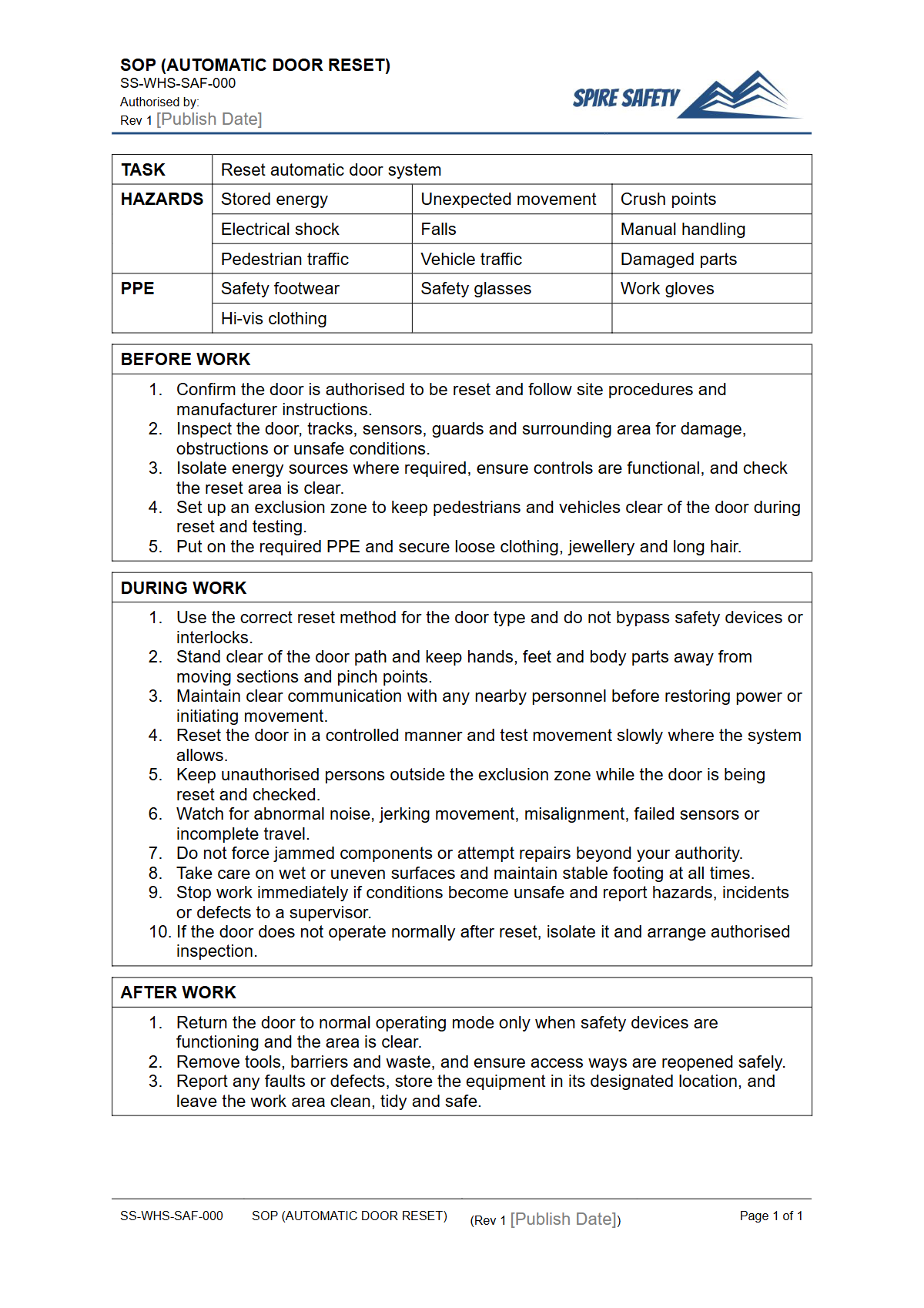
This Safe Operating Procedure (SOP) provides a structured framework for safely resetting automatic doors in a workplace. Interacting with automated systems, particularly during non-standard operations like resets, introduces significant risks.
The purpose of this document is to establish a clear, step-by-step process that helps control hazards such as crushing, shearing, impact from unexpected door movement, and electrical shock. By formalising the procedure, organisations can ensure the task is performed consistently and safely by authorised personnel, minimising the risk of injury to workers and the public.
A well-defined SOP is a critical component of broader WHS management systems, demonstrating a commitment to proactive risk management.
Video walkthrough
How to use the Free Safe Operating Procedure (Automatic Door Reset) Template
This template is provided in both DOCX and PDF formats for your convenience. The DOCX file is fully editable, allowing you to tailor the content to your specific operational needs.
It is crucial to understand that this is a template, not a finished document. We have provided a structured starting point, but you must adapt it to the specific automatic door models, site conditions, and legislative requirements of your workplace.
This includes adding details such as manufacturer instructions, required Personal Protective Equipment (PPE), lockout/tagout procedures, and emergency contact information. For another example of a task-specific procedure, see our free Air Compressor SOP.
When to use this Safe Operating Procedure
This SOP should be used whenever an automatic door system requires a manual reset. Common scenarios include:
- Following a power outage or restoration of power.
- After an emergency stop button has been activated.
- When the door's control panel displays a fault code that requires a reset as per the manufacturer's guide.
- Before returning a door to service after maintenance or repairs.
Using a formal procedure ensures that all safety checks are completed before, during, and after the reset. This process can be verified through routine safety checks and formal WHS compliance auditing to ensure it is being followed correctly.
Who should use this Safe Operating Procedure
Use of this SOP must be restricted to personnel who are trained, competent, and explicitly authorised to perform the task. This typically includes facilities maintenance staff, qualified electricians, or specialist door technicians.
Untrained individuals must not attempt to reset automatic doors, as they may not recognise the potential hazards or understand the correct sequence required by the manufacturer. Competency should be verified and documented, ensuring that anyone performing the reset understands the specific risks of the equipment they are working on. Even seemingly simple tasks require formal instruction, as outlined in documents like the FREE Step Ladder SOP Template.
Integrating with other safety systems
An SOP for resetting automatic doors does not exist in isolation. It must be integrated with your site's overarching safety protocols, most importantly your Lockout/Tagout (LOTO) procedure.
Before any physical interaction with the door's mechanisms or control panel, the relevant energy sources must be isolated to prevent unexpected start-up. This is a fundamental principle of machinery safety that applies across all equipment, from automatic doors to complex industrial plant like that covered in our FREE CNC Machine SOP.
Review and improvement
Like all safety documents, this SOP should be treated as a living document. It must be reviewed regularly—at least annually—or whenever there is a change in equipment, processes, or regulations.
It should also be reviewed immediately following any incident or near-miss related to the automatic doors. Regular reviews ensure the procedure remains effective and relevant to the risks present in your workplace. For more tools to support your safety management efforts, browse our complete free WHS resources library.
Common mistakes
Common mistakes to avoid
- Failing to consult the specific manufacturer's manual for the correct reset sequence.
- Neglecting to perform a lockout/tagout procedure to isolate energy sources before starting.
- Allowing untrained or unauthorised staff to attempt the reset.
- Forgetting to test all safety sensors and features after the reset is complete.
Legal references
Legal considerations
The following legal requirements may be relevant to this type of work.
- Work Health and Safety Act (Harmonised) — Provides the primary duties for protecting workers and other people from work health and safety risks.
- Work Health and Safety Regulations (Harmonised) — Sets out requirements supporting the management of workplace hazards and risks.
The following codes may be relevant to this type of work.
- Managing WHS Risks Code of Practice — Provides practical guidance on identifying hazards, assessing risks and applying effective controls.
- Work Health and Safety Consultation, Cooperation and Coordination Code of Practice — Provides practical guidance on consulting workers and coordinating with other duty holders.
- Managing the Work Environment and Facilities Code of Practice — Provides practical guidance on safe work environments, workplace facilities and related controls.
Did you know
Australian Standard
In Australia, AS 5007:2007 sets out the minimum requirements for the design, installation, and maintenance of powered doors for pedestrian access to ensure user safety.
Maintenance Risks
A significant percentage of machinery-related injuries occur during non-routine tasks like maintenance, cleaning, and resets, not during normal operation. This highlights the critical need for formal procedures like SOPs.
FAQ
Frequently asked questions
01What key information should be included in an automatic door reset SOP?
02Is a unique SOP required for every different model of automatic door?
03Who is responsible for training workers on this Safe Operating Procedure?
04How often should a Safe Operating Procedure for automatic door resets be reviewed?
Share this resource
Free Safe Operating Procedure (Automatic Door Reset) Template
Browse Categories
How To Use It
- 1Download and open in Word or PDF.
- 2Replace the placeholders with your business details.
- 3Get it reviewed by a WHS specialist before rollout.
Need it customised?
Our WHS consultants can adapt this template to your site, run a gap analysis, or audit what you already have in place.
Book a Free Consultation WHS consulting servicesor call 1300 156 382
Related templates
- Free Safe Operating Procedure (Automatic Door Service) Template
- Free Safe Operating Procedure (Automatic Gate Reset) Template
- Free Safe Operating Procedure (Aviation Fuel Sampling) Template
- Free Safe Operating Procedure (Avocado Harvesting) Template
- Free Safe Operating Procedure (Awning Maintenance) Template
- Free Safe Operating Procedure (Backflow Device Check) Template