
Free Safe Operating Procedure (Autoclave) Template
Download our free Safe Operating Procedure (Autoclave) template. This user-friendly DOCX and PDF resource helps you outline safe work steps. Get started now.
Free Safe Operating Procedure (Autoclave) Template
DOCX • 126 KB + PDF
Updated Oct 2026
No signup required
Purpose of the Free Safe Operating Procedure (Autoclave) Template
An autoclave uses high-pressure saturated steam to sterilise equipment and supplies. Due to the significant hazards involved, including extreme heat, high pressure, and potential biological exposure, a formal process is essential.
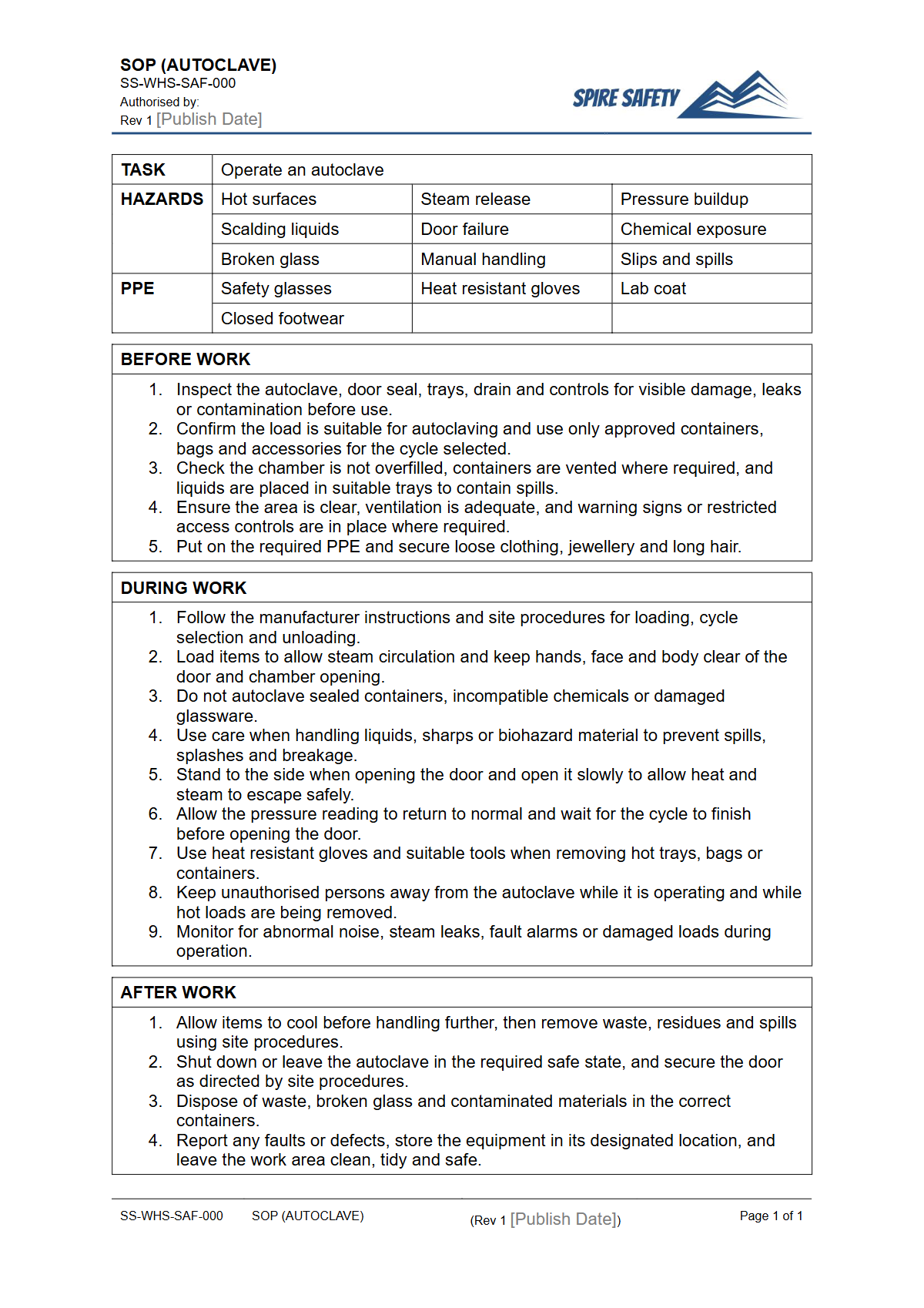
This Free Safe Operating Procedure (Autoclave) Template provides a structured starting point for documenting the step-by-step process required to operate this equipment safely. A documented SOP is a key part of managing risks, ensuring consistent operational practices, and providing clear instructions for all users, which is crucial for meeting your WHS obligations.
Using a standardised procedure helps control hazards such as severe burns from steam or hot surfaces, impact injuries from explosive decompression, and infection from improperly sterilised materials. Just as you would require a safe operating procedure for an air compressor due to its pressure vessel risks, an autoclave demands the same level of documented safety.
This template helps you formalise pre-operational checks, loading and unloading protocols, and emergency responses.
Video walkthrough
How to use the Free Safe Operating Procedure (Autoclave) Template
This template is available as a fully editable DOCX file, allowing for complete customisation. The goal is to create a document that is specific to your organisation’s environment and the exact equipment in use.
To effectively use this resource, download the file and methodically work through each section, replacing the placeholder text with your site-specific details. This includes the make and model of the autoclave, the types of materials being processed, required PPE, and emergency contact information.
It is crucial to remember that this is a template, not a finished document. We have provided a structured framework aligned with Australian WHS practice, but you must customise the content to reflect your specific workplace, the exact model of autoclave you use, the materials being sterilised, and your existing safety procedures.
This process should involve consulting the manufacturer’s operating manual, relevant Safety Data Sheets (SDS), and the workers who will be using the equipment. A well-developed SOP is a critical component of your overall WHS management systems.
Key Elements of an Effective Autoclave Safe Operating Procedure
A robust SOP should be clear, concise, and easy for any operator to follow. It typically includes several key stages:
- Pre-Operational Checks: Detailing visual inspections before each use, such as checking the door gasket for wear, verifying that gauges are functioning, and ensuring safety valves are unobstructed.
- Safe Loading and Operation: Instructions on how to load materials to allow for steam penetration, the importance of not overloading the chamber, using appropriate cycle settings for different loads, and ensuring containers are not tightly sealed.
- Post-Operational Procedures: Critical steps for safely unloading, including verifying the cycle has completed and the chamber has depressurised and cooled to a safe temperature before opening the door. It also specifies the PPE needed for handling hot items. Creating detailed procedures is also vital for other high-risk equipment, as outlined in our FREE Plasma Cutter SOP Template.
- Emergency Response: Clear actions to take in the event of a power failure, steam leak, alarm activation, or other malfunction.
When to use this Safe Operating Procedure
A Safe Operating Procedure for an autoclave should be used consistently as a primary reference and training tool. It is not a document to be filed away and forgotten.
It should be readily accessible near the equipment for quick reference. Key times to use the SOP include during the induction and training of new staff, as a refresher for infrequent users, and as a benchmark during performance reviews or incident investigations.
Regular reviews of the SOP are also vital, particularly after any near-miss, when equipment is modified, or when new types of loads are introduced. These procedures are often examined during a formal WHS compliance auditing process to verify that safe systems of work are in place and being followed.
Who should use this Safe Operating Procedure
This SOP is intended for all individuals involved with the use of an autoclave. The Person Conducting a Business or Undertaking (PCBU) holds the primary duty of care to provide safe work systems, which includes developing and implementing SOPs.
Supervisors and managers are responsible for ensuring workers are trained on the SOP and adhere to it. The end-users—including laboratory technicians, medical staff, researchers, and maintenance personnel—are the primary audience.
They must follow the procedure for every task to ensure their own safety and the safety of others. Worker consultation is a mandatory part of developing safety documents, ensuring the procedures are practical and reflect the realities of the task.
Even seemingly simple tasks benefit from documented procedures, which is why a step ladder SOP is just as important in its own context. To discover more templates for various workplace tasks and equipment, explore our complete free WHS resources library.
Common mistakes
Common mistakes to avoid
- Opening the door before the cycle is complete and the pressure has returned to zero.
- Overloading the chamber, which prevents proper steam penetration and sterilisation.
- Using tightly sealed containers that can rupture or explode under pressure.
- Neglecting to wear appropriate Personal Protective Equipment (PPE), such as heat-resistant gloves and eye protection, during unloading.
Legal references
Legal considerations
The following legal requirements may be relevant to this type of work.
- Work Health and Safety Act (Harmonised) — Provides the primary duties for protecting workers and other people from work health and safety risks.
- Work Health and Safety Regulations (Harmonised) — Sets out requirements supporting the management of workplace hazards and risks.
The following codes may be relevant to this type of work.
- Managing WHS Risks Code of Practice — Provides practical guidance on identifying hazards, assessing risks and applying effective controls.
- Work Health and Safety Consultation, Cooperation and Coordination Code of Practice — Provides practical guidance on consulting workers and coordinating with other duty holders.
- Managing the Work Environment and Facilities Code of Practice — Provides practical guidance on safe work environments, workplace facilities and related controls.
Did you know
Invention of the Autoclave
The autoclave was invented in 1879 by Charles Chamberland, a French microbiologist who worked with Louis Pasteur. Its original purpose was to sterilise medical equipment to prevent infections.
Pressure and Temperature
To achieve effective steam sterilisation, autoclaves typically operate at temperatures of 121°C or 134°C. The high pressure (around 100-200 kPa or 15-30 psi above atmospheric) is necessary to reach these temperatures with steam.
FAQ
Frequently asked questions
01What are the main hazards of using an autoclave?
02Does this template cover specific autoclave models?
03How often should an Autoclave SOP be reviewed?
04Is training required in addition to an SOP?
Share this resource
Free Safe Operating Procedure (Autoclave) Template
Browse Categories
How To Use It
- 1Download and open in Word or PDF.
- 2Replace the placeholders with your business details.
- 3Get it reviewed by a WHS specialist before rollout.
Need it customised?
Our WHS consultants can adapt this template to your site, run a gap analysis, or audit what you already have in place.
Book a Free Consultation WHS consulting servicesor call 1300 156 382
Related templates
- Free Safe Operating Procedure (Automated Guided Vehicle) Template
- Free Safe Operating Procedure (Automatic Door Reset) Template
- Free Safe Operating Procedure (Automatic Door Service) Template
- Free Safe Operating Procedure (Automatic Gate Reset) Template
- Free Safe Operating Procedure (Aviation Fuel Sampling) Template
- Free Safe Operating Procedure (Avocado Harvesting) Template