
Free Safe Operating Procedure (Asphalt Paver) Template
Download our free Safe Operating Procedure (Asphalt Paver) Template.
Free Safe Operating Procedure (Asphalt Paver) Template
DOCX • 126 KB + PDF
Updated Oct 2026
No signup required
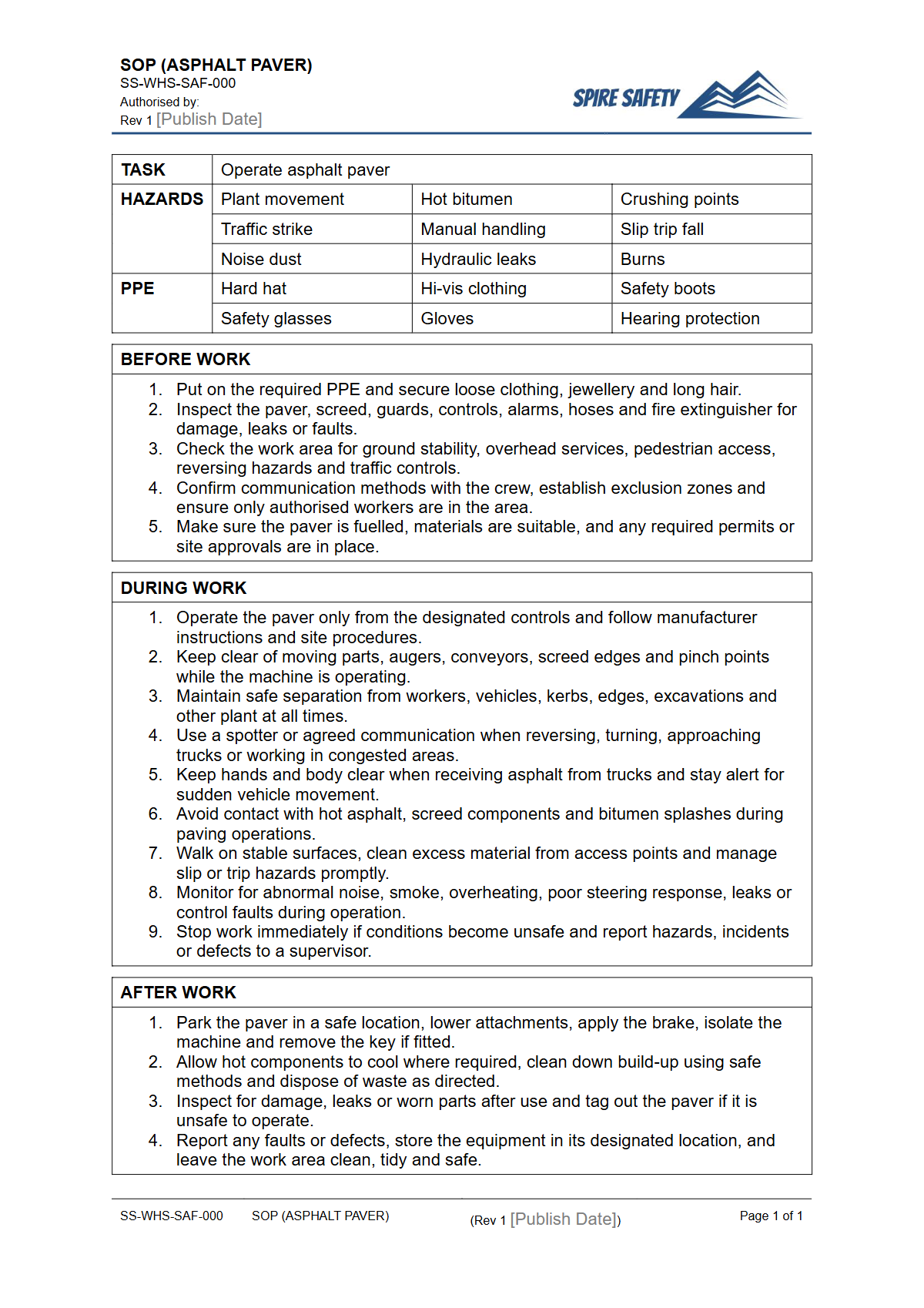
Purpose of the Free Safe Operating Procedure (Asphalt Paver) Template
Operating an asphalt paver involves significant risks, including exposure to high temperatures, traffic hazards, silica dust, chemical fumes, and loud noise. This Free Safe Operating Procedure (Asphalt Paver) Template provides a structured starting point for documenting a safe system of work for these tasks.
A well-developed Safe Operating Procedure (SOP) is a critical tool for any organisation, helping to standardise procedures, manage high-risk activities, and ensure every worker understands their safety obligations before work commences.
A documented SOP helps a Person Conducting a Business or Undertaking (PCBU) fulfil their primary duty of care under Australian WHS laws. It serves as a practical control measure, forming a key component of your overall safety framework.
Integrating SOPs into your daily operations demonstrates a commitment to proactive risk management and supports the development of robust WHS management systems that protect workers and ensure operational consistency.
Video walkthrough
How to use the Free Safe Operating Procedure (Asphalt Paver) Template
This document is a template and must be customised to suit the specific context of your workplace. Before use, you must conduct a thorough risk assessment and consult with your workers and any health and safety representatives.
This ensures the final SOP reflects the actual machinery in use, the unique site conditions, and the experience of the operators performing the task.
To effectively use this Safe Operating Procedure template:
- Download the DOCX file and add your company name, logo, and relevant project details.
- Identify the specific make and model of the asphalt paver and incorporate its unique operating instructions and safety features.
- Detail the required Personal Protective Equipment (PPE), such as heat-resistant gloves, safety footwear, high-visibility clothing, and respiratory protection.
- Outline the step-by-step process for pre-start checks, operation, shutdown, and emergency procedures.
- Ensure all workers who will operate or work near the asphalt paver receive training on the contents of the finalised SOP.
The principles of developing an SOP for an asphalt paver are transferable to other types of heavy mobile plant. For example, similar steps involving pre-start checks, operational controls, and shutdown procedures are detailed in our FREE Dozer SOP (Safe Operating Procedure) Template.
When to use a Safe Operating Procedure
An SOP for an asphalt paver should be used as a primary reference document for all paving operations. It is not a document to be filed away; it is an active tool for daily safety management.
It should be consulted during pre-start meetings or toolbox talks to reinforce safe work practices before each shift. It is also an essential training document for new operators during their induction and for existing operators as part of refresher training programs.
Furthermore, the SOP should be reviewed and referenced following any incident, near miss, or change in the work environment or equipment. This ensures that learnings are captured and that the procedure remains relevant and effective. The coordination of plant on site, such as the delivery of materials, also requires procedural control, as covered in resources like our FREE Body Truck SOP (Safe Operating Procedure) Template.
Who should use it
This Safe Operating Procedure should be used by a range of personnel within a civil construction or road maintenance organisation. This includes:
- Site Supervisors and Forepersons: To plan work, conduct pre-start briefings, and monitor compliance on-site.
- WHS Advisors and Managers: To develop, implement, and review safety procedures as part of the broader safety management system.
- Machine Operators: As a direct guide for performing their work safely and consistently.
- Training Coordinators: As a foundational document for competency assessment and operator training programs.
The development of the SOP itself should be a collaborative effort led by management but carried out in direct consultation with the machine operators who have hands-on experience. For organisations needing guidance on this consultative process or on implementing effective safety documentation, engaging external WHS consulting services can provide valuable expertise and support.
Creating detailed procedures for all high-risk plant is a fundamental safety requirement. The structured approach used in this asphalt paver SOP can be adapted for other machinery, such as that covered in our FREE Scraper SOP (Safe Operating Procedure) Template. For more guidance and templates, browse our entire free WHS resources library.
Common mistakes
Common mistakes to avoid
- Using a generic SOP without customising it for the specific machine and site conditions.
- Failing to consult with experienced operators during the drafting and review process.
- Not providing adequate training on the finalised SOP to all relevant personnel.
- Treating the SOP as a 'set and forget' document instead of reviewing and updating it regularly.
Legal references
Legal considerations
The following legal requirements may be relevant to this type of work.
- Work Health and Safety Act (Harmonised) — Provides the primary duties for protecting workers and other people from work health and safety risks.
- Work Health and Safety Regulations (Harmonised) — Sets out requirements supporting the management of workplace hazards and risks.
The following codes may be relevant to this type of work.
- Managing WHS Risks Code of Practice — Provides practical guidance on identifying hazards, assessing risks and applying effective controls.
- Work Health and Safety Consultation, Cooperation and Coordination Code of Practice — Provides practical guidance on consulting workers and coordinating with other duty holders.
- Managing the Work Environment and Facilities Code of Practice — Provides practical guidance on safe work environments, workplace facilities and related controls.
Did you know
Extreme Temperatures
Hot mix asphalt is typically laid at temperatures between 150°C and 175°C. Direct contact can cause severe thermal burns, making heat-resistant PPE and strict exclusion zones essential.
Fume Hazards
The fumes released from hot asphalt contain substances like polycyclic aromatic hydrocarbons (PAHs). Effective ventilation and, where necessary, respiratory protection are critical to control long-term health risks from inhalation.
FAQ
Frequently asked questions
01What is a Safe Operating Procedure for an asphalt paver?
02Is this asphalt paver SOP template ready to use immediately?
03How often should an asphalt paver SOP be reviewed?
04Who is responsible for creating an asphalt paver SOP?
Share this resource
Free Safe Operating Procedure (Asphalt Paver) Template
Browse Categories
How To Use It
- 1Download and open in Word or PDF.
- 2Replace the placeholders with your business details.
- 3Get it reviewed by a WHS specialist before rollout.
Need it customised?
Our WHS consultants can adapt this template to your site, run a gap analysis, or audit what you already have in place.
Book a Free Consultation WHS consulting servicesor call 1300 156 382
Related templates
- Free Safe Operating Procedure (Athletics Pit Raking) Template
- Free Safe Operating Procedure (Athletics Track Care) Template
- Free Safe Operating Procedure (Auger Operation) Template
- Free Safe Operating Procedure (Autoclave) Template
- Free Safe Operating Procedure (Automated Guided Vehicle) Template
- Free Safe Operating Procedure (Automatic Door Reset) Template