
Free Safe Operating Procedure (Arbor Press) Template
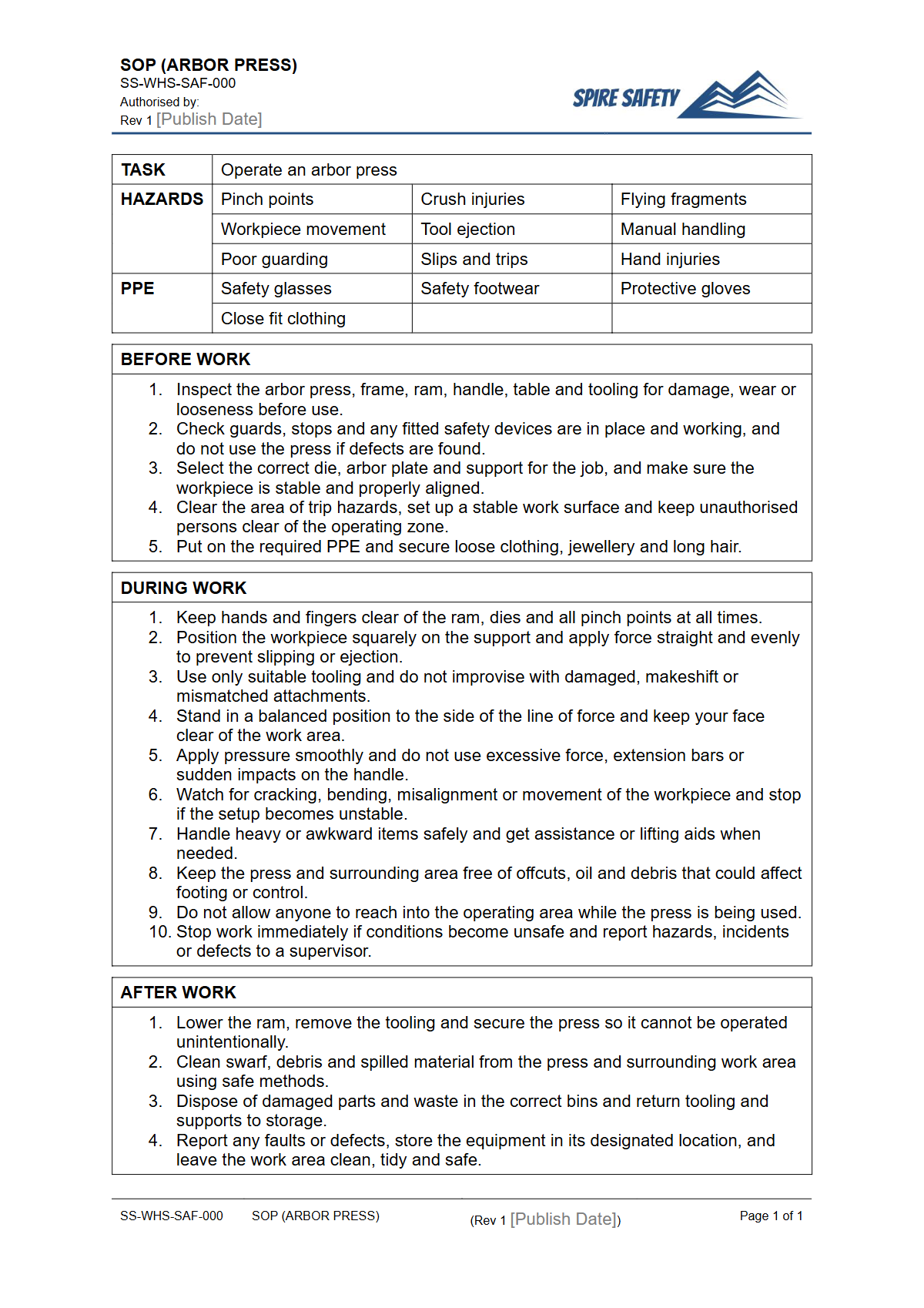
Download our free Safe Operating Procedure (Arbor Press) template.
Free Safe Operating Procedure (Arbor Press) Template
DOCX • 126 KB + PDF
Updated Oct 2026
No signup required
Purpose of the Free Safe Operating Procedure (Arbor Press) Template
An arbor press, while seemingly simple, poses significant risks of crushing, pinching, and other serious injuries if not used correctly. This Free Safe Operating Procedure (Arbor Press) Template provides a structured framework for documenting the specific steps required to operate this equipment safely.
It is designed to help your organisation meet its duty of care under Australian WHS legislation by formalising processes, identifying hazards, and implementing effective control measures. Using a clear SOP ensures that all operators, regardless of experience level, have access to consistent and approved instructions for performing tasks safely.
A well-drafted SOP is a critical component of any workshop's safety framework. It serves as a key training document for new workers and a reference for experienced operators, helping to standardise safe work practices across the team.
Integrating documents like this into your company’s processes is a foundational part of building robust WHS management systems that protect workers and improve operational efficiency.
Video walkthrough
How to use the Free Safe Operating Procedure (Arbor Press) Template
This downloadable template, available in both DOCX and PDF formats, is a starting point for your organisation. It is essential that you customise the document to reflect the specific arbor press models, tasks, and environment at your workplace.
This involves consulting with the workers who actually operate the equipment, as they have firsthand knowledge of the risks and practicalities involved.
Important: This is a template, not a finished document. We cannot guarantee it will be suitable for your specific circumstances.
You must adapt the content by adding your company name and logo, and most importantly, conducting a site-specific risk assessment to populate the procedure with details relevant to your machinery and operational context. Failure to customise the SOP may render it ineffective.
For similar workshop equipment, our Brake Press SOP template offers another example of a task-specific procedure.
When to use it
A Safe Operating Procedure for an arbor press should be a living document, integrated into daily operations. It should be readily available near the equipment and used in several key situations.
Primarily, it forms the basis of initial training and competency assessment for any worker before they are authorised to use the press. It should also be used for regular refresher training to reinforce safe behaviours and address any complacency.
Furthermore, the SOP must be reviewed and referenced following any incident or near-miss involving the arbor press. It is also a valuable tool during routine workplace inspections and safety observations.
Regularly reviewing your SOPs is a key activity verified during a WHS compliance auditing process, demonstrating proactive risk management.
Who should use it
This Safe Operating Procedure is intended for a broad audience within an organisation. Workers and Operators are the primary users, referencing it to ensure they follow the correct, safe steps for every task.
Supervisors and Team Leaders use the SOP to conduct training, supervise work, and verify that procedures are being followed correctly. They are responsible for ensuring the SOP is understood and implemented on the workshop floor.
WHS Managers and Safety Professionals use the template to develop and standardise documentation across the business, ensuring it aligns with the model WHS framework and company policies. They also lead the review and update process.
The principles of safe operation outlined in this document are transferable to other workshop equipment, just as one would use a specific Plasma Cutter SOP template for that distinct hazard profile.
Similarly, other digitally controlled machinery requires its own dedicated procedures, which is why we also offer a free CNC Machine SOP to address those unique risks. You can explore our entire collection of templates in our free WHS resources library to build a comprehensive set of safety documents for your workplace.
Common mistakes
Common mistakes to avoid
- Using an unstable setup, such as stacking loose blocks or using a workpiece that is not properly supported.
- Applying excessive force by using a 'cheater bar' or extension on the handle, which can overload and break the press casting.
- Failing to wear appropriate personal protective equipment (PPE), particularly safety glasses to protect from flying debris.
- Attempting to press hardened materials or objects that exceed the press's structural capacity or tonnage rating.
Legal references
Legal considerations
The following legal requirements may be relevant to this type of work.
- Work Health and Safety Act (Harmonised) — Provides the primary duties for protecting workers and other people from work health and safety risks.
- Work Health and Safety Regulations (Harmonised) — Sets out requirements supporting the management of workplace hazards and risks.
The following codes may be relevant to this type of work.
- Managing WHS Risks Code of Practice — Provides practical guidance on identifying hazards, assessing risks and applying effective controls.
- Work Health and Safety Consultation, Cooperation and Coordination Code of Practice — Provides practical guidance on consulting workers and coordinating with other duty holders.
- Managing the Work Environment and Facilities Code of Practice — Provides practical guidance on safe work environments, workplace facilities and related controls.
Did you know
Mechanical Advantage
Arbor presses use compound leverage to generate significant compressive force from minimal human effort. A small force applied to the handle is multiplied through the rack and pinion gear system, creating tonnes of force at the ram.
What's in a Name?
The term 'arbor' in machine tools refers to a spindle or shaft. In an arbor press, the main toothed shaft that is moved by the lever and pinion is called the arbor, giving the press its name.
FAQ
Frequently asked questions
01What are the main hazards of using an arbor press?
02Is specific training required to use an arbor press?
03How often should an Arbor Press SOP be reviewed?
04Can I use this template for a hydraulic press?
Share this resource
Free Safe Operating Procedure (Arbor Press) Template
Browse Categories
How To Use It
- 1Download and open in Word or PDF.
- 2Replace the placeholders with your business details.
- 3Get it reviewed by a WHS specialist before rollout.
Need it customised?
Our WHS consultants can adapt this template to your site, run a gap analysis, or audit what you already have in place.
Book a Free Consultation WHS consulting servicesor call 1300 156 382
Related templates
- Free Safe Operating Procedure (Arc Gouging) Template
- Free Safe Operating Procedure (Artificial Turf Care) Template
- Free Safe Operating Procedure (Asphalt Paver) Template
- Free Safe Operating Procedure (Athletics Pit Raking) Template
- Free Safe Operating Procedure (Athletics Track Care) Template
- Free Safe Operating Procedure (Auger Operation) Template