
Free Safe Operating Procedure (Arc Gouging) Template
Download our free Safe Operating Procedure (Arc Gouging) Template. This customisable DOCX and PDF resource helps you outline key safety steps. Get started now.
Free Safe Operating Procedure (Arc Gouging) Template
DOCX • 126 KB + PDF
Updated Oct 2026
No signup required
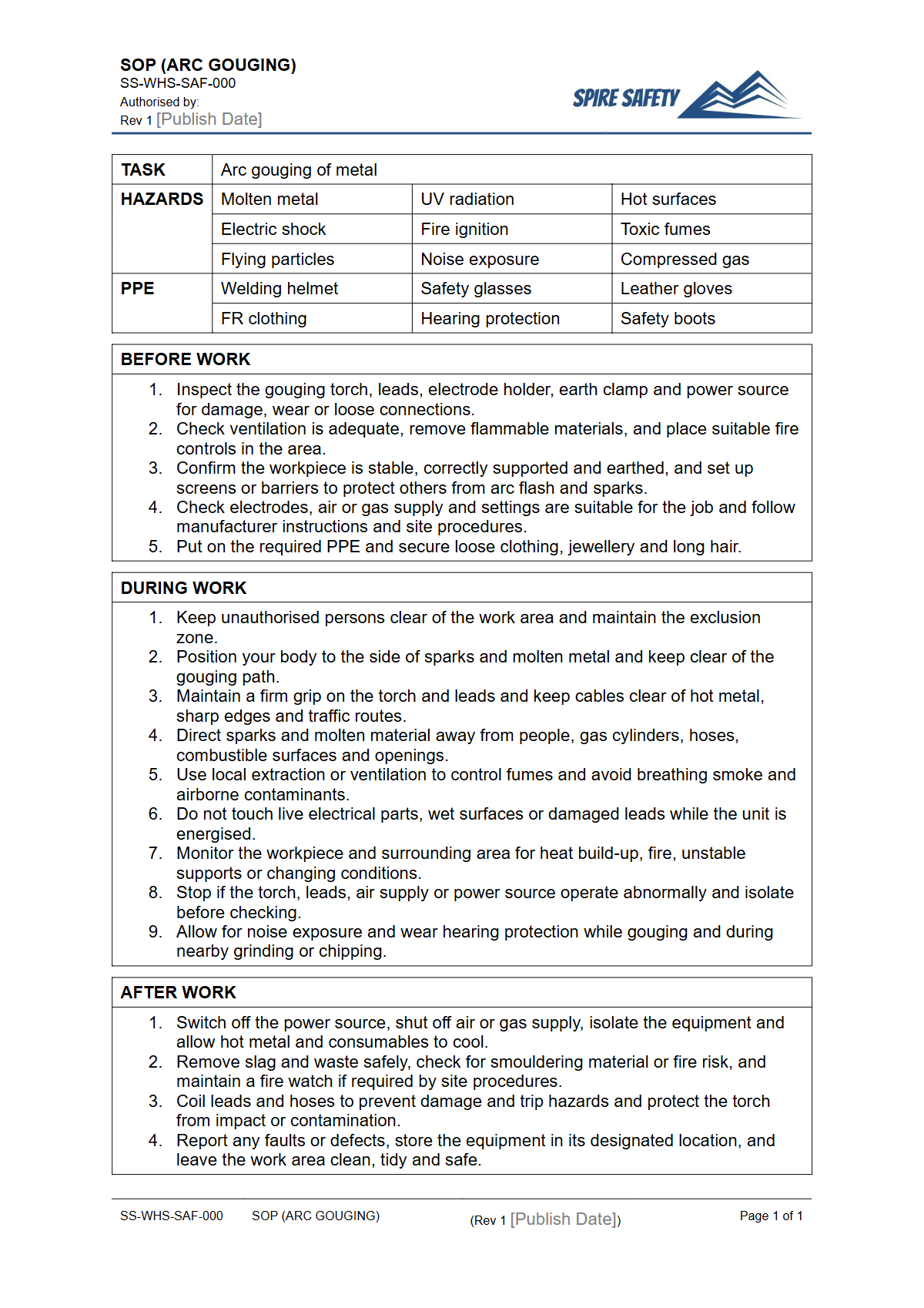
Purpose of the Free Safe Operating Procedure (Arc Gouging) Template
This free Safe Operating Procedure (Arc Gouging) Template provides a structured framework for documenting the safety requirements for air carbon-arc gouging tasks. Its primary purpose is to help Persons Conducting a Business or Undertaking (PCBUs) manage significant health and safety risks associated with the process.
Arc gouging generates multiple hazards simultaneously, including intense ultraviolet (UV) radiation, high concentrations of toxic fumes and gases, extreme noise levels, fire risks from sparks and molten metal, and the potential for severe electrical shock. By using this template, you can establish and communicate a standardised, step-by-step method for performing the task safely.
A documented SOP serves as a critical control measure, ensuring that all operators understand the required precautions, personal protective equipment (PPE), and emergency responses. It forms a key part of your safe system of work, helping to minimise incidents and meet your WHS obligations.
While it shares principles with other thermal processes detailed in documents like a plasma cutter SOP, arc gouging's specific combination of high amperage, compressed air, and carbon electrodes demands its own dedicated procedure.
Effectively managing safety in a workshop involves documenting procedures for all high-risk equipment. Standardising processes for equipment like those covered in our free Brake Press SOP template alongside your gouging procedure creates a more consistent and safer work environment for everyone.
This structured approach helps streamline training, supervision, and operational consistency across your entire facility.
Video walkthrough
How to use the Free Safe Operating Procedure (Arc Gouging) Template
This document is a starting point designed for customisation. To use it effectively, follow these steps:
- Download: Choose the DOCX file for easy editing or the PDF for reference.
- Customise: Adapt the content to your specific workplace. This includes adding details about the make and model of your arc gouging power source and air supply, the specific types of base metals and electrodes used, and your unique site layout and emergency procedures.
- Consult: Involve the workers who perform the task. Consultation is not only a legal requirement but also ensures the procedure is practical and reflects how the work is actually done. Workers often have the best insights into the real-world hazards.
- Train: Use the finalised SOP to train all relevant personnel. Ensure they understand every step and have demonstrated their competence before undertaking the task unsupervised.
- Review: Schedule regular reviews of the SOP (e.g., annually) or whenever there is a change in equipment, processes, or after an incident.
Please note: This document is a template. We've provided a solid foundation based on the model WHS framework, but you must customise it with your own site-specific details, equipment models, and workplace policies.
A generic SOP is not enough to ensure safety. An effective SOP is a vital record within your broader WHS management systems, demonstrating how your organisation controls specific high-risk activities.
When to use a Safe Operating Procedure for Arc Gouging
An SOP for arc gouging should be developed, approved, and implemented before any such work is permitted on site. It should be used as a primary reference document during several key activities, including worker training and inductions, for verifying competency, and as a guide for pre-start checks and toolbox talks.
It also serves as a crucial benchmark during incident investigations or when conducting workplace safety inspections.
Before starting any gouging task, operators should review the SOP to ensure all safety measures are in place. This includes confirming the ventilation system is operational, fire prevention measures are set up, and all supporting equipment is ready.
For instance, the safe operation of equipment detailed in an air compressor SOP is critical, as a reliable and correctly-pressurised air stream is essential for the gouging process.
Who should use it
The development of the SOP is typically led by a supervisor, WHS manager, or another competent person with extensive knowledge of arc gouging processes and workplace safety principles. However, the final document is intended for use by several groups:
- Operators: Workers who perform arc gouging must be trained on and follow the procedure to the letter.
- Supervisors: Team leaders and managers use the SOP to monitor work, enforce safety standards, and conduct inspections.
- Trainers: WHS trainers use it as the foundation for practical instruction and competency assessments.
- Safety Personnel: WHS advisors and officers refer to the SOP when conducting risk assessments and audits.
Ultimately, the PCBU is responsible for ensuring that a safe system of work, including a relevant and specific SOP, is in place for all high-risk tasks. Regular checks, often as part of a formal WHS compliance auditing program, should confirm that the steps outlined in the SOP are being followed correctly and remain effective.
If you need more guidance, you can explore our comprehensive free WHS resources library for other templates and guides.
Common mistakes
Common mistakes to avoid
- Using the template without adding site-specific details for equipment, materials, and emergency procedures.
- Failing to install or use local exhaust ventilation (LEV) systems, leading to high exposure to toxic fumes.
- Using standard welding helmets or safety glasses instead of PPE with the appropriate high-rating for the intense radiation produced.
- Neglecting to clear the work area of combustibles or use fire-resistant blankets, leading to a high risk of fire from sparks and molten metal.
Legal references
Legal considerations
The following legal requirements may be relevant to this type of work.
- Work Health and Safety Act (Harmonised) — Provides the primary duties for protecting workers and other people from work health and safety risks.
- Work Health and Safety Regulations (Harmonised) — Sets out requirements supporting the management of workplace hazards and risks.
The following codes may be relevant to this type of work.
- Managing WHS Risks Code of Practice — Provides practical guidance on identifying hazards, assessing risks and applying effective controls.
- Work Health and Safety Consultation, Cooperation and Coordination Code of Practice — Provides practical guidance on consulting workers and coordinating with other duty holders.
- Managing the Work Environment and Facilities Code of Practice — Provides practical guidance on safe work environments, workplace facilities and related controls.
Did you know
Extreme Temperatures
The electric arc used in arc gouging can reach temperatures exceeding 4,000°C, which is essential for rapidly melting metal.
High Removal Rate
Compared to grinding or chipping, air carbon-arc gouging can remove metal up to four times faster, making it a highly efficient but hazardous process.
FAQ
Frequently asked questions
01What are the main hazards of arc gouging that an SOP should cover?
02Does an SOP replace the need for a risk assessment for arc gouging?
03Who needs to be trained on the arc gouging Safe Operating Procedure?
04How often should an arc gouging SOP be reviewed and updated?
Share this resource
Free Safe Operating Procedure (Arc Gouging) Template
Browse Categories
How To Use It
- 1Download and open in Word or PDF.
- 2Replace the placeholders with your business details.
- 3Get it reviewed by a WHS specialist before rollout.
Need it customised?
Our WHS consultants can adapt this template to your site, run a gap analysis, or audit what you already have in place.
Book a Free Consultation WHS consulting servicesor call 1300 156 382
Related templates
- Free Safe Operating Procedure (Artificial Turf Care) Template
- Free Safe Operating Procedure (Asphalt Paver) Template
- Free Safe Operating Procedure (Athletics Pit Raking) Template
- Free Safe Operating Procedure (Athletics Track Care) Template
- Free Safe Operating Procedure (Auger Operation) Template
- Free Safe Operating Procedure (Autoclave) Template