
Free Safe Operating Procedure (Arbor Mulching) Template
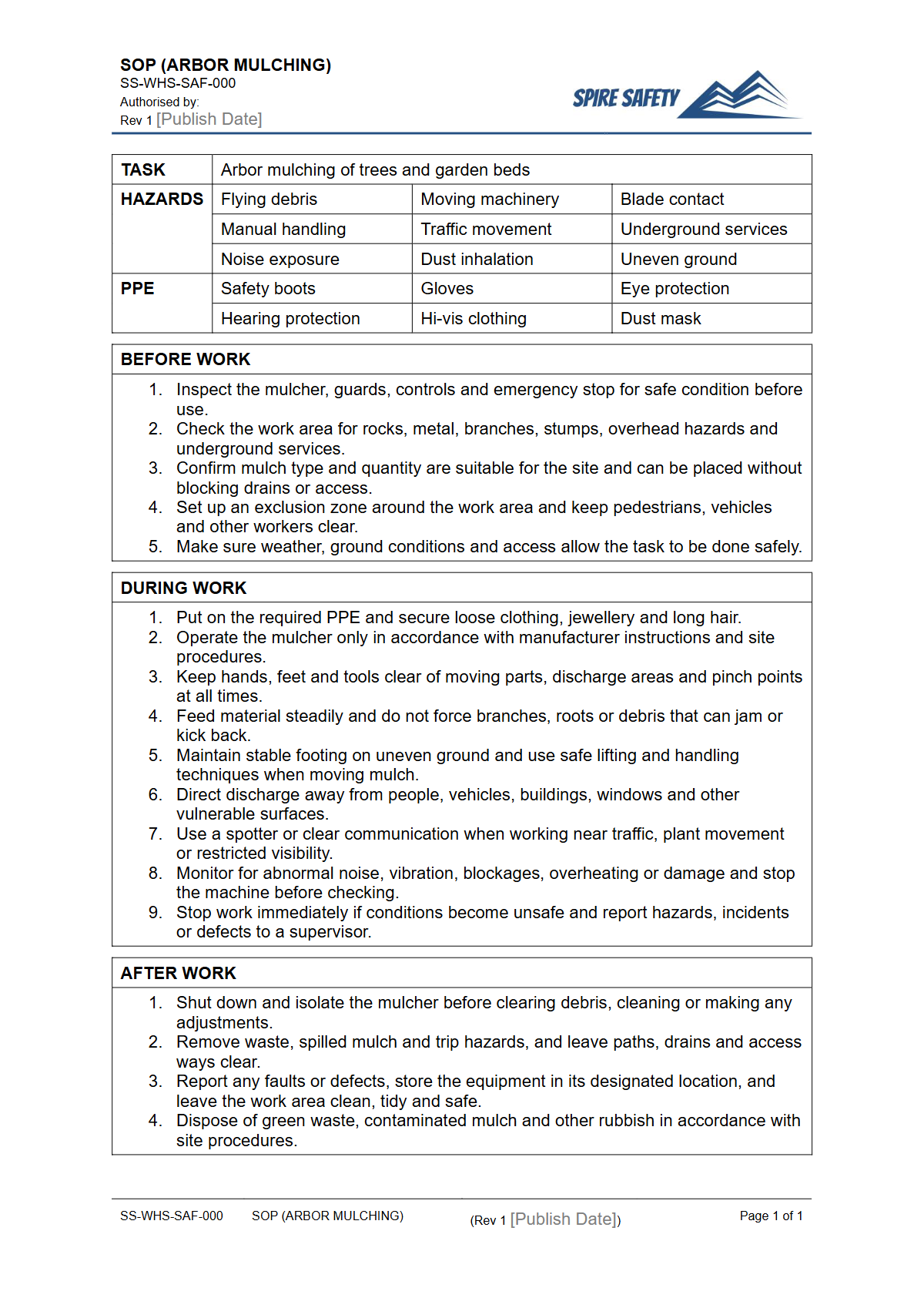
Download our free Safe Operating Procedure (Arbor Mulching) Template to formalise safe work methods for using wood chippers. Customise your DOCX or PDF today.
Free Safe Operating Procedure (Arbor Mulching) Template
DOCX • 126 KB + PDF
Updated Oct 2026
No signup required
Purpose of the Free Safe Operating Procedure (Arbor Mulching) Template
Operating arbor mulchers and wood chippers presents significant work health and safety risks, including entanglement, impact from projectiles, and noise exposure. This Free Safe Operating Procedure (Arbor Mulching) Template provides a structured framework for documenting the specific steps required to perform this task safely.
Formalising your process helps to minimise risks, ensure consistent operational practices, and demonstrate WHS due diligence. An effective SOP is a critical component of any risk management strategy, providing clear, actionable guidance for workers and supervisors.
By implementing a documented procedure, you create a reliable training tool for new operators and a clear reference for experienced staff. This process is a fundamental part of building a robust WHS management system, helping your organisation proactively manage hazards associated with high-risk plant before they lead to an incident.
This template is designed to align with Australian WHS principles and the model Code of Practice for managing risks of plant.
Video walkthrough
How to use the Free Safe Operating Procedure (Arbor Mulching) Template
This resource is available as a DOCX file, which is fully editable in Microsoft Word or other compatible software, and as a PDF for easy printing and distribution. To use it effectively, download the DOCX version and meticulously adapt it to your specific workplace conditions.
This includes detailing the exact make and model of the mulcher, the types of materials being processed, and the unique environmental factors of your worksites.
It is crucial to involve the workers who actually operate the machinery in the customisation process. Their hands-on experience is invaluable for identifying practical safety measures and ensuring the final SOP is realistic and effective. For guidance on facilitating this collaborative process, you may benefit from engaging with expert WHS consulting services. Please note: This is a template and must be customised to reflect the specific equipment, environment, and work practices of your site. Spire Safety is not liable for any incidents that may occur from the use of this template.
When to use it
A Safe Operating Procedure for arbor mulching should be developed, finalised, and communicated before any worker operates the equipment for the first time. It forms a core part of site and equipment-specific inductions.
The SOP should be readily accessible near the work area for quick reference during operations. Furthermore, the procedure must be reviewed regularly, at least annually, or whenever there is a change in equipment, processes, or personnel.
It is also mandatory to review and, if necessary, update the SOP following any incident or near-miss to incorporate lessons learned and prevent recurrence.
This structured approach to task management is not unique to mulching; similar principles apply to other high-risk plant. For example, our free dozer SOP template follows a similar logic for managing the risks of heavy earthmoving equipment.
Consistently applying SOPs across all relevant tasks creates a culture of safety and procedural discipline.
Who should use it
This template is designed for use by Persons Conducting a Business or Undertaking (PCBUs), site supervisors, and WHS managers within industries such as arboriculture, forestry, landscaping, and council works. It is their responsibility to ensure safe systems of work are in place.
The document is also a vital tool for the workers and operators themselves, as it clearly outlines the expected safe behaviours and steps they must follow to protect themselves and others. It empowers them to understand the risks and the established controls, fostering a sense of ownership over their safety.
The principles outlined can be adapted for a wide range of powered equipment. While this SOP focuses on mulching, the methodology of identifying hazards and outlining controls is universal.
For instance, the same systematic approach is necessary when detailing the safe use of circular saws and other portable power tools commonly found on site. Integrating SOPs for all key tasks helps create a comprehensive safety framework.
Effective site management also involves considering the entire workflow, including the transport of materials and equipment. Procedures for ancillary tasks, such as the safe operation of a body truck to move mulch or machinery, are just as important in preventing incidents. For more templates and guidance, explore our full library of free WHS resources.
Common mistakes
Common mistakes to avoid
- Failing to establish and clearly mark an adequate exclusion zone around the mulcher during operation.
- Attempting to clear jams or blockages from the feed chute or discharge vent while the machine is still running.
- Wearing loose clothing, long hair untied, or gloves that can be easily snagged by branches and pulled into the feed mechanism.
- Neglecting critical pre-start checks, such as verifying the condition of safety guards, emergency stops, and cutter knives.
Legal references
Legal considerations
The following legal requirements may be relevant to this type of work.
- Work Health and Safety Act (Harmonised) — Provides the primary duties for protecting workers and other people from work health and safety risks.
- Work Health and Safety Regulations (Harmonised) — Sets out requirements supporting the management of workplace hazards and risks.
The following codes may be relevant to this type of work.
- Managing WHS Risks Code of Practice — Provides practical guidance on identifying hazards, assessing risks and applying effective controls.
- Work Health and Safety Consultation, Cooperation and Coordination Code of Practice — Provides practical guidance on consulting workers and coordinating with other duty holders.
- Managing the Work Environment and Facilities Code of Practice — Provides practical guidance on safe work environments, workplace facilities and related controls.
Did you know
A Leading Cause of Injury
Contact with the rotating knives of a wood chipper is one of the most common causes of severe and fatal injuries in the arboriculture industry. Most incidents occur when operators attempt to clear blockages or feed material without shutting the machine down.
FAQ
Frequently asked questions
01What are the key hazards in arbor mulching?
02Who is responsible for developing a Safe Operating Procedure for arbor mulching?
03How often should an arbor mulching SOP be reviewed?
04Does this template cover all types of wood chippers and mulchers?
Share this resource
Free Safe Operating Procedure (Arbor Mulching) Template
Browse Categories
How To Use It
- 1Download and open in Word or PDF.
- 2Replace the placeholders with your business details.
- 3Get it reviewed by a WHS specialist before rollout.
Need it customised?
Our WHS consultants can adapt this template to your site, run a gap analysis, or audit what you already have in place.
Book a Free Consultation WHS consulting servicesor call 1300 156 382
Related templates
- Free Safe Operating Procedure (Arbor Press) Template
- Free Safe Operating Procedure (Arc Gouging) Template
- Free Safe Operating Procedure (Artificial Turf Care) Template
- Free Safe Operating Procedure (Asphalt Paver) Template
- Free Safe Operating Procedure (Athletics Pit Raking) Template
- Free Safe Operating Procedure (Athletics Track Care) Template