
Free Safe Operating Procedure (Aquatic Weed Removal) Template
Download our free Safe Operating Procedure (Aquatic Weed Removal) Template. This DOCX & PDF resource helps detail controls for aquatic maintenance.
Free Safe Operating Procedure (Aquatic Weed Removal) Template
DOCX • 126 KB + PDF
Updated Oct 2026
No signup required
Purpose of the Free Safe Operating Procedure (Aquatic Weed Removal) Template
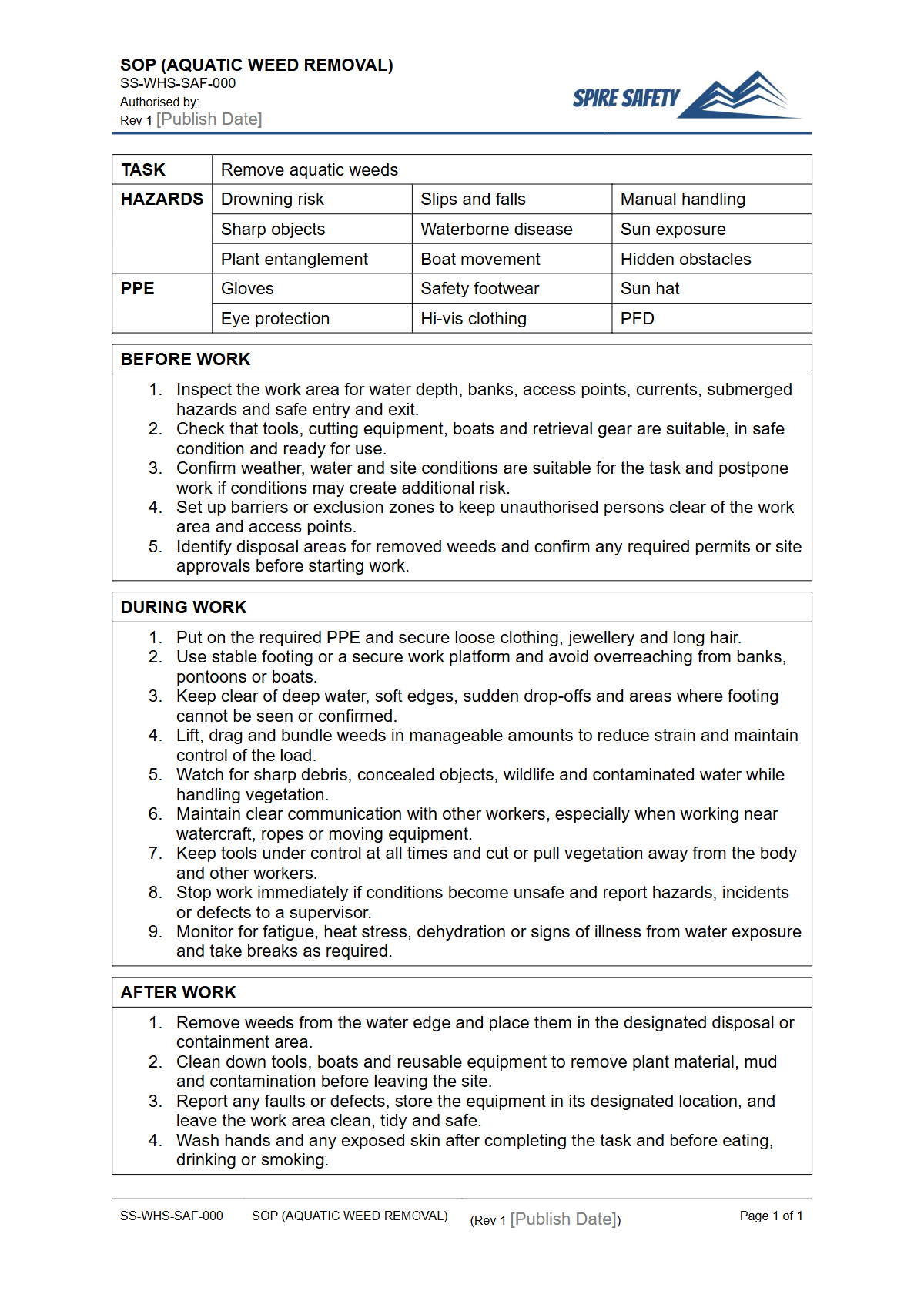
This Free Safe Operating Procedure (Aquatic Weed Removal) Template provides a structured framework for documenting the controls required to manage risks associated with removing weeds from rivers, lakes, dams, and other waterways. The task involves significant hazards, including drowning, slips and trips on wet or unstable ground, manual handling injuries from pulling weeds and carrying equipment, and potential exposure to biological contaminants within the water.
This document helps organisations outline a clear, step-by-step process for workers, ensuring the task is performed safely and consistently.
A well-defined SOP is a critical tool for risk management. It formalises the safest method for completing a job, which helps in training workers and setting clear performance expectations.
Integrating this SOP into a broader WHS management system helps ensure safety protocols are consistently applied and reviewed across all of the organisation's operations, promoting a proactive safety culture.
Video walkthrough
How to use the Free Safe Operating Procedure (Aquatic Weed Removal) Template
The Free Safe Operating Procedure (Aquatic Weed Removal) Template is provided in an editable DOCX format and as a ready-to-print PDF. The DOCX version is designed for easy customisation, allowing you to add, remove, and modify sections to suit your specific operational context.
This includes detailing the exact types of aquatic plants being managed, the specific tools and machinery in use (e.g., long-reach rakes, mechanical harvesters, boats), and the personal protective equipment (PPE) required, such as life jackets, waders, and gloves.
It is essential to adapt this document to the specific equipment, environment, and processes used in your workplace. We strongly recommend a Person Conducting a Business or Undertaking (PCBU) consults with workers on the front line to ensure the final SOP is practical and reflects the realities of the task. This collaborative approach ensures the procedure is not only aligned with WHS regulations but is also effective and understood by those who must follow it. Once customised, the effectiveness of the SOP should be verified through practical observation and regular WHS compliance auditing.
When to use this Safe Operating Procedure
This Safe Operating Procedure should be developed and implemented before any aquatic weed removal work commences. It serves as a primary reference document during several key phases of the work health and safety lifecycle.
It is a vital resource for inducting and training new employees, ensuring they understand the inherent risks and control measures from day one. It should also be used as a checklist during pre-start meetings to remind the team of critical safety steps before beginning work each day.
The SOP is also an invaluable tool following an incident or near-miss. It provides a baseline against which events can be reviewed, helping to identify any procedural gaps or areas for improvement.
For tasks that involve clearing overgrown banks to access the water, a specific procedure like our free Circular Saw SOP might also be required. Furthermore, if work involves accessing the water's edge via steep or uneven banks, referencing a Step Ladder SOP could be beneficial for managing potential fall risks, even if a ladder isn't used in the conventional sense.
Who should use this Safe Operating Procedure
This SOP is intended for use by multiple roles within an organisation responsible for waterway maintenance. WHS Managers and Site Supervisors should use the template to establish and enforce a standardised, safe system of work.
They are responsible for ensuring the procedure is properly customised, workers are trained in its contents, and its application is monitored. Team Leaders and experienced workers should actively participate in its development and review, providing practical insights to ensure its relevance and effectiveness.
The end-users are the workers themselves, who perform the aquatic weed removal. For them, the SOP is a direct guide to performing their duties safely.
It empowers them to recognise hazards and implement controls, and provides a clear protocol to follow in case of an emergency. Organisations that use vehicles to haul away the removed vegetation will also need procedures for safe transport, such as a body truck SOP. You can explore more templates for various high-risk tasks and equipment in our full library of free WHS resources.
Common mistakes
Common mistakes to avoid
- Failing to assess water conditions, including depth, current, and submerged hazards, before starting work.
- Using incorrect or poorly maintained personal protective equipment (PPE), such as non-certified life jackets.
- Neglecting to establish clear communication protocols between workers, especially when operating machinery or when visibility is limited.
- Not planning for the safe and environmentally responsible disposal of large volumes of removed weed.
Legal references
Legal considerations
The following legal requirements may be relevant to this type of work.
- Work Health and Safety Act (Harmonised) — Provides the primary duties for protecting workers and other people from work health and safety risks.
- Work Health and Safety Regulations (Harmonised) — Sets out requirements supporting the management of workplace hazards and risks.
The following codes may be relevant to this type of work.
- Managing WHS Risks Code of Practice — Provides practical guidance on identifying hazards, assessing risks and applying effective controls.
- Work Health and Safety Consultation, Cooperation and Coordination Code of Practice — Provides practical guidance on consulting workers and coordinating with other duty holders.
- Managing the Work Environment and Facilities Code of Practice — Provides practical guidance on safe work environments, workplace facilities and related controls.
Did you know
Rapid Growth
Certain invasive aquatic weeds, like Salvinia, can double their biomass in just 2-3 days under ideal conditions, making regular and efficient management critical for waterway health.
Waterway Risks
According to Royal Life Saving Australia, rivers, creeks, and streams are the leading location for drowning deaths, accounting for 20% of all drownings and highlighting the risks of working near inland waterways.
FAQ
Frequently asked questions
01What are the main hazards in aquatic weed removal?
02Does this SOP template cover chemical herbicide use?
03Who is responsible for implementing this Safe Operating Procedure?
04How often should an aquatic weed removal SOP be reviewed?
Share this resource
Free Safe Operating Procedure (Aquatic Weed Removal) Template
Browse Categories
How To Use It
- 1Download and open in Word or PDF.
- 2Replace the placeholders with your business details.
- 3Get it reviewed by a WHS specialist before rollout.
Need it customised?
Our WHS consultants can adapt this template to your site, run a gap analysis, or audit what you already have in place.
Book a Free Consultation WHS consulting servicesor call 1300 156 382
Related templates
- Free Safe Operating Procedure (Arbor Mulching) Template
- Free Safe Operating Procedure (Arbor Press) Template
- Free Safe Operating Procedure (Arc Gouging) Template
- Free Safe Operating Procedure (Artificial Turf Care) Template
- Free Safe Operating Procedure (Asphalt Paver) Template
- Free Safe Operating Procedure (Athletics Pit Raking) Template