
Free Safe Operating Procedure (Apron Cone Placement) Template
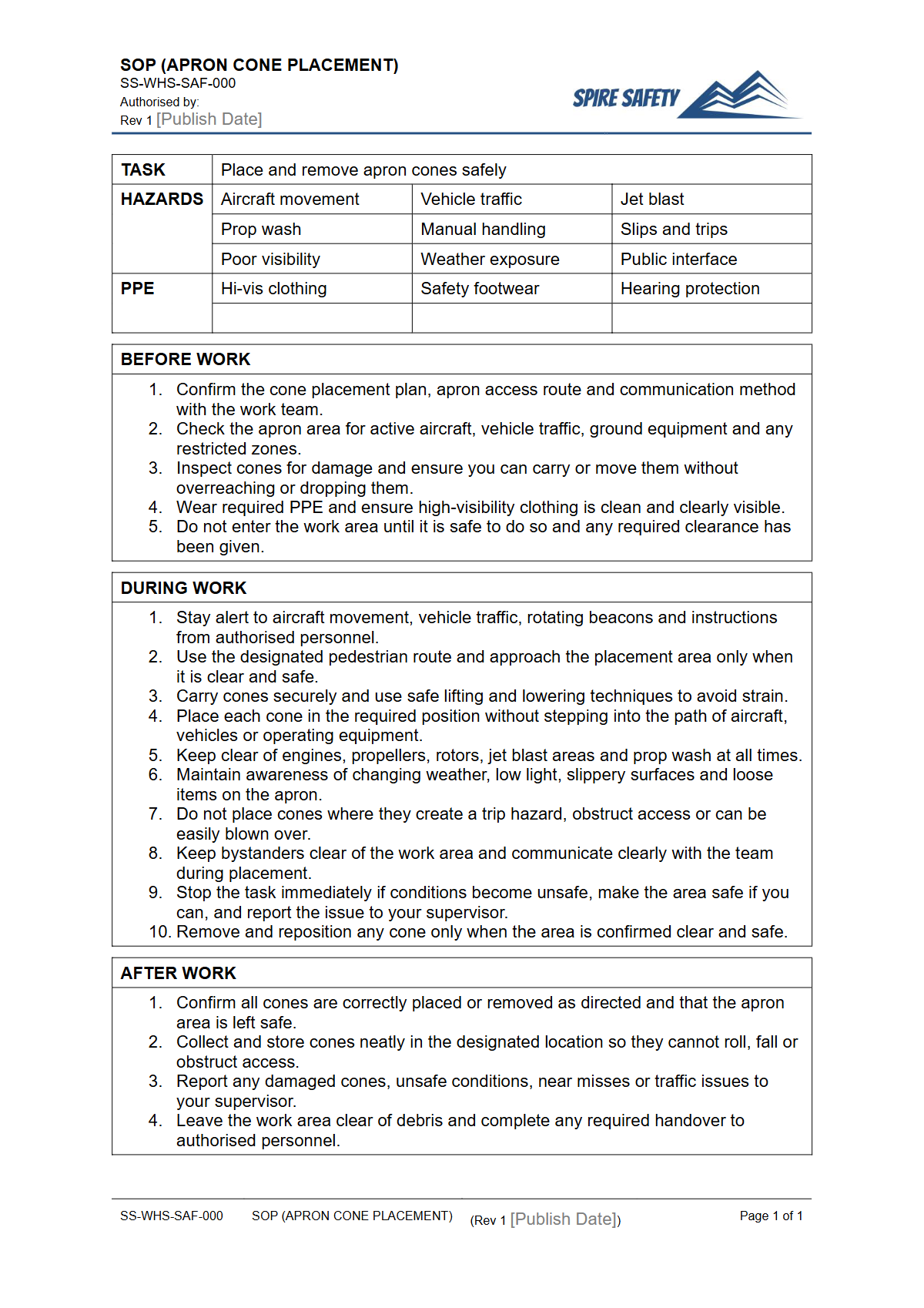
Download our free Safe Operating Procedure (Apron Cone Placement) Template.
Free Safe Operating Procedure (Apron Cone Placement) Template
DOCX • 126 KB + PDF
Updated Oct 2026
No signup required
Purpose of the Free Safe Operating Procedure (Apron Cone Placement) Template
Establishing clear, safe work methods is fundamental to maintaining safety on a busy airport apron. This free Safe Operating Procedure (Apron Cone Placement) Template provides a structured framework for outlining the required steps to safely position cones around parked aircraft.
The primary goal of this task is to create a distinct visual boundary, or 'equipment restraint area', which helps prevent accidental contact between ground support equipment (GSE) and the aircraft, a costly and dangerous event often referred to as 'ramp rash'.
By documenting a standardised process, organisations can reduce ambiguity and ensure all ground crew members follow the same safe sequence of actions. A well-defined SOP is a cornerstone of an effective safety management system.
It serves as a critical training tool for new employees and a reference for experienced personnel, reinforcing safe behaviour and minimising the risk of incidents. This template is designed to integrate into broader comprehensive WHS management systems, demonstrating a proactive approach to risk management in the high-consequence aviation environment.
Video walkthrough
How to use the Free Safe Operating Procedure (Apron Cone Placement) Template
This document is a template, not a finished procedure. It must be customised to align with the specific operational context of your workplace.
A competent person, such as a Ramp Manager or WHS Advisor, should lead this customisation process. Start by downloading the DOCX file and systematically working through each section.
You will need to add details specific to your airport, including bay markings, local airside driving regulations, and specific aircraft types your team services (e.g., A320, B737, Dash-8), as cone placement can vary significantly.
Important Note: We have created this template as a starting point. It is your responsibility to ensure the final document is tailored to your unique equipment, personnel, and operational environment.
You should detail the specific personal protective equipment (PPE) required, such as high-visibility clothing and hearing protection. The final, approved Safe Operating Procedure should be used as a basis for training and competency verification.
Regular reviews and updates are also crucial, particularly after an incident or when new aircraft or GSE are introduced. The process can also be an input for your WHS compliance auditing program.
When to use a Safe Operating Procedure for Apron Cone Placement
An SOP for apron cone placement should be consulted and followed every time an aircraft is chocked and parked on an apron or stand where ground servicing will occur. It is not an optional task; it is a critical safety step. Key scenarios include:
- Upon aircraft arrival and after wheel chocks are confirmed in place.
- Before any ground support equipment, such as belt loaders, catering trucks, or refuelling vehicles, approach the aircraft.
- During staff training and induction for all ground handling and ramp personnel.
- As a reference document during pre-shift safety briefings or toolbox talks.
- When conducting risk assessments for ground handling operations.
The procedure is equally important for removal, which must be done in a controlled sequence to ensure no equipment is left behind and the area is clear for pushback or power-out manoeuvres.
Who should use this Safe Operating Procedure
This Safe Operating Procedure is intended for all personnel involved in the aircraft turnaround process. A clear understanding of the procedure is essential for maintaining a safe working environment for everyone on the ramp. Specific roles that will use or be affected by this SOP include:
- Ground Handling Agents/Ramp Agents: The primary users who will physically perform the task of placing and removing the cones.
- Ramp Supervisors/Lead Agents: Responsible for overseeing the turnaround, ensuring the SOP is followed correctly, and coordinating the ground crew.
- GSE Operators: Drivers of catering trucks, belt loaders, and other vehicles must recognise the coned area as an exclusion zone and follow procedures for entering and exiting it. Developing a Body Truck SOP template is a logical next step for many operators.
- Aircraft Maintenance Engineers: Who often work within the coned area and need to be aware of the established boundaries.
- WHS Managers and Safety Officers: Who use the SOP for training, auditing, and incident investigation purposes.
For operations involving other types of mobile plant, such as those used in construction or logistics near airside operations, consider adapting our free Telehandler SOP Template. Similarly, ensuring safe access around the aircraft might involve tasks covered by a Step Ladder SOP template.
Common mistakes
Common mistakes to avoid
- Placing cones too close to the aircraft, failing to provide an adequate safety buffer for GSE.
- Failing to remove cones in the correct sequence before pushback or departure, leaving hazards in the movement area.
- Using damaged, dirty, or non-reflective cones, which severely reduces visibility, especially at night or in poor weather.
- Poor communication between the ground crew, GSE operators, and the flight deck during cone placement or removal.
Legal references
Legal considerations
The following legal requirements may be relevant to this type of work.
- Work Health and Safety Act (Harmonised) — Provides the primary duties for protecting workers and other people from work health and safety risks.
- Work Health and Safety Regulations (Harmonised) — Sets out requirements supporting the management of workplace hazards and risks.
The following codes may be relevant to this type of work.
- Managing WHS Risks Code of Practice — Provides practical guidance on identifying hazards, assessing risks and applying effective controls.
- Work Health and Safety Consultation, Cooperation and Coordination Code of Practice — Provides practical guidance on consulting workers and coordinating with other duty holders.
- Managing the Work Environment and Facilities Code of Practice — Provides practical guidance on safe work environments, workplace facilities and related controls.
Did you know
Ramp Rash
"Ramp rash" is aviation industry slang for minor but expensive damage to aircraft, like dents and scratches, caused by ground support equipment. Proper cone placement is a key defence against it.
Wingtip Clearance
Cone placement isn't random. It often corresponds to critical clearance points like wingtips, engine cowlings, and the tail, marking the absolute 'no-go' zones for vehicle traffic.
FAQ
Frequently asked questions
01What is the primary purpose of apron cone placement?
02Is this Safe Operating Procedure template ready to use immediately?
03Who is responsible for ensuring cones are placed correctly?
04How does an SOP for cone placement improve airside safety?
Share this resource
Free Safe Operating Procedure (Apron Cone Placement) Template
Browse Categories
How To Use It
- 1Download and open in Word or PDF.
- 2Replace the placeholders with your business details.
- 3Get it reviewed by a WHS specialist before rollout.
Need it customised?
Our WHS consultants can adapt this template to your site, run a gap analysis, or audit what you already have in place.
Book a Free Consultation WHS consulting servicesor call 1300 156 382
Related templates
- Free Safe Operating Procedure (Apron Driving) Template
- Free Safe Operating Procedure (Apron Equipment Staging) Template
- Free Safe Operating Procedure (Apron Feeder) Template
- Free Safe Operating Procedure (Aquatic Weed Removal) Template
- Free Safe Operating Procedure (Arbor Mulching) Template
- Free Safe Operating Procedure (Arbor Press) Template