
Free Safe Operating Procedure (Apron Driving) Template
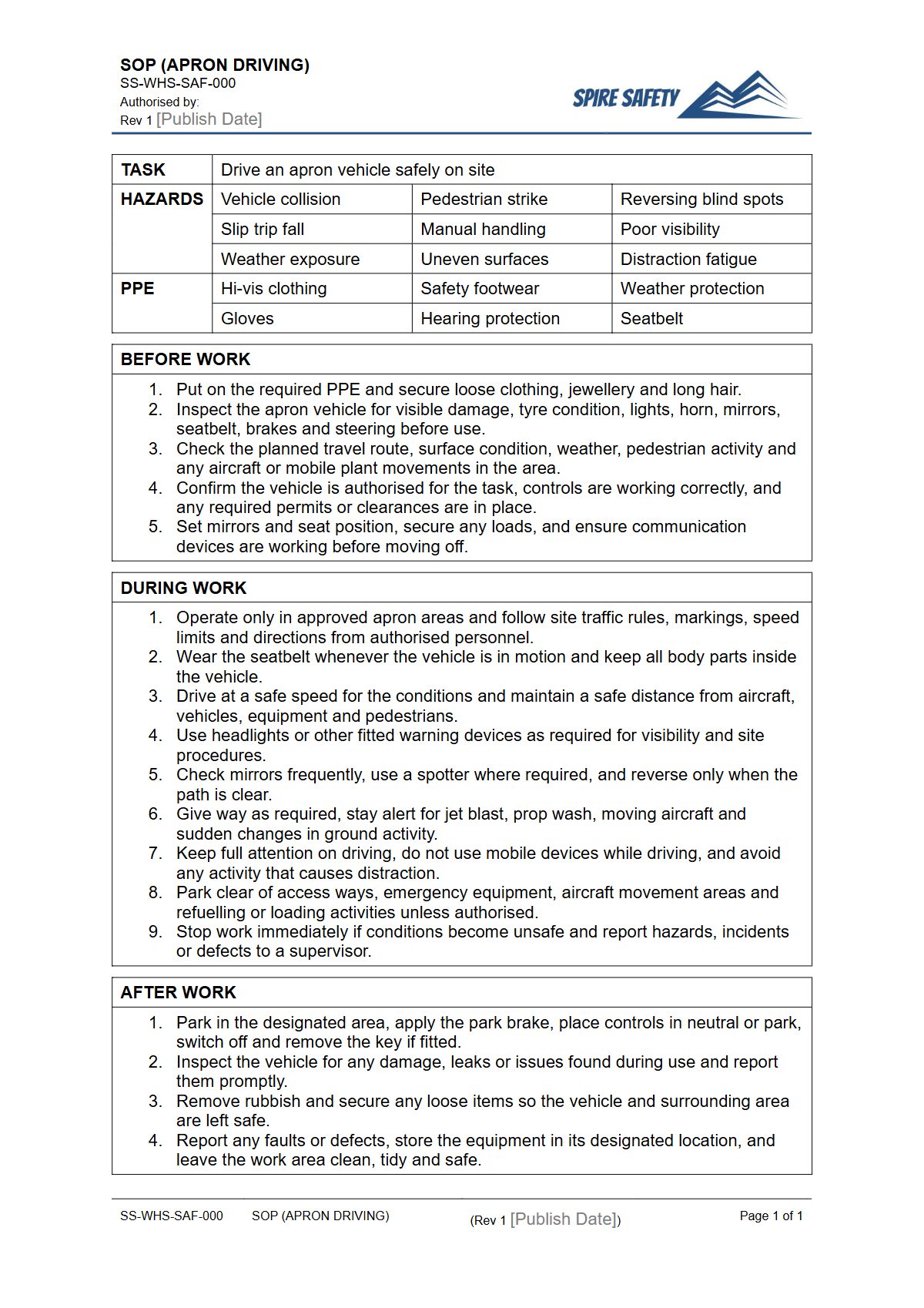
Download our free Safe Operating Procedure (Apron Driving) template. This customisable DOCX and PDF provides a clear framework for airport ground operations.
Free Safe Operating Procedure (Apron Driving) Template
DOCX • 126 KB + PDF
Updated Oct 2026
No signup required
Purpose of the Free Safe Operating Procedure (Apron Driving) Template
This Free Safe Operating Procedure (Apron Driving) Template provides a structured framework for documenting the safe methods required to operate vehicles on an airport apron. Driving in an airside environment presents unique and significant risks, including potential collisions with aircraft, ground support equipment (GSE), and personnel.
This SOP template helps organisations outline controls for these hazards, such as observing right-of-way protocols, managing interactions with jet blast, and adhering to strict speed limits. Formalising these steps is a critical component of a systematic approach to safety, ensuring all tasks are performed consistently and to a defined standard.
Implementing robust procedures like this is fundamental to developing effective WHS management systems in the aviation sector.
Video walkthrough
How to use the Free Safe Operating Procedure (Apron Driving) Template
To get started, download the template in your preferred format (DOCX for easy editing or PDF for straightforward printing). It is crucial to recognise that this document is a starting point, not a finished product.
Effective safety procedures must be tailored to the specific context of your workplace.
Note: This is a template that you must customise. We are not you. You must adapt this document to reflect the unique layout of your aerodrome, the specific types of vehicles and aircraft in operation, local traffic rules, communication protocols, and the identified risks at your site.
Generic procedures are insufficient for managing site-specific hazards.
Once downloaded, you should:
- Consult with ground crew, vehicle operators, and supervisors who perform the task.
- Identify and document all site-specific hazards and control measures.
- Incorporate details such as aerodrome-specific speed limits, radio communication channels, vehicle right-of-way rules, and emergency contact information.
- Have the finalised SOP reviewed and approved by a competent person within your organisation.
- Use the completed document as a core tool for induction, training, and competency assessments. A well-customised SOP is an essential piece of evidence during a WHS compliance auditing process.
Key Elements of an Apron Driving SOP
A comprehensive SOP for apron driving should cover several critical areas to ensure clarity and effectiveness. The template prompts you to detail:
- Required PPE: Specifies mandatory personal protective equipment, such as high-visibility clothing, hearing protection, and safety footwear.
- Pre-Operational Checks: Outlines a checklist for inspecting the vehicle before use, covering brakes, steering, lights, horns, and communication equipment.
- Step-by-Step Procedures: This is the core of the document, detailing the sequence for safe operation. It includes obtaining clearance to enter the apron, following pavement markings and signals, maintaining safe distances from aircraft, and correct parking procedures.
- Communication Protocols: Defines the required use of two-way radios, hand signals, and communication with air traffic control or ground coordinators.
- Emergency Procedures: Describes the steps to take in case of an accident, vehicle breakdown, fuel spill, or fire.
The structured approach is similar to what you might find in a Body Truck SOP, where clear, sequential steps are vital for managing vehicle-related risks.
When to use it
A Safe Operating Procedure for apron driving should be a living document integrated into your daily operations. It is not a file-and-forget tool. Its primary uses include:
- Induction and Training: As a foundational document for training new ground crew and vehicle operators.
- Refresher Training: For periodic retraining to ensure standards are maintained and to communicate any changes in procedure.
- Risk Assessments: As a reference when conducting or reviewing risk assessments for ground operations.
- Incident Investigations: To review whether established procedures were followed and to identify potential improvements after an incident or near-miss.
The principles of documenting routine tasks for safety are universal across different types of heavy equipment, as demonstrated in our free Dozer SOP template.
Who should use it
This template is designed for any person or business conducting or having control over airside vehicle operations. This includes:
- Aerodrome Operators: Responsible for overall safety and traffic management on the apron.
- Ground Handling Agents: Companies providing baggage handling, catering, fuelling, and other ground support services.
- Airlines: For their own staff who operate vehicles airside.
- Fixed-Base Operators (FBOs): Servicing general and business aviation.
Within these organisations, roles such as WHS Managers, Operations Managers, and Supervisors will be responsible for developing and implementing the SOP. The end-users are the workers themselves—including baggage handlers, maintenance engineers, and catering staff—who must be trained on and follow the procedure. The development process should involve direct consultation with these workers, as they have firsthand knowledge of the tasks and risks, similar to the process for operating specialised plant detailed in our free Telehandler SOP template.
By properly customising and implementing this SOP, your organisation can establish a clear, consistent, and safe system of work for apron driving. For more templates and safety guides, you can browse our complete free WHS resources library.
Common mistakes
Common mistakes to avoid
- Failing to conduct and document pre-start vehicle inspections before entering the apron.
- Ignoring designated vehicle lanes, guide markings, and stop bars.
- Poor situational awareness, especially regarding jet blast from taxiing aircraft and the movement of other GSE.
- Using mobile phones or other distracting devices while operating a vehicle airside.
Legal references
Legal considerations
The following legal requirements may be relevant to this type of work.
- Work Health and Safety Act (Harmonised) — Provides the primary duties for protecting workers and other people from work health and safety risks.
- Work Health and Safety Regulations (Harmonised) — Sets out requirements supporting the management of workplace hazards and risks.
The following codes may be relevant to this type of work.
- Managing WHS Risks Code of Practice — Provides practical guidance on identifying hazards, assessing risks and applying effective controls.
- Work Health and Safety Consultation, Cooperation and Coordination Code of Practice — Provides practical guidance on consulting workers and coordinating with other duty holders.
- Managing the Work Environment and Facilities Code of Practice — Provides practical guidance on safe work environments, workplace facilities and related controls.
Did you know
Apron Speed Limits
Speed limits on an airport apron are extremely low for safety, often capped at 20-30 km/h in general movement areas and as low as 5-10 km/h (walking pace) when operating close to an aircraft.
Aircraft Right of Way
In the airside environment, aircraft always have the right of way over all vehicles and personnel. This fundamental rule is a cornerstone of apron safety management and is enforced without exception.
FAQ
Frequently asked questions
01What is an SOP for apron driving?
02Why is driving on an airport apron considered a high-risk activity?
03Who is responsible for creating and implementing an apron driving SOP?
04How often should an apron driving SOP be reviewed?
Share this resource
Free Safe Operating Procedure (Apron Driving) Template
Browse Categories
How To Use It
- 1Download and open in Word or PDF.
- 2Replace the placeholders with your business details.
- 3Get it reviewed by a WHS specialist before rollout.
Need it customised?
Our WHS consultants can adapt this template to your site, run a gap analysis, or audit what you already have in place.
Book a Free Consultation WHS consulting servicesor call 1300 156 382
Related templates
- Free Safe Operating Procedure (Apron Equipment Staging) Template
- Free Safe Operating Procedure (Apron Feeder) Template
- Free Safe Operating Procedure (Aquatic Weed Removal) Template
- Free Safe Operating Procedure (Arbor Mulching) Template
- Free Safe Operating Procedure (Arbor Press) Template
- Free Safe Operating Procedure (Arc Gouging) Template