
Free Safe Operating Procedure (Anodising) Template
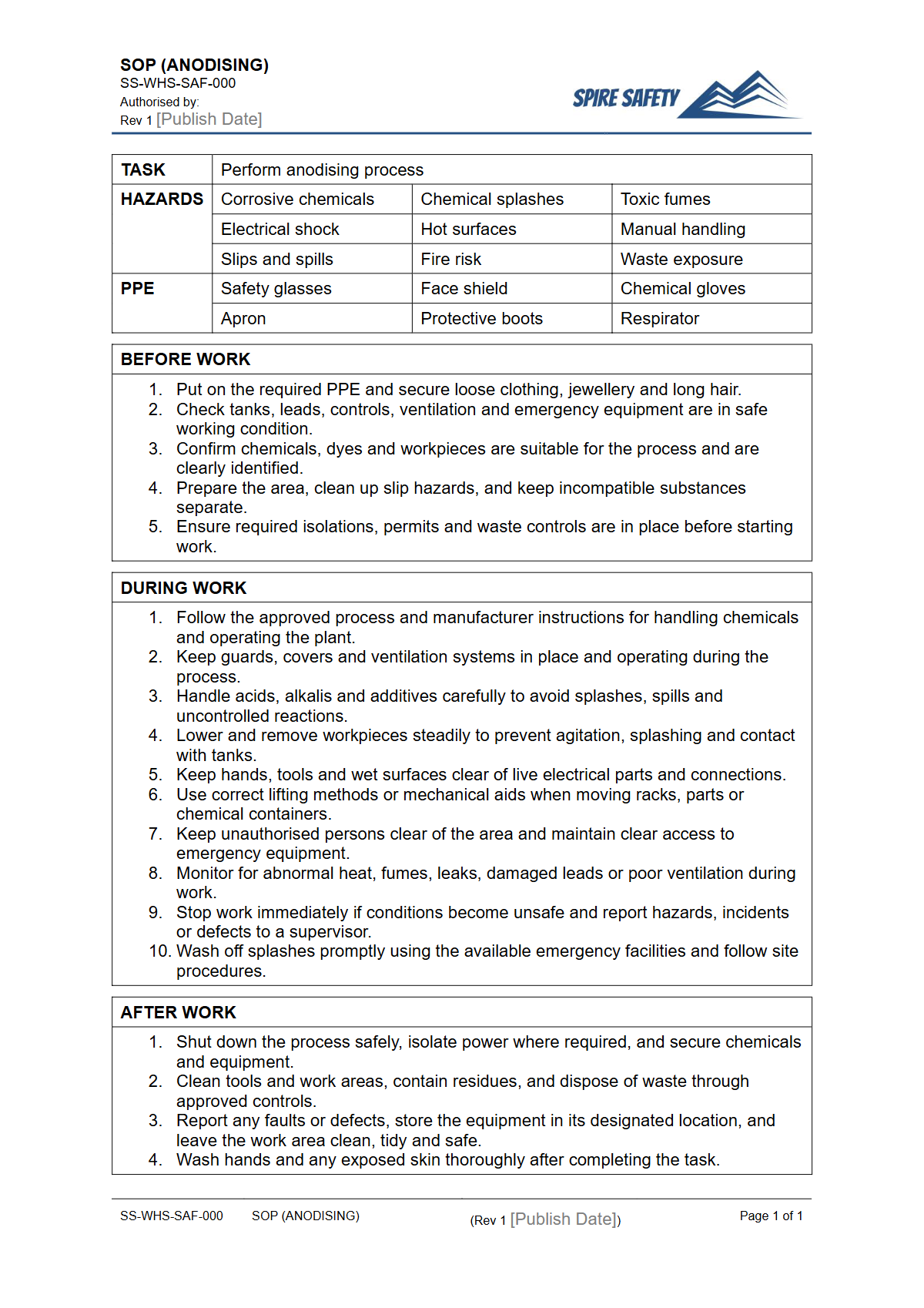
Download our free Safe Operating Procedure (Anodising) template.
Free Safe Operating Procedure (Anodising) Template
DOCX • 126 KB + PDF
Updated Oct 2026
No signup required
Purpose of the Free Safe Operating Procedure (Anodising) Template
Anodising involves electrochemical processes that use hazardous chemicals and electrical currents to treat the surface of metals, most commonly aluminium. Due to these inherent risks, a documented safe system of work is essential.
This Free Safe Operating Procedure (Anodising) Template provides a structured framework for outlining the hazards and control measures required to perform anodising tasks safely. A Safe Operating Procedure (SOP), also known as a Safe Work Procedure (SWP), breaks down a task into a logical sequence of steps, ensuring that safety is integrated into every stage.
Using a standardised SOP helps your organisation meet its duty of care under Australian WHS legislation by providing clear, consistent instructions to workers. It serves as a vital tool for training, risk management, and incident prevention.
A well-developed SOP is a cornerstone of a safe workplace, especially in manufacturing or fabrication environments where multiple high-risk processes occur. For example, anodising may be one part of a workflow that also involves a plasma cutter SOP template for initial shaping.
Key Hazard Areas in Anodising
Your customised SOP should address the specific hazards in your workplace, which typically include:
- Chemical Exposure: Contact with or inhalation of vapours from corrosive acids (e.g., sulfuric acid, chromic acid) and alkaline solutions used for cleaning and sealing.
- Electrical Hazards: Risk of electric shock from the rectifiers and other electrical equipment used to supply current to the anodising tank.
- Thermal Hazards: Burns from contact with hot tanks, solutions, or freshly treated parts.
- Slips, Trips, and Falls: Wet floors from spills or splashes are common in anodising areas, increasing the risk of falls.
- Manual Handling: Lifting and moving parts, chemical containers, and equipment can lead to musculoskeletal injuries.
Video walkthrough
How to use the Free Safe Operating Procedure (Anodising) Template
This template is provided in both DOCX and PDF formats. The DOCX file is fully editable, allowing you to tailor the content to your specific operational context.
It is crucial to replace the placeholder text with information relevant to your equipment, chemicals, facility layout, and internal procedures. A generic document is not sufficient; effective safety management requires site-specific details.
Please note: this template is a starting point. We strongly recommend you customise it to reflect the specific equipment, chemicals, processes, and risks in your workplace.
Consultation with workers who perform the task is a critical part of this customisation process. If you require assistance in adapting this document or developing your safety systems, consider seeking specialist WHS consulting.
The procedure should clearly outline pre-operational checks, personal protective equipment (PPE) requirements, step-by-step instructions for the anodising process, and emergency response actions for spills, chemical exposure, or electrical incidents. For other common workshop equipment, you may also need a free Air Compressor SOP to cover all facility risks.
When to use a Safe Operating Procedure
An anodising SOP is not a document to be filed away and forgotten. It should be a living document used actively within your workplace health and safety management system. Key times to use the SOP include:
- Training and Induction: For training new operators and as a refresher for existing workers.
- Pre-Task Planning: As a reference before starting an anodising job to review steps and required controls.
- Supervision and Monitoring: By supervisors to ensure the agreed-upon safe procedure is being followed correctly.
- Incident Investigation: To determine if a deviation from the established procedure contributed to an incident or near-miss.
- Periodic Review: SOPs should be reviewed regularly (e.g., annually) and updated whenever there are changes to equipment, chemicals, processes, or legislation.
Integrating SOPs into your daily operations is a practical way to manage risks and is a fundamental component of formalised WHS management systems.
Who should use it
This Safe Operating Procedure template is designed for use by various personnel within an organisation that performs anodising. This includes:
- WHS Managers and Safety Officers: To develop and implement standardised procedures as part of the overall safety framework.
- Workshop Managers and Supervisors: To train their teams, enforce safe work practices, and conduct pre-work briefings.
- Business Owners (PCBUs): To ensure they are taking reasonably practicable steps to provide a safe working environment.
- Operators: As a practical guide to performing their tasks safely and consistently.
Developing the SOP should be a collaborative effort. The people who actually perform the anodising work have invaluable hands-on knowledge of the risks and practicalities of the task. Their input is essential for creating a procedure that is both safe and workable, whether for anodising or for operating machinery documented in a Brake Press SOP template. To explore more templates for different tasks and equipment, browse our complete free WHS resources library.
Common mistakes
Common mistakes to avoid
- Using a generic SOP without customising it for site-specific chemicals, equipment, and controls.
- Failing to reference the specific Safety Data Sheets (SDS) for all chemicals used in the process.
- Inadequate training on emergency procedures, particularly for chemical spills and electric shock.
- Neglecting to review and update the SOP after process changes or near-miss incidents.
Legal references
Legal considerations
The following legal requirements may be relevant to this type of work.
- Work Health and Safety Act (Harmonised) — Provides the primary duties for protecting workers and other people from work health and safety risks.
- Work Health and Safety Regulations (Harmonised) — Sets out requirements supporting the management of workplace hazards and risks.
The following codes may be relevant to this type of work.
- Managing WHS Risks Code of Practice — Provides practical guidance on identifying hazards, assessing risks and applying effective controls.
- Work Health and Safety Consultation, Cooperation and Coordination Code of Practice — Provides practical guidance on consulting workers and coordinating with other duty holders.
- Managing the Work Environment and Facilities Code of Practice — Provides practical guidance on safe work environments, workplace facilities and related controls.
Did you know
Chemical Hazards
Anodising often uses sulfuric or chromic acid, which can cause severe chemical burns and respiratory issues if inhaled. Proper ventilation and PPE are non-negotiable.
Not Just for Colour
While often used for colouring aluminium, anodising's main purpose is to increase the thickness of the natural oxide layer, dramatically improving corrosion and wear resistance.
FAQ
Frequently asked questions
01What are the main hazards of anodising?
02Is a Safe Operating Procedure a legal requirement for anodising in Australia?
03How often should an anodising SOP be reviewed?
04What PPE is required for anodising?
Share this resource
Free Safe Operating Procedure (Anodising) Template
Browse Categories
How To Use It
- 1Download and open in Word or PDF.
- 2Replace the placeholders with your business details.
- 3Get it reviewed by a WHS specialist before rollout.
Need it customised?
Our WHS consultants can adapt this template to your site, run a gap analysis, or audit what you already have in place.
Book a Free Consultation WHS consulting servicesor call 1300 156 382
Related templates
- Free Safe Operating Procedure (Apartment Handover Clean) Template
- Free Safe Operating Procedure (Apron Cone Placement) Template
- Free Safe Operating Procedure (Apron Driving) Template
- Free Safe Operating Procedure (Apron Equipment Staging) Template
- Free Safe Operating Procedure (Apron Feeder) Template
- Free Safe Operating Procedure (Aquatic Weed Removal) Template