
Free Safe Operating Procedure (Annular Cutter) Template
Download our free Safe Operating Procedure (SOP) template for annular cutters.
Free Safe Operating Procedure (Annular Cutter) Template
DOCX • 126 KB + PDF
Updated Oct 2026
No signup required
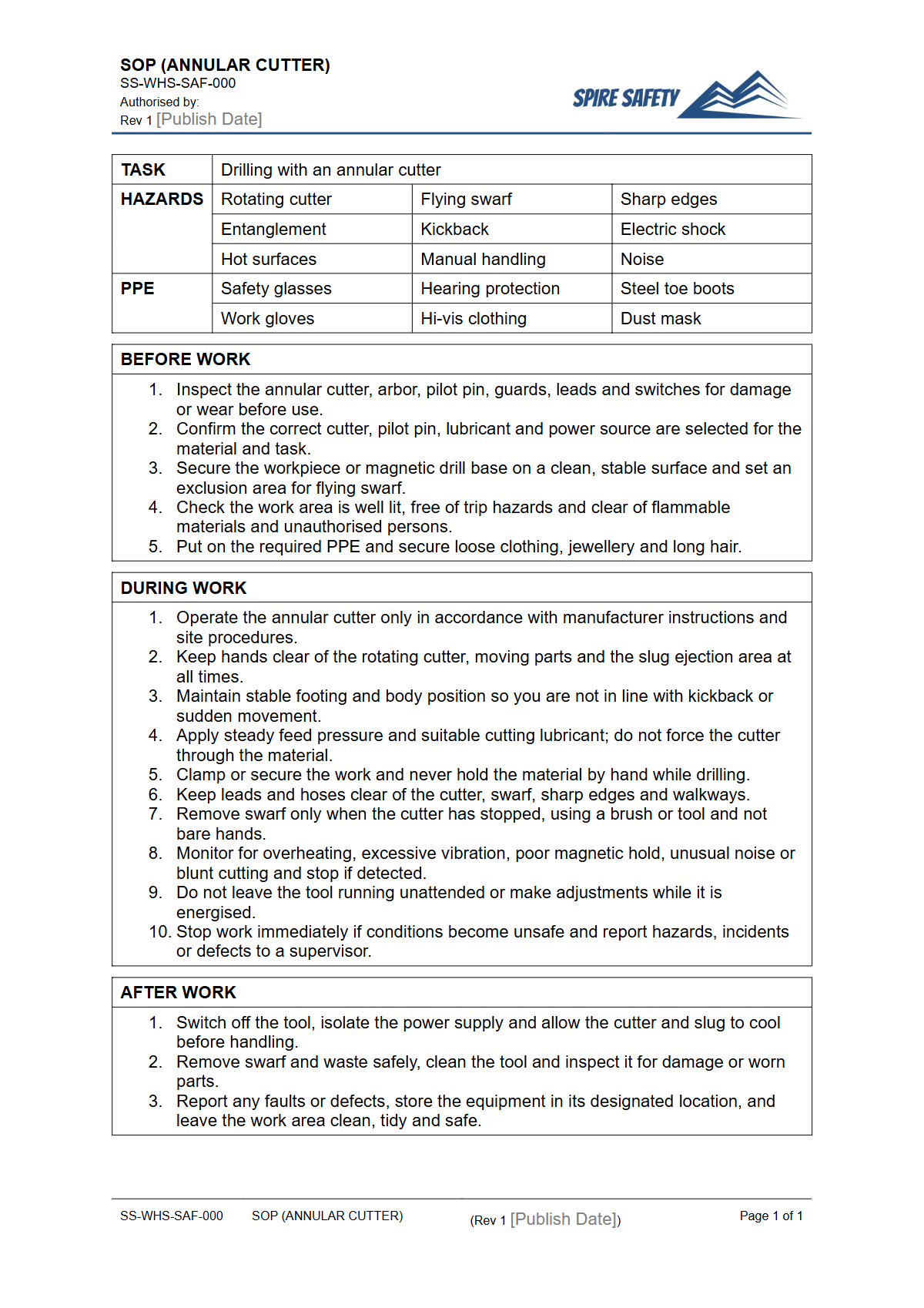
Purpose of the Free Safe Operating Procedure (Annular Cutter) Template
An annular cutter, often used with a magnetic base drill, is a specialised tool for creating clean, precise holes in metal. While highly efficient, it presents significant hazards, including entanglement with rotating parts, lacerations from sharp cutters, eye injuries from swarf, and electrical dangers.
This Free Safe Operating Procedure (Annular Cutter) Template provides a structured framework for documenting the safest way to perform this task, helping your organisation meet its duty of care. It is a critical component for managing risks, training operators, and demonstrating a commitment to workplace health and safety.
A well-developed SOP forms the foundation of a safe system of work. It is not just a document, but a key tool for operational consistency and risk mitigation.
Integrating SOPs into your daily operations is a core part of building robust WHS management systems that protect your workers and your business. The template helps you detail pre-start checks, required personal protective equipment (PPE), step-by-step operational instructions, and emergency procedures, ensuring all personnel have a clear reference for safe operation.
What is a Safe Operating Procedure?
A Safe Operating Procedure (SOP) is a written document that provides detailed, step-by-step instructions on how to safely perform a specific task or operate a piece of machinery. Its primary goal is to minimise the risk of injury or harm by standardising a work process.
SOPs are essential for high-risk activities and are a fundamental part of a proactive safety culture. They are used for worker induction, ongoing training, and as a benchmark during safety observations or incident investigations.
While this document focuses on annular cutters, similar principles apply to our template for CNC machines and other fabrication equipment.
Video walkthrough
How to use the Free Safe Operating Procedure (Annular Cutter) Template
This document is designed as a comprehensive starting point. To make it effective, you must customise it to reflect the specific circumstances of your workplace.
Download the DOCX file and begin by conducting a thorough risk assessment on the task of using your specific annular cutter and magnetic drill model. Involve experienced operators in this process to ensure the procedure is practical and addresses all relevant hazards.
Pay close attention to sections covering PPE, pre-operational checks, and waste disposal (swarf management). Fill in the details based on your risk assessment, the manufacturer’s instructions for the equipment, and any site-specific rules.
The procedure should be clear, concise, and easy for any operator to understand. For other metalworking tasks, you might also find our brake press SOP template a useful reference for structuring your safety documentation.
Important: It is crucial to remember that this is a template, not a finished document. We have provided a comprehensive framework, but you must adapt it to the specific models of equipment used in your workplace, the materials being cut, and your unique operational environment.
A generic procedure is not sufficient; a site-specific one is required for effective safety management.
When to use it
An SOP for an annular cutter should be developed and implemented before any worker is permitted to operate the equipment. It serves as the primary training document for new users and a vital refresher for experienced ones.
The SOP should be readily accessible in the work area for quick reference. Furthermore, it should be formally reviewed whenever there is a change to the equipment, the process, or the work environment. Regular reviews, typically annually, are also essential to ensure the procedure remains current and effective, a process that can be formalised through scheduled WHS compliance auditing.
Who should use it
This Safe Operating Procedure template is intended for a broad range of personnel within an organisation. Supervisors and managers must use it to ensure they are providing a safe system of work and to train their teams effectively.
WHS and safety officers will use it as part of the overall safety management system and during risk assessments. Most importantly, the operators of the annular cutter must use it as their guide for every task to ensure they, and their colleagues, are protected from harm.
This principle of documented safety procedures is universal across various tools, as seen in a safe operating procedure for a circular saw, where operator guidance is paramount. For an even wider selection of safety documents, explore our free WHS resources library.
Common mistakes
Common mistakes to avoid
- Using dull, chipped, or incorrect types of cutters for the material being drilled.
- Failing to properly secure the workpiece, allowing it to spin or move during drilling.
- Neglecting to use the safety strap or chain provided with the magnetic drill as a secondary restraint.
- Wearing loose clothing, long hair, or jewellery that can become entangled in the rotating cutter or drill spindle.
Legal references
Legal considerations
The following legal requirements may be relevant to this type of work.
- Work Health and Safety Act (Harmonised) — Provides the primary duties for protecting workers and other people from work health and safety risks.
- Work Health and Safety Regulations (Harmonised) — Sets out requirements supporting the management of workplace hazards and risks.
The following codes may be relevant to this type of work.
- Managing WHS Risks Code of Practice — Provides practical guidance on identifying hazards, assessing risks and applying effective controls.
- Work Health and Safety Consultation, Cooperation and Coordination Code of Practice — Provides practical guidance on consulting workers and coordinating with other duty holders.
- Managing the Work Environment and Facilities Code of Practice — Provides practical guidance on safe work environments, workplace facilities and related controls.
Did you know
Magnetic Base Safety
The magnetic base on many annular cutter drills is a critical safety feature. It must be engaged on a clean, flat, ferrous surface of adequate thickness to prevent the powerful drill from breaking free and rotating violently during operation.
Efficiency by Design
Because they only cut the material at the periphery of the hole, annular cutters can produce a finished hole up to three times faster than a conventional twist drill, all while consuming less energy.
FAQ
Frequently asked questions
01What is an annular cutter and how does it differ from a twist drill?
02Is a Safe Operating Procedure a legal requirement for using an annular cutter in Australia?
03What PPE is typically required when operating an annular cutter?
04How often should an annular cutter SOP be reviewed?
Share this resource
Free Safe Operating Procedure (Annular Cutter) Template
Browse Categories
How To Use It
- 1Download and open in Word or PDF.
- 2Replace the placeholders with your business details.
- 3Get it reviewed by a WHS specialist before rollout.
Need it customised?
Our WHS consultants can adapt this template to your site, run a gap analysis, or audit what you already have in place.
Book a Free Consultation WHS consulting servicesor call 1300 156 382
Related templates
- Free Safe Operating Procedure (Anodising) Template
- Free Safe Operating Procedure (Apartment Handover Clean) Template
- Free Safe Operating Procedure (Apron Cone Placement) Template
- Free Safe Operating Procedure (Apron Driving) Template
- Free Safe Operating Procedure (Apron Equipment Staging) Template
- Free Safe Operating Procedure (Apron Feeder) Template