
Free Safe Operating Procedure (Animal Crush) Template
Manage the risks of working with livestock. Our free Safe Operating Procedure (Animal Crush) template provides a structured guide for Australian farms.
Free Safe Operating Procedure (Animal Crush) Template
DOCX • 126 KB + PDF
Updated Oct 2026
No signup required
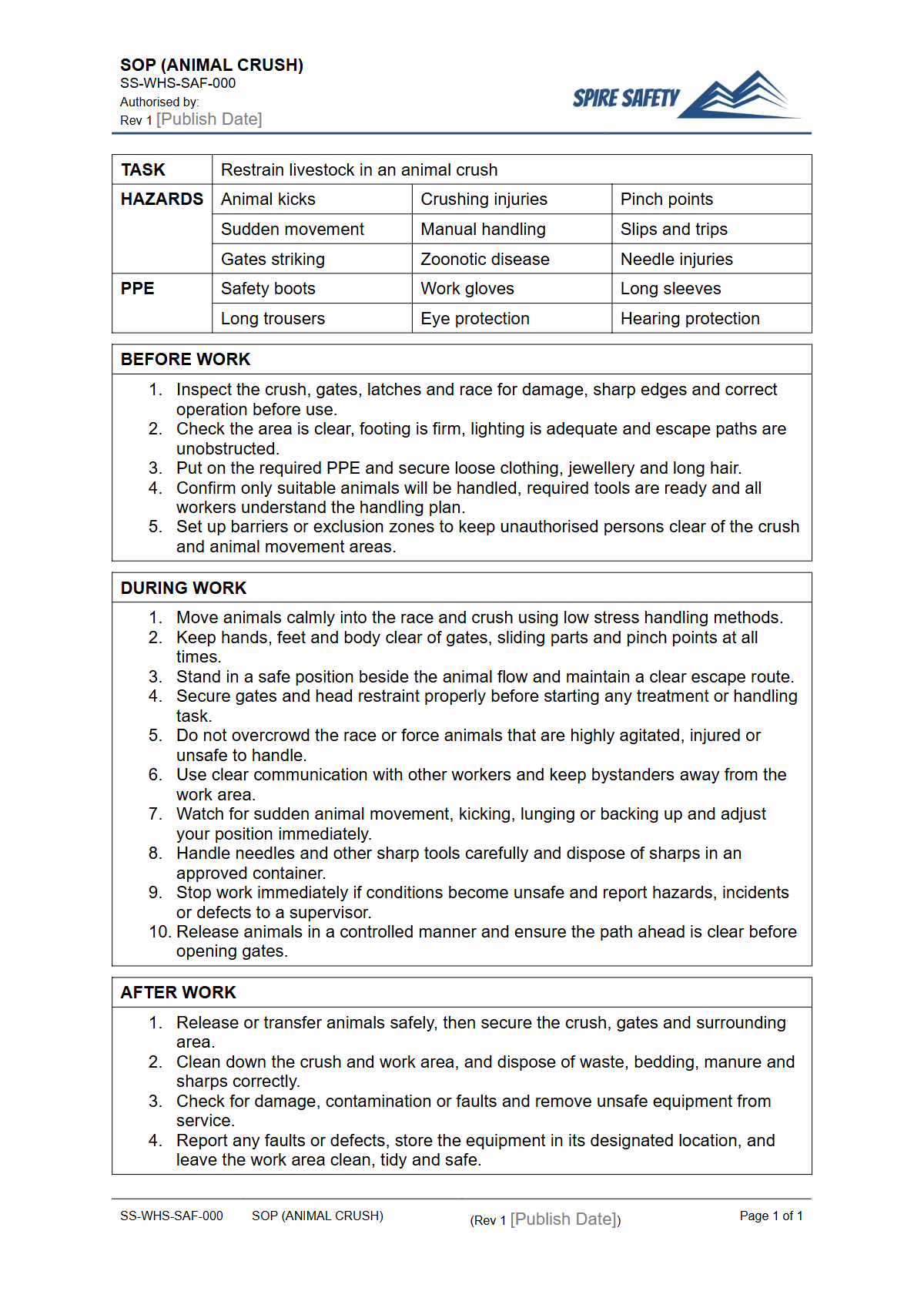
Purpose of the Free Safe Operating Procedure (Animal Crush) Template
Working with livestock involves significant risks, and using an animal crush is a high-risk activity that demands a formalised, safe system of work. This Free Safe Operating Procedure (Animal Crush) Template provides a structured starting point for farms, veterinary clinics, and other agricultural businesses to document the required steps for operating an animal crush safely.
Implementing a clear SOP helps manage hazards such as crushing, kicking, pinning, and unexpected animal behaviour, ensuring that all workers follow a consistent and safe process.
A well-defined SOP is a fundamental component of your work health and safety framework. It serves as a critical training tool for new and existing staff, clarifies responsibilities, and demonstrates your organisation's commitment to eliminating or minimising risks so far as is reasonably practicable.
This document is aligned with the principles of Australian WHS legislation, helping you establish and communicate safe work practices effectively.
Video walkthrough
How to Use the Free Safe Operating Procedure (Animal Crush) Template
This document is provided as a template in both DOCX and PDF formats. It is not a finished, universal procedure.
You must adapt it to reflect the specific animal crush model you use, the types of livestock you handle, your site layout, and the unique environmental conditions of your property. Effective safety management requires procedures that are tailored to the actual work being performed.
IMPORTANT NOTE: This is a template that we have created and it must be customised to your specific workplace. We recommend a person conducting a business or undertaking (PCBU) consults with their workers, supervisors, and other relevant parties to ensure the final document accurately reflects all site-specific hazards and control measures.
If you are unsure how to complete this process, you may need to seek professional WHS consulting services.
When to Use an Animal Crush SOP
A Safe Operating Procedure for an animal crush should be used consistently as a reference and control measure. Key times for its application include:
- Worker Training: Use the SOP as the foundation for inducting and training new livestock handlers or as a refresher for experienced staff.
- Pre-Operational Checks: The SOP should outline the daily or pre-use inspections required to ensure the crush is in safe working order, checking for structural damage, worn parts, or malfunctioning gates and latches.
- During Operation: Workers should have access to the SOP to reference the correct sequence for moving animals into, securing them within, and releasing them from the crush.
- Incident Investigation: Following a near miss or incident, the SOP should be reviewed to identify if the procedure was followed and whether it needs to be updated to prevent a recurrence.
- Audits and Reviews: The SOP is a key document to be examined during internal or external safety audits.
Integrating this SOP into your broader safety framework is crucial for its effectiveness. It should not exist in isolation but as part of a comprehensive approach to farm safety, which may require you to develop a complete WHS management system for your business.
Who Should Use This Safe Operating Procedure
This SOP is intended for use by anyone involved in the lifecycle of operating an animal crush. This includes:
- Farm Owners and Managers (PCBUs): To meet their primary duty of care by providing a safe system of work.
- Supervisors and Leading Hands: To supervise workers and ensure they are following the established procedures correctly.
- Livestock Handlers and Farm Workers: As a clear guide on how to perform their tasks safely and consistently.
- Veterinarians and Vet Technicians: For performing medical procedures on animals secured within the crush.
- WHS Officers: As a tool for risk assessment, training, and compliance monitoring.
Documenting procedures for all high-risk plant is essential. For other heavy equipment commonly found on rural properties, you might also require documents like our free Dozer SOP template to manage associated risks.
Safe access to and around equipment is also a key consideration. If workers need to climb on or around the crush for maintenance, ensure you have procedures in place, which could be supported by our free Step Ladder SOP template.
For a complete overview of our procedural documents and checklists, feel free to browse our free WHS resources library for other templates that may suit your operational needs.
Common mistakes
Common mistakes to avoid
- Failing to conduct and document pre-operational checks on the crush's mechanical parts.
- Working alone when handling large or unpredictable livestock.
- Using a crush that is damaged, poorly maintained, or not appropriate for the size and type of animal.
- Neglecting to provide adequate training to all workers who may operate or assist with the crush.
Legal references
Legal considerations
The following legal requirements may be relevant to this type of work.
- Work Health and Safety Act (Harmonised) — Provides the primary duties for protecting workers and other people from work health and safety risks.
- Work Health and Safety Regulations (Harmonised) — Sets out requirements supporting the management of workplace hazards and risks.
The following codes may be relevant to this type of work.
- Managing WHS Risks Code of Practice — Provides practical guidance on identifying hazards, assessing risks and applying effective controls.
- Work Health and Safety Consultation, Cooperation and Coordination Code of Practice — Provides practical guidance on consulting workers and coordinating with other duty holders.
- Managing the Work Environment and Facilities Code of Practice — Provides practical guidance on safe work environments, workplace facilities and related controls.
Did you know
Farm Safety Statistics
The agriculture, forestry, and fishing industry consistently ranks among the most dangerous in Australia. According to Safe Work Australia, vehicles and machinery, including farm plant like crushes, are a leading cause of worker fatalities in the sector.
FAQ
Frequently asked questions
01What are the main hazards of operating an animal crush?
02What information should be included in an SOP for an animal crush?
03How often should an animal crush SOP be reviewed?
04Is specific training required to operate an animal crush?
Share this resource
Free Safe Operating Procedure (Animal Crush) Template
Browse Categories
How To Use It
- 1Download and open in Word or PDF.
- 2Replace the placeholders with your business details.
- 3Get it reviewed by a WHS specialist before rollout.
Need it customised?
Our WHS consultants can adapt this template to your site, run a gap analysis, or audit what you already have in place.
Book a Free Consultation WHS consulting servicesor call 1300 156 382
Related templates
- Free Safe Operating Procedure (Animal Watering) Template
- Free Safe Operating Procedure (Annular Cutter) Template
- Free Safe Operating Procedure (Anodising) Template
- Free Safe Operating Procedure (Apartment Handover Clean) Template
- Free Safe Operating Procedure (Apron Cone Placement) Template
- Free Safe Operating Procedure (Apron Driving) Template