
Free Safe Operating Procedure (Angle Drill) Template
Download our free Safe Operating Procedure (Angle Drill) template. This customisable DOCX & PDF resource helps document safe work practices for angle drill use.
Free Safe Operating Procedure (Angle Drill) Template
DOCX • 126 KB + PDF
Updated Oct 2026
No signup required
Purpose of the Free Safe Operating Procedure (Angle Drill) Template
Effectively managing workplace risks requires clear, documented processes. Our free Safe Operating Procedure (Angle Drill) template provides a structured starting point for your business to formalise the steps for safely using this common power tool.
An angle drill, while versatile, introduces hazards such as entanglement with rotating parts, flying debris from the workpiece, electric shock, and musculoskeletal strain from awkward postures or vibration. This Safe Operating Procedure (SOP) helps you document the essential controls to protect your workers.
A well-drafted SOP is a critical administrative control measure. It serves as a practical guide for workers, outlining pre-operational checks, step-by-step instructions for the task, and post-operational procedures.
This template is designed to align with Australian WHS principles, helping you meet your duty of care to provide a safe system of work. It is just as important as having procedures for other power tools, such as the guidance found in our free Circular Saw SOP template.
Video walkthrough
How to use the Free Safe Operating Procedure (Angle Drill) Template
This resource is available for download as a DOCX file for easy editing in Microsoft Word, or as a PDF for quick printing and viewing. To create a procedure that is effective for your site, you must adapt the content to your specific operational context.
Important Note: This document is a template only. We have developed it as a starting point, but you must customise it to reflect the specific angle drills, tasks, environment, and control measures relevant to your workplace.
Your final SOP should be developed in consultation with the workers who will be using it.
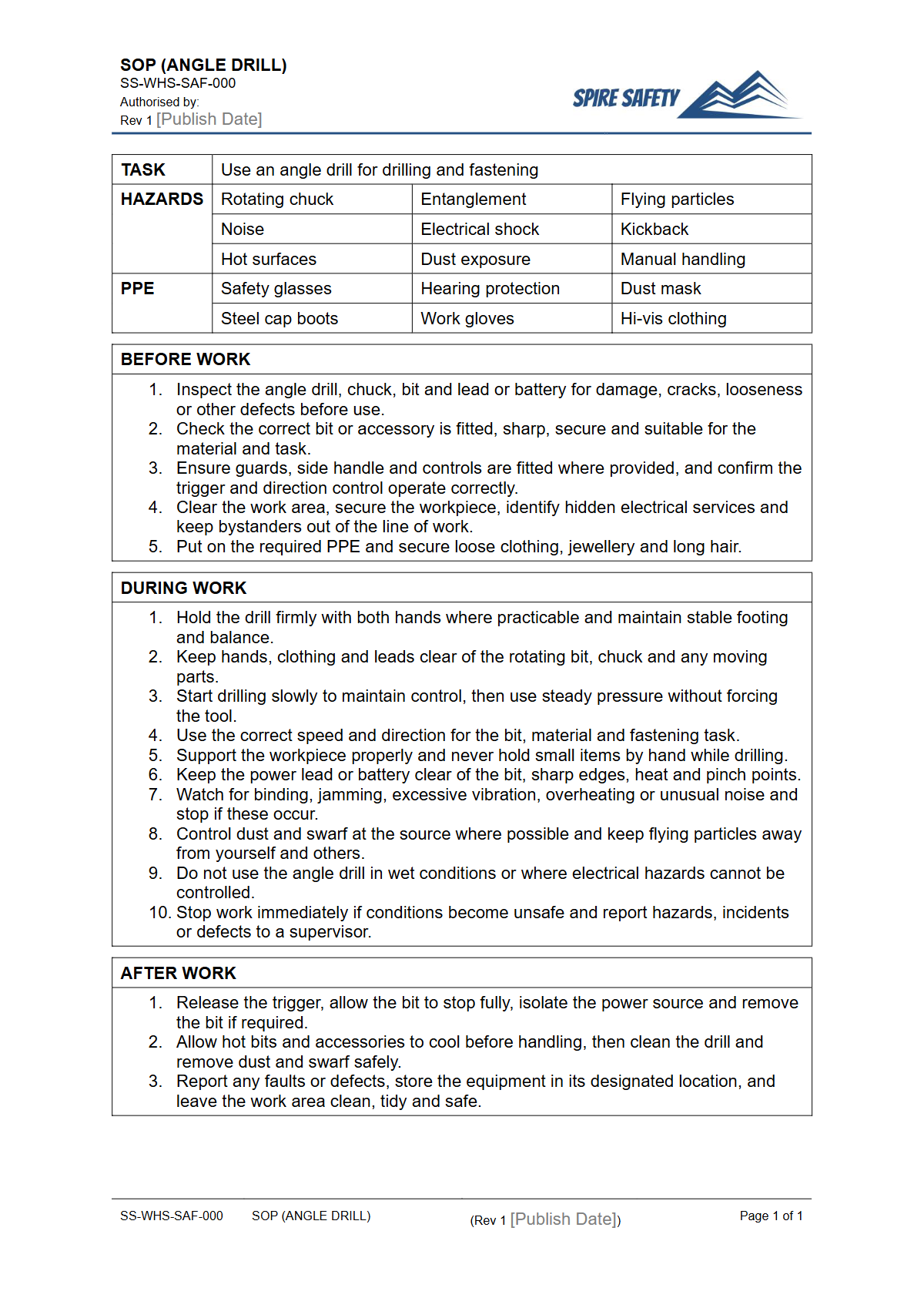
The template includes sections for:
- Required Personal Protective Equipment (PPE)
- Pre-operational Safety Checks (e.g., inspecting cords, chuck, and bits)
- Step-by-step Operating Sequence
- Post-operational Procedures (e.g., cleaning, storage)
- Potential Hazards and Control Measures
Integrating customised SOPs into your safety framework is a key function of effective WHS management systems, ensuring that safe practices are consistently applied across all operations.
When to use it
A Safe Operating Procedure for an angle drill is not a 'set and forget' document. It should be an active part of your daily safety management.
Its primary uses include inducting new employees to ensure they understand the correct usage from day one, and for refresher training with existing staff to prevent complacency. The SOP is also an invaluable reference tool for supervisors conducting workplace observations or for an operations team reviewing processes after a near miss or incident.
Regular reviews of SOPs should be scheduled to ensure they remain current with any changes in equipment or work practices. This process can be integrated into your schedule of WHS compliance auditing to verify their continued relevance and implementation.
Who should use it
This template is intended for use by Persons Conducting a Business or Undertaking (PCBUs), site managers, and supervisors responsible for creating and implementing safe work systems. Health and Safety Representatives (HSRs) will also find it a useful tool for consulting with management on workplace safety matters.
Ultimately, the finalised SOP is for the workers who operate angle drills. Involving them in the customisation process is crucial, as their direct experience provides invaluable insight into the practical hazards and effective controls associated with the task.
This collaborative approach improves the quality of the SOP and increases worker buy-in and adherence. Just as with other fabrication equipment, the operators are the experts, a principle that also applies when creating documentation like our free Plasma Cutter SOP template.
Many workshops contain a variety of equipment that requires documented procedures to ensure worker safety. An angle drill is often used alongside other powered equipment that may present similar or different hazards.
For example, ensuring procedures are in place for shared plant like an air compressor is equally important, and our free Air Compressor SOP template can provide a useful starting point for that task.
By systematically documenting safe procedures for all high-risk equipment, you build a more robust safety culture. You can browse our complete free WHS resources library for more templates to support your organisation's safety management system.
Common mistakes
Common mistakes to avoid
- Using the wrong type or size of drill bit for the material being worked on.
- Failing to securely clamp the workpiece, causing it to spin or kick back during drilling.
- Neglecting to wear appropriate PPE, especially safety glasses for eye protection against flying swarf.
- Applying excessive force instead of letting the drill do the work, leading to bit breakage or motor burnout.
Legal references
Legal considerations
The following legal requirements may be relevant to this type of work.
- Work Health and Safety Act (Harmonised) — Provides the primary duties for protecting workers and other people from work health and safety risks.
- Work Health and Safety Regulations (Harmonised) — Sets out requirements supporting the management of workplace hazards and risks.
The following codes may be relevant to this type of work.
- Managing WHS Risks Code of Practice — Provides practical guidance on identifying hazards, assessing risks and applying effective controls.
- Work Health and Safety Consultation, Cooperation and Coordination Code of Practice — Provides practical guidance on consulting workers and coordinating with other duty holders.
- Managing the Work Environment and Facilities Code of Practice — Provides practical guidance on safe work environments, workplace facilities and related controls.
Did you know
Ergonomic Risk
Angle drills, especially when used in awkward positions or for prolonged periods, can contribute to musculoskeletal disorders (MSDs). Regular breaks and correct posture are crucial controls.
Right-Angle Gearing
The 'angle' in angle drill refers to the right-angle gearbox that transfers power from the motor to the chuck, allowing drilling in tight spaces where a standard drill won't fit.
FAQ
Frequently asked questions
01What is a Safe Operating Procedure (SOP) for an angle drill?
02Is this angle drill SOP template free to use?
03Why is customisation of the SOP template important?
04Who is responsible for developing an SOP?
Share this resource
Free Safe Operating Procedure (Angle Drill) Template
Browse Categories
How To Use It
- 1Download and open in Word or PDF.
- 2Replace the placeholders with your business details.
- 3Get it reviewed by a WHS specialist before rollout.
Need it customised?
Our WHS consultants can adapt this template to your site, run a gap analysis, or audit what you already have in place.
Book a Free Consultation WHS consulting servicesor call 1300 156 382
Related templates
- Free Safe Operating Procedure (Animal Crush) Template
- Free Safe Operating Procedure (Animal Watering) Template
- Free Safe Operating Procedure (Annular Cutter) Template
- Free Safe Operating Procedure (Anodising) Template
- Free Safe Operating Procedure (Apartment Handover Clean) Template
- Free Safe Operating Procedure (Apron Cone Placement) Template